The Minimalists Minimalism and Simple Living Website Makes $80,000 Per Month
Minimalism has grown into a broader lifestyle philosophy covering money, consumption, relationships, and intentional living. This makes a Minimalism and Simple Living Website a strong niche for evergreen content and a highly engaged audience.
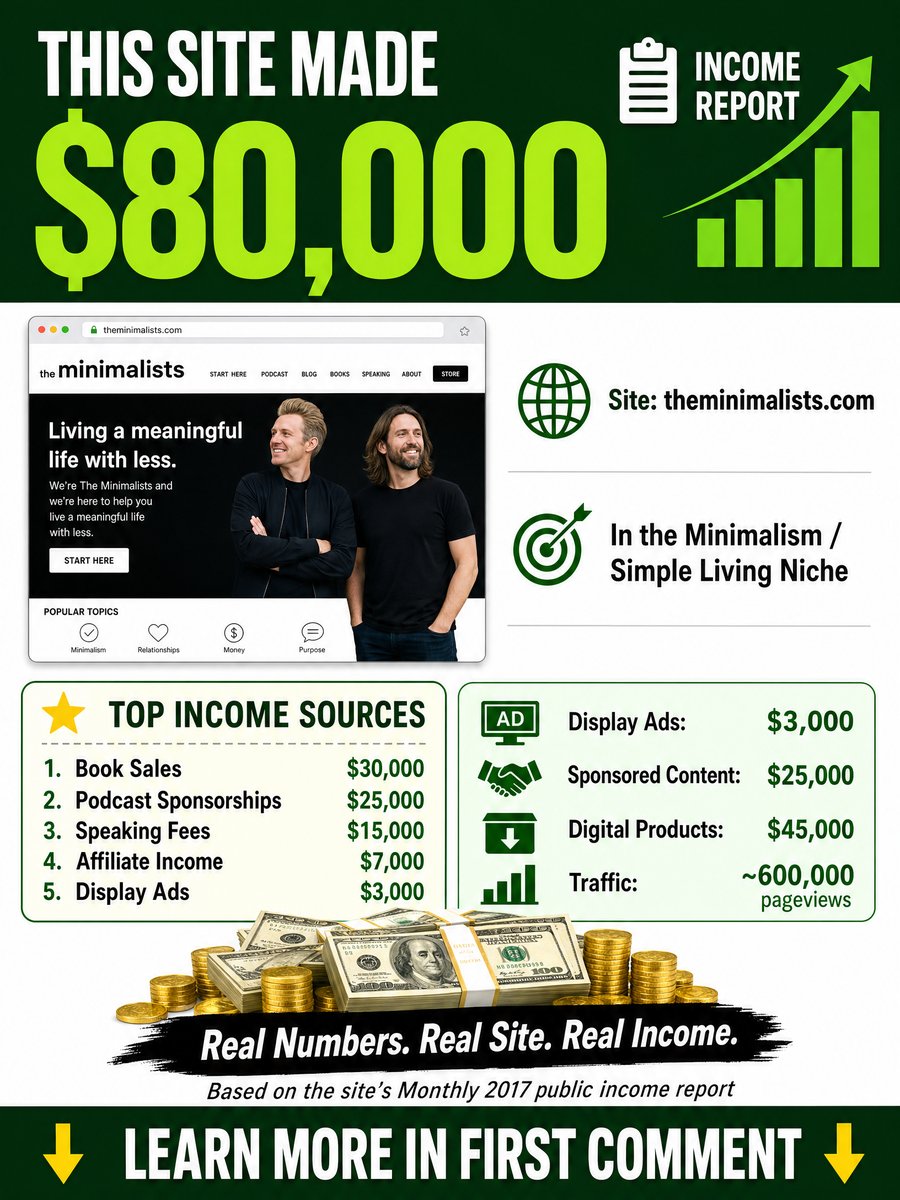
The supplied report image uses The Minimalists as an example, showing approximately $80,000 in monthly income and 600,000 pageviews. The listed revenue sources are $30,000 from books, $25,000 from podcast sponsorships, $15,000 from speaking, $7,000 from affiliates, and $3,000 from ads. A separate panel shows $45,000 in digital products, but the image does not explain how that figure relates to the main breakdown.
This report explores how a minimalism-focused publication can monetize through books, podcasts, sponsorships, affiliates, digital products, SEO content, and audience trust rather than relying mainly on advertising.
Site Snapshot
| Metric | Details |
| Website | The Minimalists |
| Domain Shown | theminimalists.com |
| Primary Niche | Minimalism and Simple Living |
| Related Topics Shown | Relationships, Money, Purpose |
| Revenue Figure Shown | $80,000 |
| Traffic Figure Shown | ~600,000 Pageviews |
| Largest Income Source Shown | Book Sales |
| Primary Monetization | Books, Podcast Sponsorships, Speaking, Affiliate Income, Display Ads |
| Report Basis Shown | Monthly 2017 Public Income Report |
Why the Minimalism and Simple Living Niche Is So Profitable
Minimalism attracts readers because it connects with multiple goals, including reducing clutter, saving money, simplifying life, and making intentional choices. This creates a broader content niche than the name suggests. The audience is often highly engaged because minimalism is tied to personal values. Long-term trust can lead to opportunities in books, podcasts, courses, newsletters, speaking, and relevant affiliate products.
Popular content areas can include:
- Minimalist living
- Decluttering
- Intentional living
- Simple living
- Frugal habits
- Meaningful consumption
- Digital minimalism
- Minimalist homes
- Relationships and boundaries
- Personal priorities
- Money and lifestyle
- Downsizing
- Capsule wardrobes
- Mindful purchasing
- Lifestyle design
This diversity is valuable because the publication does not need to depend entirely on product reviews or search-engine traffic. The brand itself can eventually become the primary asset.
Estimated Monthly Revenue Breakdown
The detailed “Top Income Sources” section of the supplied graphic gives the clearest breakdown of the $80,000 figure. Every amount below is taken directly from that section of the image.
| Revenue Source | Amount Shown |
| Book Sales | $30,000 |
| Podcast Sponsorships | $25,000 |
| Speaking Fees | $15,000 |
| Affiliate Income | $7,000 |
| Display Ads | $3,000 |
| Total Shown | $80,000 |
The right-side summary box separately displays the following figures:
| Highlighted Metric | Amount Shown |
| Display Ads | $3,000 |
| Sponsored Content | $25,000 |
| Digital Products | $45,000 |
| Traffic | ~600,000 Pageviews |
The $25,000 sponsored-content figure matches the podcast-sponsorship amount in the detailed list. The image does not explain the $45,000 digital-products figure, so it should not be added separately. The safest interpretation is that the two sections categorize revenue differently.
How The Minimalists Website Makes Money
The revenue breakdown shows a model that relies more on expertise, trust, and audience relationships than traditional advertising.
- Books ($30,000): The largest revenue source. Minimalism fits well with books because readers often want a complete framework covering possessions, money, relationships, priorities, and lifestyle choices.
- Podcast Sponsorships ($25,000): Podcasts create deeper audience connections, making the listeners valuable to sponsors compared with one-time website visitors.
- Speaking Fees ($15,000): A strong content platform can build authority that leads to conferences, workshops, corporate events, and other speaking opportunities.
- Affiliate Income ($7,000): Provides an additional revenue stream through relevant recommendations like books, tools, financial resources, and lifestyle products.
- Display Ads ($3,000): A smaller portion of revenue, showing that businesses can earn more by building direct audience relationships rather than relying mainly on ad traffic.
Why Books Can Become the Core Product
The $30,000 book-sales figure highlights the power of owned intellectual property. A strong book can build authority, attract new audiences, support podcasts and speaking opportunities, and generate long-term revenue.
Minimalism works well for evergreen books because readers continue seeking ways to reduce clutter, spend intentionally, and create simpler lives.
Potential book themes in the broader niche include:
- Minimalism for beginners
- Decluttering systems
- Intentional spending
- Simple living
- Digital minimalism
- Downsizing
- Minimalism with children
- Financial simplicity
- Purpose-driven living
- Intentional relationships
A strong content creator can use free articles to introduce individual ideas while the book provides the complete framework.
Why Podcast Sponsorships Are So Valuable
The image shows $25,000 from podcast sponsorships, highlighting the value of building an audience beyond written content. Podcasts create stronger relationships through repeated, long-form interactions, making the audience attractive to sponsors.
A minimalism podcast can discuss subjects such as:
- Simplifying possessions
- Money habits
- Relationships
- Meaningful work
- Consumer culture
- Mental clutter
- Technology use
- Lifestyle changes
- Personal stories
- Financial independence
Suitable sponsors could come from several categories, but sponsorships should align with the publication’s stated values. A minimalist brand that promotes endless unnecessary consumption would create an obvious credibility problem. The strongest sponsorship model therefore prioritizes relevance and trust over accepting every available advertiser.
Speaking Fees Turn Content Authority Into Premium Revenue
The $15,000 speaking-fee figure shows how expertise can create revenue beyond pageviews. A trusted minimalism creator can gain opportunities to speak about intentional living, productivity, money, consumer behavior, and lifestyle design.
Potential speaking environments can include:
- Conferences
- Corporate events
- Universities
- Community organizations
- Retreats
- Workshops
- Professional associations
- Media events
Speaking is less scalable than a digital product because each engagement requires time. However, revenue per engagement can be substantially higher than revenue from thousands of ordinary website visitors.
Speaking can also strengthen the wider business. Event attendees may buy books, subscribe to a podcast, join an email list, or become regular readers afterward.
Affiliate Marketing Opportunities
Affiliate marketing contributes $7,000 in the supplied breakdown, though the specific programs are not identified. For a minimalism publisher, the best affiliate strategy focuses on recommending fewer, higher-value products that align with intentional living rather than encouraging unnecessary purchases.
Potential affiliate categories include:
- Books
- Audiobooks
- Financial planning tools
- Budgeting software
- Sustainable household products
- Durable travel gear
- Organization products
- Digital productivity tools
- Educational programs
- Ethical marketplaces
Commercial content could focus on carefully selected resources rather than publishing endless “best product” lists.
Popular Affiliate Programs
A Minimalism and Simple Living Website can investigate several affiliate networks and programs that provide access to books, educational products, household products, or other resources aligned with intentional consumption. These are examples to research, not programs confirmed by the supplied image as being used by The Minimalists.
Affiliate Program Breakdown
| Affiliate Program or Network | Relevant Category | Website |
| Amazon Associates | Books and General Products | https://affiliate-program.amazon.com |
| Bookshop.org | Books | https://bookshop.org |
| Audible | Audiobooks | https://www.audible.com |
| Impact | Brands and Digital Services | https://impact.com |
| Awin | Retail and Lifestyle Affiliate Network | https://www.awin.com |
| CJ Affiliate | Affiliate Network | https://www.cj.com |
| ShareASale | Lifestyle and Retail Brands | https://www.shareasale.com |
Program availability, commissions, geographic eligibility, and promotional requirements can change. Publishers should always confirm current terms directly before investing substantial content around a specific affiliate relationship. The strongest approach is to recommend fewer products with greater editorial confidence. In minimalism, “you probably don’t need this” can sometimes build more trust than another affiliate link.
Content Strategy That Can Attract 600,000 Pageviews
The report image shows around 600,000 pageviews, proving that traffic can fuel a broader business beyond ads. Minimalism websites can combine evergreen SEO guides with personal stories, opinions, and philosophy to attract readers and build long-term loyalty.
High-potential content areas include:
- How to become a minimalist
- How to declutter your home
- Minimalist habits
- How to stop buying unnecessary things
- Digital decluttering
- Minimalist budgeting
- Simple living ideas
- Minimalist wardrobe
- Minimalist home organization
- Intentional spending
- Minimalism and relationships
- Minimalism with children
- Simple living and purpose
The strongest content does more than provide another decluttering checklist. It helps readers understand why they want fewer possessions and what they hope to gain in return.
That deeper positioning creates a much stronger brand than generic home-organization content.
Keyword Opportunities
Minimalism offers broad informational search demand, while commercial opportunities tend to appear around books, tools, organization products, and services that help readers simplify particular areas of life. A successful site should balance the two rather than trying to turn every visitor into an immediate buyer.
Potential informational keywords include:
- minimalism
- minimalist lifestyle
- simple living
- how to become a minimalist
- decluttering tips
- how to simplify your life
- intentional living
- minimalist home
- minimalist wardrobe
- minimalist habits
- digital minimalism
- minimalist budgeting
Commercially oriented keywords could include:
- best minimalism books
- best decluttering books
- minimalist planner
- budgeting app for simple living
- best organization tools
- capsule wardrobe essentials
- minimalist travel gear
- simple living books
These commercial terms should still be approached carefully. The value of the brand comes from helping readers make better decisions, not encouraging consumption simply because a product offers an affiliate commission.
Building Minimalism Topic Clusters
A strong minimalism website should organize content into connected themes, helping readers move naturally from one topic to another while improving SEO and user experience.
- Getting Started With Minimalism: Covers the basics, first steps, misconceptions, decluttering projects, and realistic expectations.
- Home and Possessions: Focuses on decluttering, organizing, downsizing, clothing, storage, and mindful buying.
- Money: Explores spending habits, budgets, debt, lifestyle inflation, intentional purchases, and financial freedom.
- Digital Minimalism: Covers smartphones, social media, notifications, email, subscriptions, and reducing digital distractions.
- Relationships and Purpose: Addresses boundaries, commitments, career choices, time management, values, and meaningful living.
This structure expands minimalism beyond possessions and reflects its broader focus on lifestyle, money, relationships, and purpose.
SEO Strategy
Minimalism has strong evergreen SEO potential because people will continue searching for ways to declutter, simplify, spend less, and build better habits. A successful strategy requires deep, authentic content and strong topic coverage rather than generic advice repeated across the web.
Important SEO practices include:
- Publishing comprehensive beginner resources
- Building topic clusters around home, money, relationships, and purpose
- Using personal experience and original examples
- Updating evergreen articles when recommendations change
- Creating strong internal links
- Publishing distinctive essays worth citing
- Maintaining clear author identity
- Developing useful tools and checklists
- Building branded search demand
Brand strength matters particularly in this niche. Readers may begin by searching “how to declutter,” but the long-term goal is for them eventually to search specifically for the publication, podcast, authors, or books. That transition from generic search traffic to branded demand can make the business considerably more resilient.
Email Marketing and Direct Audience Building
Email is particularly valuable for a philosophy-driven publication because minimalism is rarely a one-day transformation. Readers may spend months or years changing habits, reducing possessions, adjusting spending, and thinking differently about priorities. A newsletter can maintain that relationship by sending essays, practical challenges, podcast episodes, book recommendations, and new resources directly to subscribers.
Potential lead magnets include:
- 30-day minimalism challenge
- Decluttering checklist
- Simple living worksheet
- Minimalist budget planner
- Digital declutter checklist
- Intentional spending worksheet
- Capsule wardrobe planner
A direct email audience also strengthens book launches, podcast distribution, events, and speaking opportunities. Instead of depending entirely on Google or social-media algorithms, the publication can communicate directly with people who have already expressed interest. That is especially important for a business model where books, speaking, and sponsorships generate substantially more revenue than display advertising.
Why Display Ads Are Only a Small Part of the Model
The image shows about 600,000 pageviews but only $3,000 in display ads, highlighting that a media brand does not need to rely heavily on advertising.
- Less focus on ads: Excessive ads can hurt user experience, slow pages, and conflict with a minimalist brand.
- Audience matters more than impressions: Traffic can be used to build trust and drive higher-value revenue through books, sponsorships, speaking, and other products.
The revenue mix reflects an authority-driven business model rather than an ad-first publishing approach.
Why This Business Model Works
The Minimalism and Simple Living model is attractive because it transforms content into a broader intellectual-property and media business. Articles introduce the ideas, the podcast deepens the relationship, books package the philosophy, speaking monetizes expertise, sponsors pay for access to the audience, and affiliate recommendations provide an additional supporting stream.
Several structural advantages make the model strong:
- Evergreen subject matter: People continually seek simpler lifestyles.
- Deep audience identification: Minimalism can become part of a reader’s values.
- Strong book potential: The philosophy translates naturally into long-form products.
- Podcast compatibility: Reflective lifestyle subjects work well in audio.
- Speaking opportunities: Recognized expertise can command premium fees.
- Low dependence on ads: The business is not tied exclusively to pageview economics.
- Multiple adjacent topics: Money, purpose, relationships, and digital life expand the audience.
- Direct monetization: Books and events allow the brand to monetize without a third-party advertiser.
The business becomes especially powerful when the audience trusts the creators rather than merely visiting individual articles.
Lessons for Content Creators
A new minimalism publisher should avoid generic decluttering content and build a distinct perspective instead. Defining a clear focus—such as minimalist homes, financial simplicity, family life, sustainability, or digital minimalism—helps create a memorable brand.
Several lessons from the model are particularly useful:
- Build a philosophy, not just a keyword site: Give readers a clear reason to identify with the publication.
- Create owned intellectual property: Books and digital resources can outperform advertising.
- Use multiple formats: Articles, podcasts, books, newsletters, and speaking can reinforce one another.
- Keep monetization aligned with values: Excessive product promotion can undermine a minimalist brand.
- Prioritize direct audience relationships: Email and podcasts reduce dependence on search algorithms.
- Develop recognizable expertise: Authority creates opportunities beyond pageviews.
- Publish evergreen content: Foundational minimalism questions remain relevant for years.
- Use affiliates selectively: Recommend only products or services that genuinely support the reader’s goals.
- Protect reader trust: Commercial partnerships should always be transparent.
- Think beyond traffic: A smaller loyal audience can sometimes be more valuable than a larger anonymous one.
This is one of the clearest examples of why a content business should not measure success exclusively by pageviews.
Conclusion
The Minimalism and Simple Living Website model shows how a lifestyle brand can generate revenue beyond display ads by monetizing trust, expertise, and audience relationships. The supplied image estimates $80,000 in revenue from 600,000 pageviews, with income from books, podcast sponsorships, speaking, affiliates, and ads. It also shows separate digital-product and sponsorship categories that should be treated independently because the breakdown is unclear. The key lesson is that a strong minimalism brand can grow through evergreen content, books, podcasts, partnerships, and direct audience connections rather than relying mainly on advertising.
Key Takeaway: The report shows that a Minimalism and Simple Living Website can succeed through trust and expertise rather than traffic alone. With only $3,000 from display ads, the main opportunity is building a loyal audience and monetizing through books, podcasts, speaking, affiliates, sponsorships, and owned products.
Leave a Reply