marcus campbell
The Everygirl Women’s Lifestyle and Career Website Makes $45,000 Per Month
A Women’s Lifestyle Website can expand beyond fashion and beauty by covering career, finance, wellness, relationships, home, productivity, and shopping while maintaining a clear audience focus.
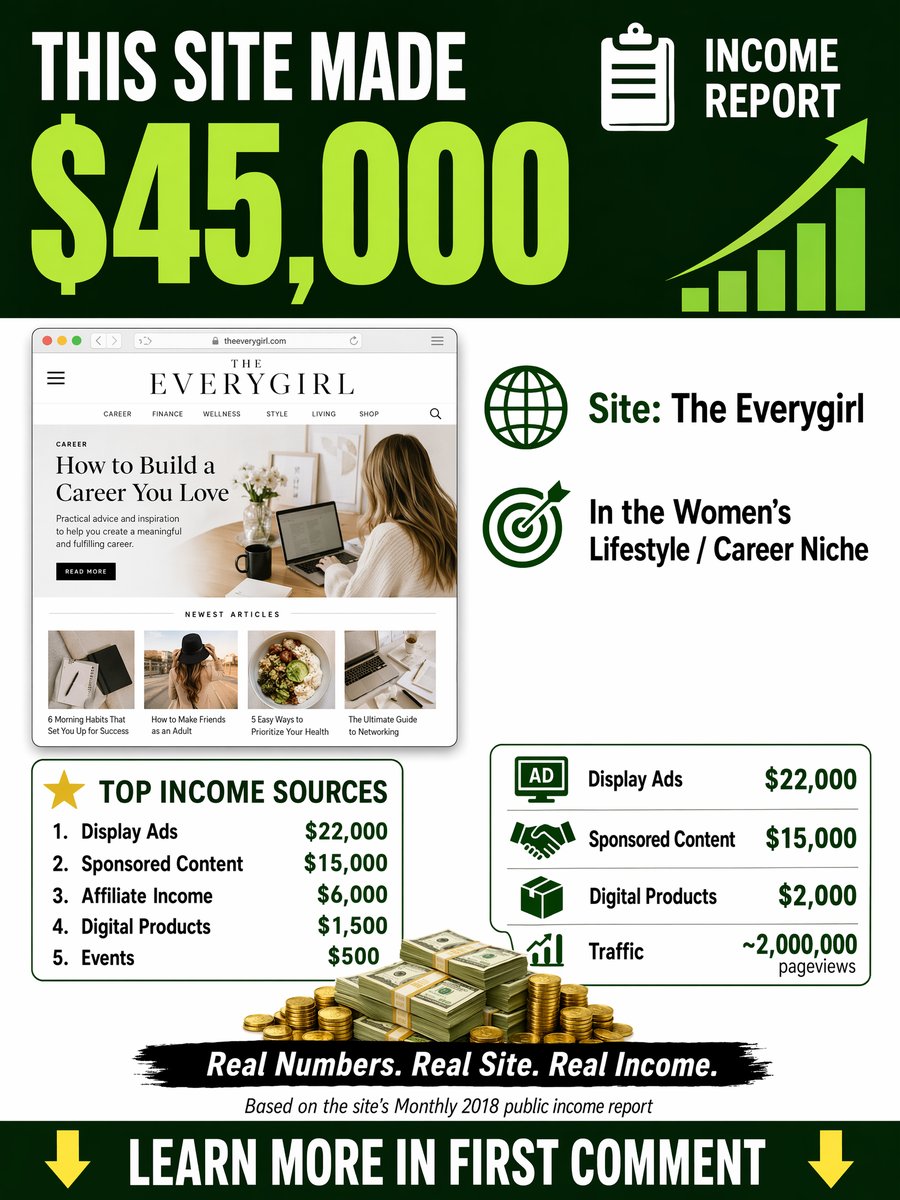
The Everygirl example shows this model. The supplied 2018 report estimates $45,000/month from 2 million pageviews, with revenue from display ads ($22,000), sponsored content ($15,000), affiliates ($6,000), digital products ($1,500), and events ($500).
The key lesson is that a lifestyle brand can combine high-volume content with multiple revenue streams, including ads, sponsorships, affiliates, and owned products. A trusted audience allows creators to monetize both attention and buying intent.
Site Snapshot
| Metric | Details |
| Website | The Everygirl |
| Primary Niche | Women’s Lifestyle / Career |
| Related Topics | Career, Finance, Wellness, Style, Living, Shopping |
| Estimated Monthly Revenue | $45,000 |
| Estimated Monthly Traffic | ~2,000,000 Pageviews |
| Largest Revenue Source | Display Advertising |
| Display Ads | $22,000 |
| Sponsored Content | $15,000 |
| Affiliate Income | $6,000 |
| Digital Products | $1,500 |
| Events | $500 |
| Report Basis | Monthly 2018 Public Income Report |
Why the Women’s Lifestyle and Career Niche Can Be Profitable
The biggest advantage of this niche is the number of recurring problems and interests it can address. Readers do not need career advice only once. They may return for job-search strategies, workplace guidance, networking advice, salary information, productivity tips, or professional development.
The same reader may also be interested in wellness, personal finance, relationships, fashion, home organization, beauty, travel, or shopping. That means a publication can potentially increase the lifetime value of a reader by serving several connected needs instead of depending on one narrow topic.
Useful content areas can include:
- Career development
- Job searching
- Workplace advice
- Networking
- Personal finance
- Budgeting
- Wellness routines
- Productivity
- Relationships
- Style
- Beauty
- Home and organization
- Shopping guides
- Gift guides
This breadth also helps with seasonality. Career content can perform throughout the year, while shopping content can become more valuable during holidays, back-to-school periods, seasonal wardrobe changes, and major retail events.
Estimated Revenue Breakdown
The five detailed income sources add exactly to the reported $45,000 total.
| Revenue Source | Estimated Monthly Revenue |
| Display Ads | $22,000 |
| Sponsored Content | $15,000 |
| Affiliate Income | $6,000 |
| Digital Products | $1,500 |
| Events | $500 |
| Estimated Total | $45,000 |
The broader summary groups some of the revenue differently:
| Summary Category | Amount |
| Display Ads | $22,000 |
| Sponsored Content | $15,000 |
| Digital Products | $2,000 |
| Traffic | ~2,000,000 Pageviews |
The $2,000 digital-products figure aligns neatly with $1,500 in digital products plus $500 from events. Affiliate income remains a separate $6,000 stream.
This makes the overall model easy to understand. Advertising and sponsorships generate most of the revenue, but affiliate commerce and owned products provide valuable diversification.
How a Women’s Lifestyle Website Makes Money
A broad lifestyle publication can monetize different reader behaviors through multiple channels:
- Display Ads: Informational content, such as career or wellness articles, can generate revenue through pageviews.
- Affiliate Marketing: Shopping-related content like workwear, beauty, home products, and gifts can generate commissions.
- Sponsored Partnerships: Brands can pay to reach a publication’s specific audience through campaigns and collaborations.
- Digital Products and Events: Loyal readers can support the brand through owned products, memberships, or experiences.
This model works well because lifestyle audiences have both informational needs and purchasing intent.
Display Advertising Is the Largest Revenue Source
Display advertising contributes $22,000, making it nearly half of the reported revenue.
- Traffic drives revenue: Career, wellness, relationships, and lifestyle articles can attract large audiences even without direct purchases.
- Evergreen content adds value: Topics like productivity, networking, routines, and organization can continue generating traffic over time.
- No purchase required: Ads allow publishers to monetize readers through content engagement rather than forcing every article into a shopping format.
Sponsored Content Adds $15,000
Sponsored content is the second-largest source at $15,000, making brand partnerships a major part of the model.
A women’s lifestyle publication can appeal to advertisers across several industries because its audience may be interested in fashion, beauty, wellness, financial services, home products, education, career tools, food, travel, and technology.
Potential sponsorship categories include:
- Fashion retailers
- Beauty brands
- Wellness companies
- Home and décor brands
- Financial services
- Career platforms
- Education companies
- Productivity software
- Food and beverage brands
- Travel companies
The strongest sponsorships fit naturally with the editorial topic. A career platform sponsoring a professional-development feature is more relevant than forcing an unrelated product into a career article.
Paid relationships should also be disclosed clearly. The audience’s trust is worth far more than one sponsored campaign.
Affiliate Income Creates a Shopping Layer
Affiliate income contributes $6,000, and this is where a broad lifestyle publication has another strong advantage.
The audience may research clothing, beauty products, office accessories, home décor, books, courses, wellness products, gifts, or everyday household items. Each category creates opportunities for commerce-focused articles.
Examples include:
- Best work bags
- Professional wardrobe essentials
- Best planners for work
- Home-office accessories
- Career-development books
- Best beauty products
- Affordable home décor
- Holiday gift guides
- Everyday wellness products
- Online courses for career growth
Affiliate content should still solve a reader problem. A shopping guide becomes valuable when it helps someone narrow down dozens of options rather than simply presenting products that pay commissions.
Popular Affiliate Programs
The historical report provides a $6,000 affiliate-income figure, but it does not identify the individual programs responsible for that amount. The programs below are current examples that fit the career, style, beauty, shopping, home, and lifestyle categories particularly well. They should not be interpreted as confirmed affiliate partners used to generate the reported revenue.
Affiliate Program Breakdown
| Affiliate Program | Best Fit | Link |
| Amazon Associates | Books, office products, home, beauty, lifestyle | https://affiliate-program.amazon.com/ |
| Target Partners | Fashion, beauty, home, wellness | https://partners.target.com/ |
| Walmart Affiliate Program | Home, beauty, fashion, everyday products | https://affiliates.walmart.com/ |
| Etsy Affiliates | Gifts, décor, jewelry, personalized products | https://www.etsy.com/affiliates |
| Nordstrom Affiliate Program | Fashion, accessories, beauty | https://www.nordstrom.com/browse/affiliate-program |
| Sephora Affiliate Program | Beauty, skincare, hair and fragrance | https://www.sephora.com/beauty/affiliates |
| LTK Creator | Fashion, beauty, home and lifestyle commerce | https://company.shopltk.com/en/creator |
| ShopMy | Beauty, fashion, wellness and lifestyle products | https://shopmy.us/home/creators |
| Coursera Affiliate Program | Career education and professional development | https://www.coursera.org/about/affiliates |
| Skillshare Affiliate Program | Creative and professional education | https://www.skillshare.com/en/affiliates |
| Grammarly Affiliate Program | Career, writing and professional communication | https://www.grammarly.com/affiliates |
Lifestyle publishers can monetize through affiliate programs from retailers like Amazon, Target, Walmart, Etsy, Nordstrom, and Sephora, as well as creator platforms like LTK and ShopMy. Career-focused content can also connect with programs from Coursera, Skillshare, and Grammarly. Publishers should verify current terms because commissions and requirements change.
Digital Products and Events Add Owned Revenue
Digital products generate $1,500, while events contribute another $500.
Those numbers are relatively small compared with advertising and sponsorships, but owned products have an important advantage: the publisher has more control over what is sold and how it is priced.
Relevant products for this niche could include:
- Career planners
- Resume templates
- Interview worksheets
- Networking guides
- Budget planners
- Productivity systems
- Digital journals
- Lifestyle guides
Events could also deepen the relationship with readers through networking sessions, career workshops, educational panels, or lifestyle experiences.
A publication does not need to launch dozens of products. One useful resource built around a recurring audience problem can be more valuable than a large collection of generic downloads.
Content Strategy That Can Drive Two Million Pageviews
A lifestyle publication needs both variety and structure. Clear content pillars help cover multiple interests without becoming scattered.
- Career Cluster: Interviews, workplace communication, networking, leadership, growth, and career changes.
- Finance Cluster: Budgeting, saving, salary discussions, financial organization, and money habits.
- Wellness Cluster: Routines, exercise, organization, stress management, and healthy living.
- Style and Living Cluster: Fashion, beauty, home décor, office products, and buying guides.
These clusters help a lifestyle brand serve a broad audience while maintaining a clear structure.
Keyword Opportunities
Potential informational keywords include:
- how to build a career you love
- career change advice
- networking tips
- how to make friends as an adult
- morning habits
- work-life balance tips
- career goals
- productivity habits
- budgeting tips for women
- wellness routine ideas
Commercial searches can include:
- best work bags
- best planners for professionals
- best office chairs
- work wardrobe essentials
- best career books
- best online career courses
- best skincare products
- affordable home décor
- gift ideas for coworkers
- best productivity tools
The strongest strategy combines both. Informational content builds reach, while commercial content monetizes readers who are closer to making a purchase.
SEO Strategy
SEO works well for lifestyle websites because topics like careers, organization, finance, and product recommendations have lasting demand.
- Build topic clusters: Connect related articles through internal links instead of targeting random keywords.
- Update regularly: Refresh product guides, career advice, examples, and resources as information changes.
- Use original insights: Interviews, personal stories, testing, and unique perspectives create content that competitors cannot easily copy.
Email Can Turn Casual Readers Into a Loyal Audience
Email is especially valuable in this niche because readers have recurring needs. Someone who visits for career advice today may return next month for a wellness article or holiday shopping guide.
A newsletter can distribute:
- Career advice
- Weekly lifestyle articles
- Shopping recommendations
- Wellness tips
- New product guides
- Seasonal content
- Exclusive resources
That direct relationship reduces dependence on search and social algorithms.
It also supports every major revenue stream. More returning readers create additional ad impressions, stronger sponsorship opportunities, more affiliate clicks, and a larger audience for future digital products.
Why This Business Model Works
The Everygirl model succeeds by uniting broad topics around one recognizable audience.
- Revenue mix: $22,000 from ads, $15,000 from sponsorships, $6,000 from affiliates, $1,500 from digital products, and $500 from events.
- Different roles: Ads monetize traffic, sponsorships monetize audience access, affiliates monetize shopping intent, and products/events create direct revenue.
- Key lesson: Traffic matters, but brand trust is what allows one audience to support multiple topics and income streams.
Lessons for Content Creators
A new lifestyle publisher should avoid trying to cover everything immediately. Start with a few closely related pillars and build real depth before expanding.
Career and productivity might form one starting point. Style and professional fashion could complement it naturally. Another creator might focus on wellness and home organization before moving into broader lifestyle topics.
The most useful principles are simple:
- Build around a clearly defined audience.
- Organize content into recognizable pillars.
- Use informational articles to attract readers.
- Add affiliate content where shopping intent already exists.
- Keep sponsorships relevant.
- Build an email list early.
- Develop owned products only when they solve a clear problem.
- Protect reader trust.
A broad lifestyle site becomes powerful when readers feel that the publication understands the stage of life they are navigating.
Conclusion
The Everygirl Women’s Lifestyle and Career Website report shows how a focused lifestyle audience can support multiple revenue streams. The 2018 report estimates $45,000/month from 2 million pageviews, with $22,000 from ads, $15,000 from sponsorships, $6,000 from affiliates, $1,500 from digital products, and $500 from events.
The key lesson is that a strong lifestyle brand grows by serving connected needs like career, wellness, style, finance, and everyday living, then monetizing through ads, sponsorships, affiliates, and owned products.
Frugal Travel Guy Budget Travel Hacking Website Makes $45,000 Per Month
The Budget Travel Hacking niche has strong commercial potential because travelers actively search for cheaper flights, rewards strategies, hotel deals, and ways to save money on trips. A website that helps readers reduce travel costs can attract both loyal readers and valuable advertisers.
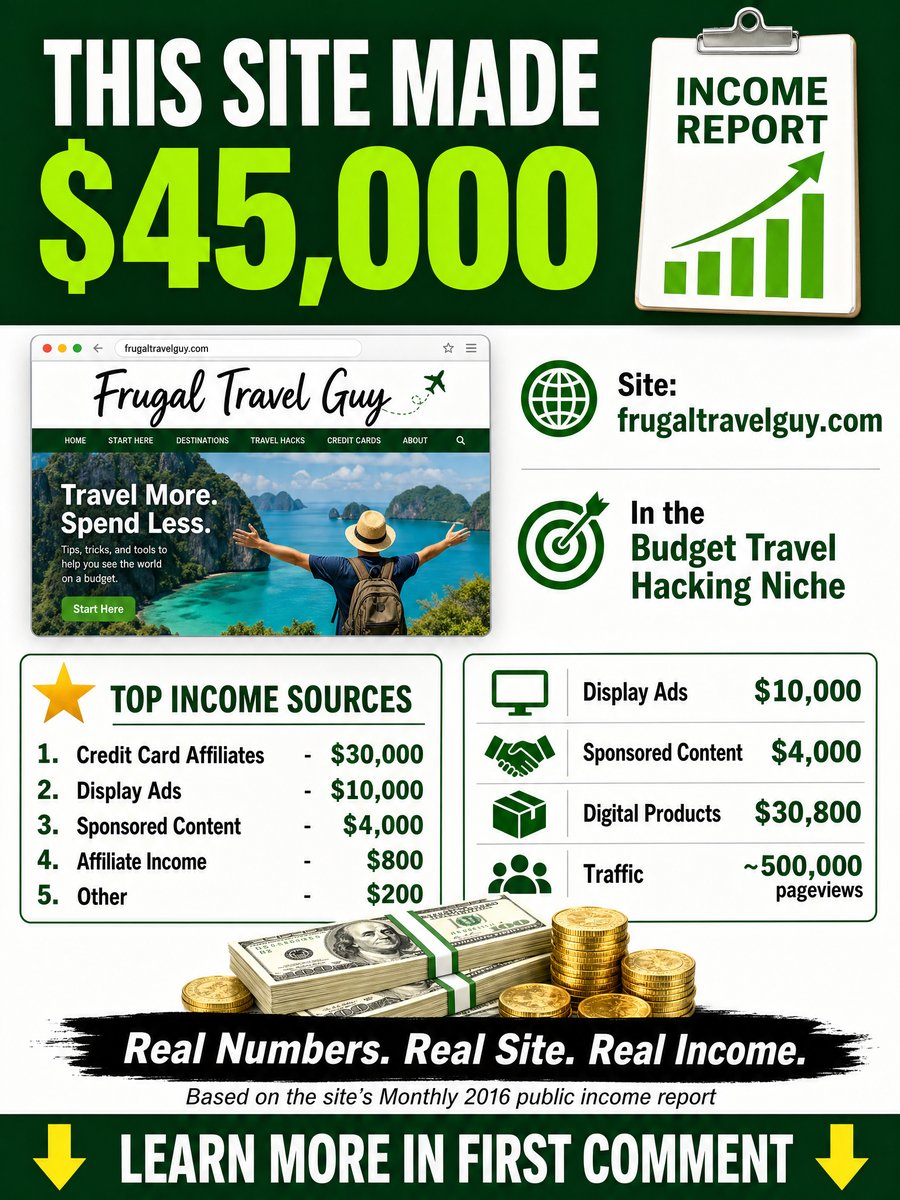
The supplied Frugal Travel Guy 2016 report estimates $45,000/month from 500,000 pageviews, with revenue from credit card affiliates ($30,000), ads ($10,000), sponsorships ($4,000), other affiliates ($800), and other sources ($200). The key lesson is that high-intent travel content can monetize through financial products, travel services, affiliates, sponsorships, and advertising—not just pageviews.
Site Snapshot
| Metric | Details |
| Website | Frugal Travel Guy |
| Domain | frugaltravelguy.com |
| Primary Niche | Budget Travel Hacking |
| Related Topics | Travel Rewards, Credit Cards, Destinations, Travel Deals |
| Estimated Monthly Revenue | $45,000 |
| Estimated Monthly Traffic | ~500,000 Pageviews |
| Largest Revenue Source | Credit Card Affiliates |
| Credit Card Affiliates | $30,000 |
| Display Ads | $10,000 |
| Sponsored Content | $4,000 |
| Affiliate Income | $800 |
| Other | $200 |
| Report Basis | Monthly 2016 Public Income Report |
Why the Budget Travel Hacking Niche Can Be Profitable
Budget travel content solves a very clear problem: people want to travel without overspending. That gives creators a wide range of evergreen topics while keeping everything connected to one central audience need.
A reader might begin by searching for cheap flights. Once planning begins, that same person may need a hotel, transportation, travel insurance, activities, or information about earning points. This makes travel especially interesting from an affiliate-marketing perspective because one trip can involve several separate purchasing decisions.
Useful content areas include:
- Cheap flight strategies
- Travel rewards
- Credit card points
- Airline miles
- Hotel points
- Budget destinations
- Affordable accommodation
- Travel insurance
- Rental cars
- Free and low-cost activities
- Travel deal alerts
- Points redemption guides
- Budget trip planning
- Destination itineraries
The strongest sites do not simply chase deals. They help readers understand how the pieces fit together. A well-written guide can teach someone how to choose a destination, earn rewards responsibly, book accommodation, and reduce unnecessary travel costs.
That creates far more long-term value than publishing one isolated list of cheap destinations.
Estimated Revenue Breakdown
The detailed revenue sources total exactly $45,000.
| Revenue Source | Estimated Monthly Revenue |
| Credit Card Affiliates | $30,000 |
| Display Ads | $10,000 |
| Sponsored Content | $4,000 |
| Affiliate Income | $800 |
| Other | $200 |
| Estimated Total | $45,000 |
A separate summary in the report categorizes the business somewhat differently:
| Summary Category | Amount |
| Display Ads | $10,000 |
| Sponsored Content | $4,000 |
| Digital Products | $30,800 |
| Traffic | ~500,000 Pageviews |
There is an important distinction here. The detailed income list identifies $30,000 as credit card affiliates and $800 as affiliate income, while the broader summary combines $30,800 under the label Digital Products. Since the report does not explain that categorization further, the safest approach is to preserve both versions rather than inventing a different breakdown.
The detailed list remains the clearest representation of how the $45,000 total is constructed.
Credit Card Affiliates Drive Most of the Revenue
The standout revenue source is $30,000 from credit card affiliates, making it the main commercial driver in the report.
- Strong market fit: Travel rewards and credit cards naturally connect because readers want points, miles, and savings strategies.
- Content opportunities: Topics can include rewards basics, card comparisons, fees, redemption strategies, and travel points.
- Trust is essential: Financial products require responsible coverage of fees, eligibility, risks, and limitations rather than commission-driven recommendations.
- Transparency builds loyalty: Helpful financial guidance strengthens reader trust and long-term audience value.
Display Advertising Adds $10,000
Display advertising contributes $10,000, making it the second-largest revenue stream.
- Monetizes broad traffic: Travel guides, stories, packing tips, and budget articles can earn revenue even when readers are not ready to buy.
- Supports content variety: Publishers can create useful informational content without forcing affiliate offers into every article.
- Balanced model: High-intent pages drive affiliates, while broader content builds SEO traffic and generates ad revenue.
Sponsored Content Creates Another $4,000
Sponsored content adds $4,000 to the reported monthly revenue.
- Potential sponsors: Travel apps, airlines, luggage brands, tourism boards, hotels, rental companies, financial services, and travel platforms.
- Relevance matters: Sponsored content should solve audience problems rather than promote unrelated products.
- Transparency builds trust: Paid partnerships should be clearly disclosed, and editorial independence should remain a priority.
Popular Affiliate Programs
The report lists $30,000 from credit card affiliates and another $800 from affiliate income, but it does not identify the individual programs involved. The following options are current travel affiliate or partner programs that fit a Budget Travel Hacking Website particularly well. They are examples for publishers to investigate, not confirmed Frugal Travel Guy partners.
Affiliate Program Breakdown
| Affiliate Program | Best Fit | Official Link |
| Booking.com | Hotels, transportation and attractions | https://www.booking.com/affiliate-program/v2/index.html |
| Expedia Group Travel Creator Program | Hotels, Vrbo, cars and activities | https://partner.expediagroup.com/en-us/solutions/build-your-travel-experience/travel-creator-program |
| Tripadvisor Affiliate Program | Hotel and destination content | https://www.tripadvisor.com/affiliates |
| Agoda Affiliate Program | Hotels and accommodation | https://partners.agoda.com/ |
| Viator Affiliate Program | Tours and activities | https://partnerresources.viator.com/ |
| DiscoverCars Affiliate Program | Rental cars | https://www.discovercars.com/affiliate |
| Hostelworld Affiliate Programme | Budget accommodation and hostels | https://partners.hostelworld.com/ |
| World Nomads Affiliate Program | Travel insurance | https://www.worldnomads.com/partnerships/affiliates |
| SafetyWing Ambassador Program | Travel medical insurance | https://safetywing.com/ambassador |
| Travelpayouts | Multi-brand travel affiliate network | https://www.travelpayouts.com/ |
| Going Affiliate Program | Cheap-flight membership | https://www.going.com/affiliate |
Travel publishers can monetize through affiliate programs from brands like Booking.com, Expedia, Hotels.com, Vrbo, Tripadvisor, Agoda, Viator, DiscoverCars, Hostelworld, World Nomads, SafetyWing, Travelpayouts, and Going.
Program terms, commissions, eligibility, and requirements change over time, so publishers should verify current details before building content around specific offers.
Content Strategy for a Budget Travel Hacking Website
The strongest content strategy combines evergreen education with high-intent travel planning.
Evergreen content can teach readers how points work, how to compare travel costs, how to find affordable accommodation, or how to plan a trip on a limited budget. Destination content can then capture people actively preparing to travel.
Useful clusters might include:
- Budget travel for beginners
- Travel rewards
- Cheap flights
- Budget hotels
- Hostels
- Travel credit cards
- Airline miles
- Hotel points
- Low-cost destinations
- Weekend trips
- Travel insurance
- Car rentals
This creates natural internal links. Someone reading about cheap flights to Europe may also need budget accommodation, local transportation, and travel insurance.
Each additional helpful article keeps the reader within the same ecosystem while creating another possible monetization opportunity.
Keyword Opportunities
Budget travel offers a strong mix of informational and commercial keywords.
Informational topics can include:
- how to travel cheaply
- budget travel tips
- how to find cheap flights
- travel hacking for beginners
- how airline miles work
- how hotel points work
- cheap vacation ideas
- best budget destinations
- how to travel Europe cheaply
- how to save money on hotels
Commercial topics may include:
- best travel rewards cards
- best hotel booking sites
- best hostel booking website
- best travel insurance
- cheapest rental car websites
- best flight deal services
- best travel apps
- Booking.com alternatives
- best tours in a destination
- budget hotel comparison
The important point is intent. Someone searching “how airline miles work” may still be learning. Someone searching for the best travel insurance or hotel booking service may be much closer to purchasing.
A profitable publishing strategy serves both stages.
SEO Strategy
SEO is valuable in travel because people constantly search for destinations, deals, accommodations, transportation, and ways to save money.
- Build topic clusters: Create connected content around flights, hotel rewards, loyalty programs, budget travel, and booking strategies.
- Keep information updated: Travel prices, routes, offers, fees, and rewards programs change frequently.
- Use strong SEO practices: Publish detailed guides, clear titles, internal links, comparison content, and firsthand travel insights.
The goal is to become a trusted resource readers return to for every trip-planning decision.
Email Can Turn One Trip Into a Long-Term Audience Relationship
Travel is recurring. Someone planning one vacation today may plan another six months later, which makes email particularly useful.
A newsletter could offer:
- Cheap flight alerts
- Travel reward tips
- Points opportunities
- Destination deals
- Budget itineraries
- Hotel promotions
- Travel-hacking tutorials
Instead of depending on readers to rediscover the site every time they plan a trip, email allows the publisher to maintain the relationship directly.
That can improve the value of affiliate content because subscribers already understand the publisher’s approach. It can also increase direct traffic and reduce dependence on search algorithms.
Why This Business Model Works
The Frugal Travel Guy model succeeds because it combines high-value travel decisions with content that solves money-saving problems.
- Revenue mix: The report shows $30,000 from credit card affiliates, $10,000 from ads, $4,000 from sponsorships, $800 from other affiliates, and $200 from other sources.
- Match content to monetization: Travel rewards articles support credit card affiliates, destination guides support hotels and experiences, rental-car content supports bookings, and general tips generate ad revenue.
Key lesson: Different content types can support different income streams instead of relying on one monetization method.
Lessons for Content Creators
The biggest lesson is to help readers save money, not simply promote travel products.
- Prioritize honesty: Explain drawbacks, alternatives, and when a product or service is not the right choice.
- Diversify revenue: Combine affiliates with ads, sponsorships, and other income sources.
- Start with a focused angle: Build authority around topics like cheap flights, points, backpacking, budget destinations, or affordable family travel.
- Build trust first: The strongest travel content provides practical advice and helps readers make better decisions.
Conclusion
The Frugal Travel Guy Budget Travel Hacking Website report shows how a focused travel audience can support multiple revenue streams. The 2016 figures estimate $45,000 from 500,000 pageviews, with $30,000 from credit card affiliates, $10,000 from ads, $4,000 from sponsorships, and $1,000 from other sources.
The key lesson is to create useful travel content, build trust, and recommend relevant financial or travel services that genuinely help readers save money.
Minimalist Baker Simple Vegan Recipes Website Makes $45,000 Per Month
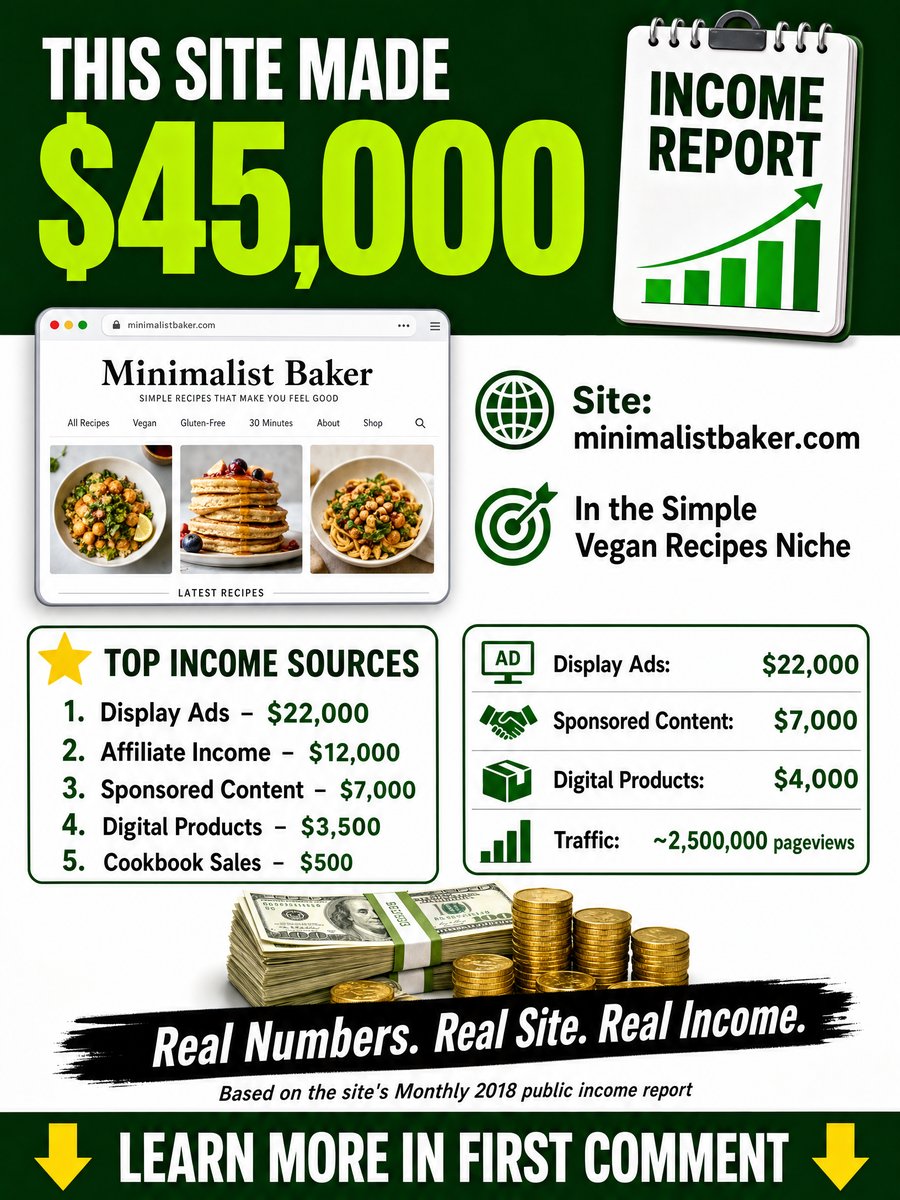
A recipe website can become a diversified publishing business through SEO traffic, advertising, affiliates, sponsorships, digital products, and cookbooks. The Minimalist Baker Simple Vegan Recipes example shows how approachable, visual food content can scale into multiple revenue streams.
According to the supplied 2018 report, the site generated about $45,000/month from 2.5 million pageviews, with $22,000 from ads, $12,000 from affiliates, $7,000 from sponsorships, $3,500 from digital products, and $500 from cookbooks. The key lesson is that strong recipe traffic can support both advertising and higher-value monetization through products, partnerships, and audience trust.
Site Snapshot
Site Snapshot
| Metric | Details |
| Website | Minimalist Baker |
| Domain | minimalistbaker.com |
| Primary Niche | Simple Vegan Recipes |
| Related Topics | Vegan Cooking, Gluten-Free Recipes, Quick Meals, Plant-Based Food |
| Estimated Monthly Revenue | $45,000 |
| Estimated Monthly Traffic | ~2,500,000 Pageviews |
| Largest Revenue Source | Display Advertising |
| Display Ads | $22,000 |
| Affiliate Income | $12,000 |
| Sponsored Content | $7,000 |
| Digital Products | $3,500 |
| Cookbook Sales | $500 |
| Report Basis | Monthly 2018 Public Income Report |
Why the Simple Vegan Recipes Niche Can Be Profitable
The Simple Vegan Recipes niche combines evergreen food demand with specific search intent. People always need meal ideas, and a focused angle like plant-based cooking makes content easier to organize and discover.
Readers searching for vegan recipes often have clear goals, allowing publishers to build large content libraries around ingredients, seasons, meal types, and cooking methods.
Useful content categories can include:
- Easy vegan dinners
- Plant-based breakfasts
- Vegan desserts
- 30-minute meals
- One-pot recipes
- Gluten-free meals
- Vegan pasta
- Plant-based soups
- Vegan baking
- Meal-prep recipes
- Healthy snacks
- Seasonal recipes
This niche also has strong repeat-visit potential. Someone who enjoys one recipe may return for another dinner idea, save several recipes, subscribe to a newsletter, or browse related dishes. That repeat behavior becomes especially valuable when display advertising is the largest revenue stream.
Revenue Breakdown
The reported $45,000 comes from five distinct sources, which gives the business a healthy mix of traffic-based, performance-based, sponsored, and owned-product revenue.
| Revenue Source | Estimated Monthly Revenue |
| Display Ads | $22,000 |
| Affiliate Income | $12,000 |
| Sponsored Content | $7,000 |
| Digital Products | $3,500 |
| Cookbook Sales | $500 |
| Estimated Total | $45,000 |
The broader summary combines some of those categories:
| Summary Category | Amount |
| Display Ads | $22,000 |
| Sponsored Content | $7,000 |
| Digital Products | $4,000 |
| Traffic | ~2,500,000 Pageviews |
The $4,000 digital-products total corresponds naturally to $3,500 in digital products plus $500 in cookbook sales. Affiliate income remains a separate $12,000 stream.
This structure matters because it shows that the business is not dependent on one monetization method. Advertising is the largest source, but affiliate marketing and sponsorships together contribute another $19,000.
How a Simple Vegan Recipe Website Makes Money
The strength of this model is that different readers create revenue in different ways.
- Display Advertising ($22,000): Recipe traffic generates ad revenue from large numbers of visitors.
- Affiliate Marketing ($12,000): Product recommendations like kitchen tools, appliances, and services can earn commissions when they solve a reader’s needs.
- Sponsored Content ($7,000): Food and kitchen brands can reach a targeted audience through campaigns and collaborations.
- Digital Products: Cookbooks and other resources create owned revenue beyond advertising.
This approach allows the website to monetize different types of readers without making every page overly commercial.
Display Advertising Is the Largest Revenue Source
Display advertising contributes $22,000 per month, making it nearly half of the reported revenue.
- High traffic potential: Food content attracts repeat search traffic because readers constantly look for specific recipes and meal ideas.
- No purchase required: A recipe can generate revenue through pageviews alone as visitors read, browse, and explore related content.
- Content volume matters: A large library of evergreen recipes can create steady traffic, making many small sources of revenue add up over time.
Affiliate Income Adds $12,000
Affiliate income is the second-largest source at $12,000, and food content offers plenty of natural ways to use affiliate links without making recipes feel overly commercial.
A recipe might require a high-speed blender, food processor, baking pan, knife, storage container, or specialty ingredient. When the publisher already uses or genuinely recommends that product, linking to it can help readers find what they need.
The strongest affiliate opportunities can come from:
- Blenders
- Food processors
- Juicers
- Cookware
- Baking equipment
- Kitchen utensils
- Grocery delivery
- Plant-based meal services
- Specialty ingredients
- Pantry products
- Food storage
- Small appliances
Affiliate links work best when they solve a practical problem. If a reader needs a blender to prepare a recipe, a carefully chosen recommendation makes sense. Adding unrelated products simply because they offer commissions would weaken the reader experience.
Popular Affiliate Programs
The historical report identifies $12,000 in affiliate income but does not name the individual programs responsible for that figure. The programs below are current examples that fit a Simple Vegan Recipes or plant-based food publisher particularly well. They are not presented as confirmed Minimalist Baker affiliate partners.
Affiliate Program Breakdown
| Affiliate Program | Best Fit for This Niche | Link |
| Amazon Associates | Kitchen equipment, cookware, ingredients | https://affiliate-program.amazon.com/ |
| Thrive Market Affiliate Program | Plant-based groceries and pantry items | https://thrivemarket.com/affiliate-program |
| Vitamix Affiliate Program | High-performance blenders | https://www.vitamix.com/us/en_us/owners-resources/affiliates |
| iHerb Affiliate Program | Food, wellness and pantry products | https://www.iherb.com/info/affiliates |
| Hurom Affiliate Program | Juicers and kitchen equipment | https://www.hurom.com/pages/affiliate-program |
| Instacart Affiliate Program | Shoppable recipes and grocery delivery | https://company.instacart.com/affiliate |
| Purple Carrot Affiliate Program | Plant-based meal kits | https://www.accelerationpartners.com/affiliate-programs/purple-carrot/ |
| Sur La Table Affiliate Program | Cookware and kitchen tools | https://www.surlatable.com/affiliateprograms.html |
| Walmart Affiliate Program | Groceries, cookware and appliances | https://affiliates.walmart.com/ |
| Target Partners | Kitchen tools, groceries and household products | https://partners.target.com/ |
Food publishers can monetize through affiliate programs from platforms like Amazon Associates, Thrive Market, Vitamix, Hurom, Instacart, Purple Carrot, Sur La Table, Walmart, Target, and iHerb. These partnerships can support recipe content through recommendations for kitchen tools, groceries, meal services, and wellness products. Since commissions, availability, and requirements change, creators should verify current program terms before building commercial content.
Sponsored Content Adds $7,000
Sponsored content contributes $7,000, giving the site another meaningful revenue source beyond ads and affiliates.
Food brands are a natural fit for recipe sponsorships because their products can be demonstrated inside useful content. A plant-based milk company, pantry brand, kitchen appliance maker, or grocery service may sponsor a recipe that genuinely uses the product.
Potential sponsor categories include:
- Plant-based food brands
- Grocery companies
- Kitchen appliances
- Cookware
- Alternative dairy products
- Plant-based proteins
- Pantry products
- Meal-delivery companies
- Food-storage brands
- Kitchen accessories
The best sponsored recipe should still be worth making even without the sponsorship. Readers should receive a useful recipe first, while the brand relationship remains clearly disclosed.
That protects the trust that makes future sponsorships valuable.
Digital Products and Cookbooks Create Owned Revenue
Digital products contribute $3,500, while cookbook sales add another $500. Together, they match the broader $4,000 digital-products summary.
Owned products are useful because the publisher controls them directly. Advertising platforms control ad rates, affiliate merchants control commissions, and sponsors control campaign budgets. A cookbook or downloadable product gives the creator more control over pricing and presentation.
Relevant products might include:
- Recipe ebooks
- Meal plans
- Plant-based cooking guides
- Pantry checklists
- Grocery planners
- Printable recipe collections
- Seasonal meal guides
- Cooking classes
Cookbooks also help turn a website into a recognizable food brand. A reader who regularly uses recipes online may be willing to purchase a curated collection in a more organized format.
Content Strategy for a Simple Vegan Recipe Website
The strongest content strategy is not simply “publish more recipes.” It is to organize recipes around clear problems readers are trying to solve.
Someone may need a vegan dinner in 30 minutes. Another person wants something gluten-free. Someone else has chickpeas, pasta, or bananas and wants to know what they can make.
That leads naturally to useful recipe clusters such as:
- 30-minute vegan dinners
- Easy chickpea recipes
- Vegan pasta recipes
- Gluten-free breakfasts
- One-pot vegan meals
- Plant-based desserts
- Vegan meal prep
- Quick lunches
- Seasonal soups
- Easy baking recipes
These clusters create natural internal links. A reader who enjoys one chickpea dish can discover several others without returning to Google.
That improves both the user experience and the amount of content consumed per visit.
Food Photography Matters
Recipe publishing is highly visual because readers often judge a dish before reading the recipe.
- Photography adds value: Strong images show texture, color, portions, and the expected result while improving social and search performance.
- Match the brand promise: Simple recipes benefit from realistic, approachable photography rather than overly complex styling.
- Build recognition: A consistent visual style helps readers see recipes as part of one trusted brand.
Keyword Opportunities
The Simple Vegan Recipes niche contains thousands of evergreen search opportunities.
Useful keyword themes include:
- easy vegan recipes
- vegan dinner ideas
- vegan breakfast
- vegan pasta recipes
- quick vegan meals
- 30-minute vegan recipes
- vegan desserts
- easy plant-based meals
- gluten-free vegan recipes
- chickpea recipes
- vegan soup recipes
- vegan meal prep
- simple vegan lunch
- one-pot vegan meals
More specific keywords can be especially useful because they match clear intent. A reader searching for “30-minute vegan chickpea curry” knows exactly what kind of recipe they want.
Commercial keywords can also support affiliate income, including:
- best blender for vegan recipes
- best food processor
- best nonstick pan
- best vegan meal kit
- best kitchen knife
- best meal-prep containers
The strongest site uses both. Recipe searches drive large-scale traffic, while carefully selected buying guides can monetize readers who are actively researching kitchen products.
SEO Strategy
SEO is a major opportunity because recipe demand is highly evergreen. People may discover a specific recipe years after it is published as long as the content remains useful and competitive.
Strong recipe SEO starts with matching the reader’s intent quickly. A person searching for vegan pancakes wants a pancake recipe, so the page should make ingredients, instructions, substitutions, and useful tips easy to find.
A strong approach includes:
- Clear recipe titles
- Search-focused descriptions
- Well-organized ingredient lists
- Useful cooking instructions
- Related-recipe internal links
- Original photography
- Mobile-friendly pages
- Updated evergreen content
- Recipe structured data
- Fast, easy navigation
The site can also build topical authority by covering ingredients and meal categories in depth. Instead of publishing one random chickpea recipe, a publisher can create a complete collection of chickpea meals and connect them together.
Traffic Strategy Behind 2.5 Million Pageviews
The report shows approximately 2.5 million pageviews, but it does not identify exact traffic sources.
- Search traffic: Captures readers already looking for specific recipes.
- Visual discovery: Platforms like Pinterest can inspire users who have not decided what to cook yet.
- Email marketing: Regular recipe updates can turn one-time visitors into loyal readers.
The long-term goal is building direct audience trust so the business depends less on any single traffic source.
Why This Business Model Works
The business model works because each revenue stream matches different reader behaviors:
- Display Ads ($22,000): Large recipe traffic generates revenue from pageviews.
- Affiliate Income ($12,000): Product recommendations create purchase opportunities.
- Sponsored Content ($7,000): Brand partnerships monetize a trusted food audience.
- Digital Products and Cookbooks ($4,000): Owned products add another income stream.
The niche benefits from evergreen demand, strong search intent, visual content, and affiliate opportunities. A single recipe can generate traffic, subscribers, commissions, and future customers.
Lessons for Content Creators
A new creator does not need millions of pageviews to apply this model. The focus should be on a clear food niche, reliable recipes, original photos, organized content, internal links, and an email audience.
- Expand monetization gradually: Use ads, relevant affiliates, sponsorships, and owned products as the audience grows.
- Prioritize trust: Useful recipes create returning readers who are more valuable than one-time affiliate clicks.
Conclusion
The Minimalist Baker Simple Vegan Recipes Website report shows how a focused recipe site can combine large traffic with multiple revenue streams. The 2018 report estimates $45,000/month from 2.5 million pageviews, with income from ads ($22,000), affiliates ($12,000), sponsorships ($7,000), digital products ($3,500), and cookbooks ($500).
The key lesson is that a strong recipe library can support several business models at once. Search-driven content attracts readers, ads monetize traffic, affiliates recommend useful products, sponsorships connect brands with audiences, and owned products create additional revenue control.
Afford Anything Real Estate Investing and FIRE Website Makes $45,000 Per Month

Real estate investing and FIRE naturally attract readers who want to build wealth, invest, and gain financial freedom. This creates a valuable audience because many visitors are actively making financial decisions.
The supplied Afford Anything Monthly 2018 report estimates $45,000/month from 400,000 pageviews, with revenue from podcast sponsorships ($20,000), affiliates ($12,000), ads ($8,000), courses ($3,500), and speaking ($1,500).
The key lesson is that this model relies on audience trust rather than ads alone. A Real Estate Investing and FIRE website can monetize through podcasts, affiliates, education, sponsorships, and speaking while building a loyal financial community.
Site Snapshot
| Metric | Details |
| Website | Afford Anything |
| Primary Niche | Real Estate Investing / FIRE |
| Related Topics | Financial Independence, Investing, Rental Properties, Personal Finance |
| Estimated Monthly Revenue | $45,000 |
| Estimated Monthly Traffic | ~400,000 Pageviews |
| Largest Revenue Source | Podcast Sponsorships |
| Podcast Sponsorships | $20,000 |
| Affiliate Income | $12,000 |
| Display Ads | $8,000 |
| Online Courses | $3,500 |
| Speaking Fees | $1,500 |
| Report Basis | Monthly 2018 Public Income Report |
Why the Real Estate Investing and FIRE Niche Can Be Profitable
This niche is commercially valuable because readers often have strong intent. People researching financial independence or real estate investing may need tools, education, software, books, and other resources.
- Long-term audience potential: A beginner may start with budgeting and FIRE basics, then later explore investing, rentals, retirement planning, taxes, and portfolio management.
- Content evolves with the reader: As financial goals change, the same audience can continue engaging with related content over many years.
Useful content areas include:
- Financial independence
- FIRE strategies
- Rental property investing
- Real estate fundamentals
- Saving and investing
- Building passive or semi-passive income
- Investment property analysis
- Property management
- Retirement planning
- Money psychology
- Lifestyle design
- Real estate case studies
The strongest version of this niche avoids presenting wealth building as guaranteed or effortless. Real estate and financial investments involve risk, so useful content should educate readers without promising that a particular strategy will produce a specific return.
Revenue Breakdown
The five reported income sources add exactly to the $45,000 headline figure.
| Revenue Source | Estimated Monthly Revenue |
| Podcast Sponsorships | $20,000 |
| Affiliate Income | $12,000 |
| Display Ads | $8,000 |
| Online Courses | $3,500 |
| Speaking Fees | $1,500 |
| Estimated Total | $45,000 |
A separate summary groups several parts of the business differently:
| Summary Category | Amount |
| Display Ads | $8,000 |
| Sponsored Content | $20,000 |
| Digital Products | $3,500 |
| Traffic | ~400,000 Pageviews |
The $20,000 sponsored-content category lines up with the $20,000 in podcast sponsorships, while the $3,500 digital-products category aligns with online-course income. Affiliate income and speaking revenue remain separate parts of the detailed $45,000 total.
How Afford Anything Makes Money
The model shows how different formats monetize different types of audience engagement:
- Podcast Sponsorships ($20,000): The largest source, showing the value of trusted audiences and long-form attention.
- Affiliate Income ($12,000): Financial and real estate readers often need tools, platforms, and services, making relevant recommendations valuable.
- Display Ads ($8,000): Monetizes broader informational traffic from readers who are not ready to buy.
- Online Courses ($3,500): Provides structured education for complex topics like investing and rental properties.
- Speaking Fees ($1,500): Shows how expertise can create opportunities beyond the website.
Podcast Sponsorships Are the Biggest Revenue Driver
Podcast sponsorships are the largest revenue source at $20,000, highlighting the value of a loyal audience relationship.
- Deeper engagement: Podcasts allow creators to build stronger connections through long-form discussions about investing, real estate, FIRE, careers, and money.
- Valuable audience: Returning listeners are attractive to sponsors because they provide consistent attention and trust.
- Key lesson: A smaller, engaged audience can be more valuable than large amounts of anonymous traffic.
Affiliate Income Adds $12,000
Affiliate marketing contributes $12,000, making it the second-largest revenue source.
- Natural opportunities: Readers may need investing platforms, portfolio tools, banking products, real-estate software, and property-management systems.
- Best affiliate content solves problems: Recommendations work best when connected to a reader’s specific need, such as rental accounting or investment tracking.
- Trust matters: Financial recommendations should explain costs, risks, limitations, and alternatives rather than focus only on promotion.
Popular Affiliate Programs
The $12,000 affiliate figure does not identify the individual programs responsible for that revenue. The following are therefore current affiliate, partner, or referral opportunities that fit a Real Estate Investing and FIRE audience, not a claim that Afford Anything generated its reported affiliate income from these companies.
Some are formal publisher affiliate programs, while others are customer referral or partner programs. That distinction matters, so the program type is included below.
Affiliate Program Breakdown
| Program | Best Fit | Program Type | Link |
| Empower | Retirement and financial planning | Affiliate | https://www.empower.com/affiliates |
| M1 | Investing and portfolio building | Affiliate Partner | https://m1.com/m1-affiliate-program-terms-and-conditions.pdf |
| Stessa | Rental-property finances | Affiliate | https://www.stessa.com/affiliate-program/ |
| RentRedi | Landlord and property management | Affiliate / Partner | https://help.rentredi.com/en/articles/4196039-signing-up-for-rentredi-affiliate-partner-program |
| DoorLoop | Property-management software | Affiliate | https://www.doorloop.com/affiliate |
| Buildium | Rental-property management | Affiliate | https://www.buildium.com/affiliate-program/ |
| TenantCloud | Landlord management software | Affiliate | https://www.tenantcloud.com/affiliate-program |
| Hemlane | Rental-property management | Referral / Affiliate | https://www.hemlane.com/referral-program/ |
| TurboTenant | Landlord and rental management | Affiliate / Referral | https://www.turbotenant.com/contact/ |
| Baselane | Landlord banking and bookkeeping | Referral | https://support.baselane.com/hc/en-us/articles/25483530422427-How-can-I-refer-other-landlords-to-join-Baselane |
| SoFi | Investing and personal finance | Referral | https://www.sofi.com/referral-program/ |
| Fundrise | Real-estate investing | Investor Referral | https://fundrise.com/help/articles/360032879391 |
Relevant affiliate opportunities in this niche include real-estate and finance tools such as Stessa, RentRedi, DoorLoop, Buildium, TenantCloud, Hemlane, Empower, M1, SoFi, Fundrise, Baselane, and TurboTenant. Programs, eligibility, commissions, and rules can change, so publishers should verify current terms before promoting any offer.
Online Courses Turn Expertise Into an Owned Product
Online courses contribute $3,500 in the report. While smaller than other revenue sources, courses are valuable because they give creators control over their own products.
- Strong fit for real estate education: Beginners often need structured guidance on property analysis, financing, cash flow, tenants, expenses, and management.
- Value comes from structure: A paid course should provide deeper organization, tools, and support than scattered free content.
- Brand connection matters: Free financial content can naturally lead readers toward more advanced paid education.
Content Strategy for a Real Estate Investing and FIRE Website
A strong content strategy should connect financial independence with the real decisions readers make.
- Key topics: Cover personal finance, rental properties, investing, FIRE planning, money psychology, and financial trade-offs.
- Guide readers through stages: Beginners can start with FIRE basics and later explore real estate, investing, and portfolio management through organized content clusters.
- Use stories carefully: Case studies make concepts relatable but should not imply guaranteed results.
Keyword Opportunities
A Real Estate Investing and FIRE Website can target a useful mix of educational and commercial searches.
Informational opportunities include:
- how to reach financial independence
- FIRE for beginners
- rental property investing
- how to analyze a rental property
- real estate investing for beginners
- how much money do I need to retire
- rental property cash flow
- financial independence strategies
- buying your first rental property
- passive income ideas
Commercial topics can include:
- best property management software
- best rental accounting software
- real estate investing platforms
- best investing apps
- best portfolio trackers
- landlord software comparison
- rental property tools
- property management software reviews
Commercial content should explain how products differ rather than simply ranking the program that pays the largest commission.
SEO Strategy
SEO can be valuable because both FIRE and real estate contain large amounts of evergreen educational demand. People will continue researching financial independence, rental properties, investing, and retirement planning for years.
A strong strategy starts with topic clusters. A rental-property cluster could cover finding properties, analyzing deals, expenses, cash flow, management, financing, and common mistakes. A FIRE cluster could cover savings rates, investing, retirement targets, lifestyle design, and financial independence planning.
Financial and real-estate content should also be reviewed regularly. Products, regulations, rates, tax rules, and platform terms can change. That makes accuracy and updating more important than simply publishing as many articles as possible.
Trust is particularly valuable here because the subject involves real money. Content should make assumptions clear, separate education from individualized advice, and avoid guarantees about investment performance.
Traffic Strategy Behind 400,000 Pageviews
The report shows around 400,000 pageviews, but it does not provide a traffic-source breakdown, so specific percentages should not be assumed.
- Multiple channels work together: Search attracts new readers, podcasts build deeper relationships, email encourages repeat visits, and direct traffic strengthens brand loyalty.
- Trust matters more than volume: With $32,000 of the $45,000 revenue coming from podcasts and affiliates, audience quality is more valuable than pageviews alone.
Why This Business Model Works
Afford Anything’s reported business model works because the monetization methods match the audience.
Podcast listeners create sponsorship value. High-intent readers create affiliate opportunities. General website traffic can be monetized through display ads. Readers who want structured education can purchase courses, while established expertise can lead to speaking engagements.
The model also reduces dependence on one revenue stream:
- Podcast Sponsorships: $20,000
- Affiliate Income: $12,000
- Display Ads: $8,000
- Online Courses: $3,500
- Speaking: $1,500
If advertising declines, sponsorships and affiliates remain. If affiliate programs change, courses and podcast revenue provide additional support. That diversification is particularly useful in finance publishing, where third-party products and platforms can change their terms.
Lessons for Content Creators
A creator entering the Real Estate Investing and FIRE niche should prioritize trust over quick monetization.
- Create useful content: Answer real questions, explain benefits and risks, and use case studies carefully.
- Recommend responsibly: Promote products only when they solve real problems and clearly disclose affiliate relationships.
- Use multiple channels: Podcasts, courses, and email can strengthen long-term audience relationships.
- Focus on loyalty: The goal is not one-time clicks but becoming a trusted resource readers return to for future financial decisions.
Conclusion
The Afford Anything Real Estate Investing and FIRE Website report shows how a finance publication can grow beyond display ads. The 2018 report estimates $45,000/month from 400,000 pageviews, with revenue from podcast sponsorships, affiliates, ads, courses, and speaking. The key lesson is that trust-based financial education can support multiple income streams when content consistently helps readers make better decisions.
Income School Blogging and SEO Website Makes $40,000 Per Month
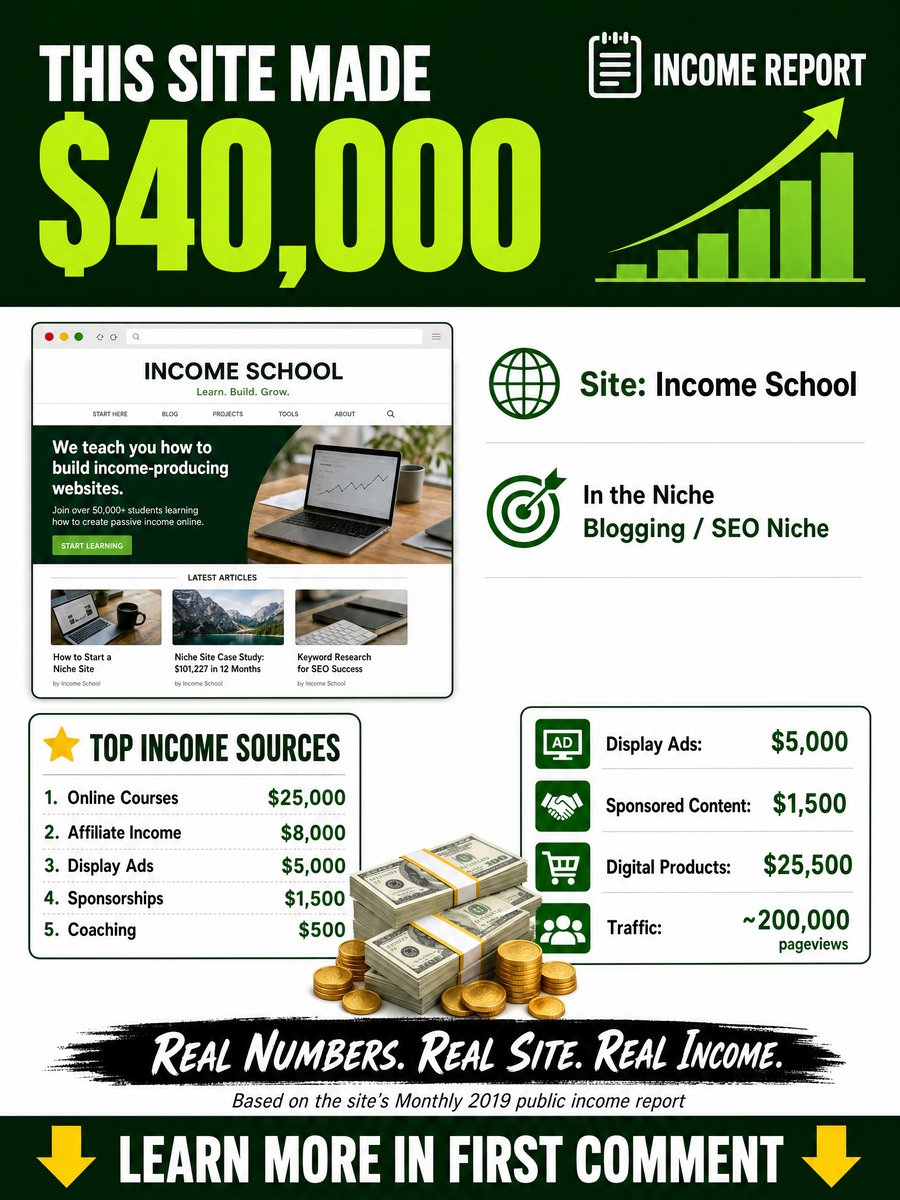
Building a profitable website requires more than random articles. The strongest model combines SEO, useful content, audience trust, affiliates, education, advertising, and other relevant revenue streams.
Income School demonstrates this approach. According to the supplied 2019 public income report, the business generated about $40,000/month from 200,000 pageviews in the Blogging and SEO niche. Revenue came from online courses ($25,000), affiliates ($8,000), ads ($5,000), sponsorships ($1,500), and coaching ($500).
The key lesson is that a targeted audience can be highly valuable. Readers building websites often need training, tools, hosting, and software, allowing educational content to generate revenue beyond advertising. This report explores the business model, SEO strategy, affiliate opportunities, and monetization methods behind a successful blogging-focused website.
Site Snapshot
| Metric | Details |
| Website | Income School |
| Primary Niche | Blogging / SEO |
| Related Topics | Niche Sites, Keyword Research, Website Building, Online Business |
| Estimated Monthly Revenue | $40,000 |
| Estimated Monthly Traffic | ~200,000 Pageviews |
| Largest Revenue Source | Online Courses |
| Online Courses | $25,000 |
| Affiliate Income | $8,000 |
| Display Ads | $5,000 |
| Sponsorships | $1,500 |
| Coaching | $500 |
| Report Basis | Monthly 2019 Public Income Report |
Why the Blogging and SEO Niche Can Be Profitable
Blogging and SEO have strong monetization potential because the audience is usually trying to accomplish something measurable. Readers may want to start a website, increase Google traffic, find better keywords, build an affiliate site, grow an email list, or turn content into income.
Those goals often require both education and software.
A person searching for “how to start a niche website” may eventually purchase hosting. Someone learning keyword research may subscribe to an SEO platform. Another reader might decide that following scattered tutorials takes too long and purchase a structured course instead.
Useful content areas include:
- Starting a blog
- Building niche websites
- Keyword research
- SEO for beginners
- Content planning
- Affiliate marketing
- Website monetization
- WordPress
- Organic traffic
- Email marketing
- Niche selection
- Blogging case studies
These subjects also connect naturally with one another. Someone who learns how to choose a niche will eventually need help creating content, ranking that content, monetizing traffic, and improving the business. A well-organized website can guide readers through that entire journey.
Revenue Breakdown
The reported $40,000 comes from five distinct revenue streams, giving the business much more diversification than a website dependent entirely on ads.
| Revenue Source | Estimated Monthly Revenue |
| Online Courses | $25,000 |
| Affiliate Income | $8,000 |
| Display Ads | $5,000 |
| Sponsorships | $1,500 |
| Coaching | $500 |
| Estimated Total | $40,000 |
The broader monetization summary groups $25,500 under digital products. That aligns directly with the $25,000 in online-course income plus $500 in coaching.
| Summary Category | Amount |
| Digital Products | $25,500 |
| Display Ads | $5,000 |
| Sponsored Content | $1,500 |
| Traffic | ~200,000 Pageviews |
The remaining $8,000 comes from affiliate income, completing the $40,000 total.
This structure immediately tells us something important: the business isn’t built around maximizing pageviews. It’s built around turning a targeted audience into customers and qualified referrals.
How Income School Makes Money
Income School’s model combines free education with multiple revenue streams, allowing readers to enter at different levels of commitment.
- Online Courses ($25,000): The largest source, showing strong demand for structured training.
- Affiliate Marketing ($8,000): Monetizes recommendations for hosting, SEO tools, email platforms, and other blogging resources.
- Display Advertising ($5,000): Earns revenue from free-content visitors who are not ready to buy.
- Sponsorships ($1,500): Provides direct income from brands targeting website owners and entrepreneurs.
- Coaching ($500): Offers personalized support for readers seeking additional guidance.
This approach creates a balanced business by serving both free readers and paying customers.
Online Courses Are the Core Revenue Driver
The largest source is clearly online education, with $25,000 coming from courses. That’s especially logical in the blogging and SEO niche because readers are trying to learn processes that involve many connected steps.
A free blog post can explain keyword research. Another can teach basic SEO. Another can cover niche selection. But someone who wants a complete system may prefer a structured program that puts everything in the correct order.
Courses in this niche can cover topics such as:
- Starting a niche website
- Finding profitable topics
- Keyword research
- SEO fundamentals
- Writing search-focused content
- Website monetization
- Affiliate marketing
- Content planning
- Growing organic traffic
The advantage for the publisher is ownership. Affiliate programs can change their commissions and ad revenue can fluctuate, but an owned course gives the business more control over pricing, curriculum, positioning, and customer relationships.
It also increases revenue per reader. Even a relatively small number of course buyers can generate far more income than thousands of additional ad impressions.
Affiliate Marketing Adds $8,000
Affiliate income contributes $8,000, making it a major revenue source because blogging requires tools and services.
- Natural product fit: Hosting, SEO tools, and email platforms can be recommended within relevant tutorials.
- Helpful first: The best affiliate strategy is recommending products that genuinely help readers complete a task.
- Content leads the recommendation: Products should support the solution rather than become the main purpose of the article.
Popular Affiliate Programs
The report provides an $8,000 affiliate-income figure, but it doesn’t identify the individual programs responsible for that revenue. The following are current examples that fit a Blogging and SEO Website; they should not be treated as confirmed Income School partnerships.
Affiliate Program Breakdown
| Affiliate Program | Category | Official Link |
| Bluehost | Web Hosting | Bluehost Affiliate Program |
| Semrush | SEO and Keyword Research | Semrush Affiliate Program |
| Kit | Email Marketing | Kit Affiliate Program |
| WP Engine | Managed WordPress Hosting | WP Engine Affiliate Program |
Bluehost, Semrush, Kit, and WP Engine offer affiliate programs for creators promoting hosting, SEO, email, and marketing tools. Programs and commissions can change, so publishers should verify current terms.
The best affiliate strategy is not choosing the highest payout, but recommending products that genuinely solve the reader’s problem.
Display Ads and Sponsorships Provide Supporting Revenue
- Display Ads ($5,000): Provide supporting revenue from informational readers who may not be ready to buy. Articles, case studies, and tutorials can still generate value through traffic.
- Sponsored Content ($1,500): Brands in hosting, SEO, content tools, website platforms, and email marketing may pay to reach a targeted audience.
- Trust matters: Paid partnerships should be clearly disclosed, with a clear separation between sponsored content and independent recommendations.
Content Strategy for a Blogging and SEO Website
A strong Blogging and SEO Website needs more than generic articles about “making money online.” The content should solve specific problems people encounter while building and growing websites.
Case studies are especially valuable because they turn abstract strategies into something concrete. A detailed article explaining how a niche site was built, what content was published, and what results followed can be far more useful than another list of generic SEO tips.
Useful content categories include:
- How to start a niche site
- Keyword research tutorials
- SEO guides
- Niche-site case studies
- Website monetization
- Blogging strategy
- Affiliate marketing
- Content planning
- Organic traffic
- Website tools
A strong content library should also serve different experience levels. Beginner guides bring new people into the audience, while detailed SEO and monetization articles give more experienced readers reasons to stay.
That progression supports the course model nicely. Readers can learn freely until they decide they want more organized training.
Keyword Opportunities
This niche includes a healthy mix of informational and commercial searches. Informational keywords build traffic, while commercial keywords can lead directly to affiliate revenue.
Potential informational topics include:
- how to start a niche website
- blogging for beginners
- how to find a niche
- keyword research for beginners
- how to get organic traffic
- how to monetize a blog
- SEO for bloggers
- affiliate marketing for beginners
- how to build a content website
- niche site ideas
Commercial topics can include:
- best web hosting for bloggers
- best keyword research tools
- best SEO software
- best email marketing platform
- best WordPress hosting
- SEO tool comparison
- blogging tools
- website hosting comparison
The strongest approach uses both types. Educational articles bring people into the site, and commercial articles help readers choose the products they need once they’re ready to act.
SEO Strategy
A website teaching SEO should prove its expertise through its own content strategy. Strong results come from building useful topic clusters rather than chasing random keywords.
- Keyword Research Cluster: Covers search intent, competition, long-tail keywords, topic selection, content planning, and tools.
- Niche Site Cluster: Covers choosing a niche, launching a site, creating content, getting traffic, monetizing, and scaling.
- Internal linking: Helps readers move through related topics while improving site structure.
- Regular updates: SEO changes over time, so tutorials and tool reviews need maintenance.
- Original case studies: Provide unique value and help a site stand out from competitors.
Traffic Strategy Behind 200,000 Pageviews
The report shows about 200,000 pageviews, but it does not provide a breakdown of traffic sources.
- Search traffic: Helps attract new readers through tutorials and keyword-focused content.
- Email audience: Turns visitors into returning readers through newsletters, case studies, and product updates.
- Video content: Can support topics that benefit from demonstrations, such as SEO tools or website setup.
The key is converting traffic into an owned audience, since returning subscribers are more valuable than one-time visitors.
Why This Business Model Works
The Income School model works because the audience has a clear objective: building and growing websites. That objective naturally creates demand for both information and products.
Free articles attract people who are learning. Courses provide structured training for readers who want to move faster. Affiliates monetize tools those readers already need. Ads monetize broader informational traffic. Sponsorships create additional revenue from relevant companies.
The numbers make the balance easy to see:
- Courses: $25,000
- Affiliate Income: $8,000
- Display Ads: $5,000
- Sponsorships: $1,500
- Coaching: $500
The biggest lesson is that only $5,000 of the $40,000 total comes from display advertising. Most of the business depends on serving a targeted audience more deeply.
That’s why 200,000 pageviews can support a much stronger business than the traffic number alone might suggest.
Lessons for Content Creators
A new creator in the Blogging and SEO niche should prioritize usefulness and trust over exaggerated income claims.
- Create valuable content: Solve specific problems, build connected topic clusters, and use transparent case studies.
- Build relationships: Grow an email list and recommend tools only when they genuinely help readers.
- Monetize with value: Courses, affiliates, and products work best when they provide deeper solutions than free content.
The strongest asset is not traffic or a single product—it is audience trust.
Conclusion
The Income School Blogging and SEO Website report shows how educational content can build a diversified online business. The 2019 report estimates $40,000/month from 200,000 pageviews, with $25,000 from courses, $8,000 from affiliates, $5,000 from ads, $1,500 from sponsorships, and $500 from coaching.
The key lesson is that success comes from building a trusted learning ecosystem, not just publishing SEO articles. A targeted audience can support courses, affiliates, ads, sponsorships, and services without requiring massive traffic.
Niche Pursuits Niche Sites and Amazon FBA Website Makes $55,000 Per Month
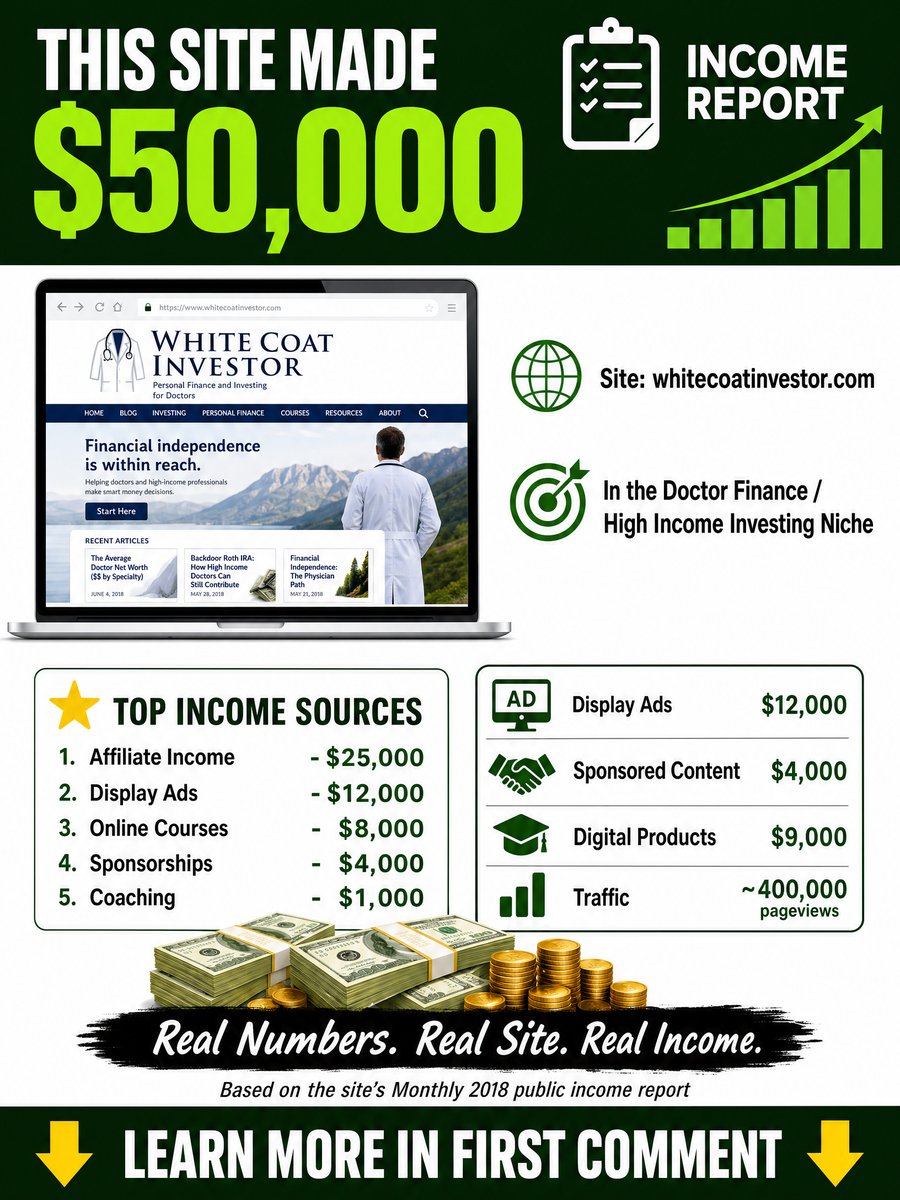
The Niche Sites and Amazon FBA niche shows how educational content can become a diversified online business through affiliates, courses, ads, sponsorships, and coaching.
According to the supplied 2019 Niche Pursuits report, the site generated about $55,000/month from 300,000 pageviews, with $25,000 from affiliates, $15,000 from courses, $10,000 from ads, $4,000 from sponsorships, and $1,000 from coaching. The $16,000 digital products category aligns with courses and coaching.
The key lesson is that a focused business audience can be highly valuable. Readers seeking niche-site strategies, affiliate marketing, and Amazon-related education often have strong buying intent for tools, software, and training, creating multiple monetization opportunities.
Site Snapshot
| Metric | Details |
| Website | Niche Pursuits |
| Primary Niche | Niche Sites / Amazon FBA |
| Related Topics | Affiliate Marketing, SEO, Website Building, Online Business |
| Estimated Monthly Revenue | $55,000 |
| Estimated Monthly Traffic | ~300,000 Pageviews |
| Largest Revenue Source | Affiliate Income |
| Affiliate Income | $25,000 |
| Online Courses | $15,000 |
| Display Advertising | $10,000 |
| Sponsorships | $4,000 |
| Coaching | $1,000 |
| Report Basis | Monthly 2019 Public Income Report |
Why the Niche Sites and Amazon FBA Niche Can Be Profitable
This niche is commercially attractive because readers are not simply looking for entertainment. They are usually trying to build something. Someone researching niche websites may need hosting, keyword research software, SEO tools, email marketing software, writing resources, affiliate networks, courses, and other products required to operate an online business.
That makes the audience potentially more valuable than traffic in many general-interest niches. A reader who spends several hundred dollars per year on business tools can generate substantially more revenue than a visitor who only views a few display ads.
The niche also contains many evergreen educational subjects, including:
- Affiliate marketing
- Niche-site creation
- Keyword research
- SEO
- Content strategy
- Website monetization
- Amazon Associates
- Amazon FBA
- Online business ideas
- Website hosting
- Email marketing
- Digital products
- Website acquisition
- Blogging
Readers can remain in this ecosystem for years because their needs evolve as their businesses grow. Someone may begin by learning how to launch a website, later research SEO tools, then explore monetization, email marketing, outsourcing, or buying additional online businesses.
Revenue Breakdown
The detailed income sources provide a clear picture of how the reported $55,000 is generated. Unlike websites that depend mainly on advertising, the largest category here comes from affiliate marketing.
| Revenue Source | Estimated Monthly Revenue |
| Affiliate Income | $25,000 |
| Online Courses | $15,000 |
| Display Ads | $10,000 |
| Sponsorships | $4,000 |
| Coaching | $1,000 |
| Total | $55,000 |
The broader summary categorizes part of the income slightly differently:
| Summary Category | Amount |
| Display Ads | $10,000 |
| Sponsored Content | $4,000 |
| Digital Products | $16,000 |
| Traffic | ~300,000 Pageviews |
The $16,000 digital-products category corresponds logically to $15,000 in online courses plus $1,000 in coaching. Affiliate income remains a separate $25,000 revenue stream, bringing the complete model to $55,000.
How Niche Pursuits Makes Money
The strength of this model comes from monetizing different levels of reader intent:
- Advertising ($10,000): Beginner readers and informational traffic can generate revenue through pageviews.
- Affiliate Marketing ($25,000): Readers researching hosting, SEO tools, and business software are closer to making purchases.
- Online Courses ($15,000): More committed visitors can invest in structured education and training.
- Coaching ($1,000): Some readers want personalized guidance and direct support.
- Sponsorships ($4,000): Brands can pay to reach a targeted business audience.
This diversified approach reduces dependence on one income source and creates a more stable online business.
Affiliate Marketing Is the Largest Revenue Source
Affiliate income accounts for about 45% of the reported $55,000 total, making it the largest revenue source.
- Natural product fit: Online business readers often need tools like hosting, SEO software, email platforms, and affiliate networks to apply what they learn.
- Content supports conversions: Tutorials and guides can introduce relevant products at the right moment in the reader’s journey.
- Trust matters: Affiliate marketing works best when recommendations genuinely help readers, not when every article becomes a sales pitch.
Online Courses Turn Knowledge Into a Product
Online courses generated $15,000, making education the second-largest revenue stream.
A free article can explain one part of building a niche website, but a course can provide a complete system. Readers may pay for structured training because it saves them from piecing together hundreds of disconnected articles.
Course topics in this niche could include:
- Building a profitable niche website
- Keyword research
- Affiliate marketing
- Content strategy
- SEO
- Website monetization
- Amazon affiliate sites
- Outsourcing content
- Growing organic traffic
- Buying and selling websites
Courses also give publishers greater control over monetization. Unlike affiliate programs, where another company controls commissions and policies, an owned course allows the publisher to determine the price, curriculum, and customer experience.
Display Advertising Monetizes Informational Traffic
Display advertising generated $10,000, providing revenue from readers who are not yet ready to buy.
- Broad traffic monetization: Articles like case studies, tutorials, and business guides can earn ad revenue through pageviews.
- High-intent monetization: Readers researching tools, software, or strategies can later generate more valuable affiliate or product revenue.
This creates a two-layer model where general content attracts traffic while targeted content drives higher-value conversions.
Sponsorships Add Direct Brand Revenue
Sponsorships contribute another $4,000. While smaller than the main income sources, sponsored content fits naturally because software companies and online-business brands want exposure to entrepreneurs.
Potential sponsors in this market can include:
- SEO software companies
- Hosting providers
- Website builders
- Email marketing platforms
- Affiliate networks
- Content tools
- Keyword research platforms
- Online business services
The strongest sponsorships provide useful information while being clearly identified as paid partnerships. Readers should always be able to tell the difference between independent recommendations and sponsored campaigns.
A smaller but highly targeted entrepreneurial audience can be especially attractive to B2B advertisers because each reader may have meaningful purchasing power.
Coaching Adds a Premium Service Layer
Coaching contributes $1,000, but it shows the value of personalized services.
- Higher-value support: Unlike courses, coaching helps individuals solve specific website or business challenges.
- Less scalable but valuable: Fewer clients may be served, but each customer can provide more revenue.
- Improves content strategy: Coaching questions reveal audience problems that can inspire better articles, courses, templates, and recommendations.
Popular Affiliate Programs
Affiliate marketing is a key part of the Niche Pursuits model. The following programs are relevant examples for a website focused on SEO, online business, and digital marketing, but they are not confirmed sources of the reported $25,000 revenue.
- Amazon Associates: Allows publishers and bloggers to earn commissions through qualifying product referrals, making it useful for product-focused content.
- Bluehost: Offers an affiliate program relevant to articles about building websites, blogs, and online businesses.
- Semrush: Provides an affiliate opportunity for publishers promoting SEO and marketing tools.
- Kit: Offers an affiliate program that fits content about email marketing, audience growth, and creator businesses.
Affiliate Program Breakdown
| Affiliate Program | Category | Official Link |
| Amazon Associates | E-commerce / Affiliate Products | https://affiliate-program.amazon.com |
| Bluehost | Web Hosting | https://www.bluehost.com/affiliates |
| Semrush | SEO and Marketing Software | https://www.semrush.com/lp/affiliate-program/en/ |
| Kit | Email Marketing | https://kit.com/affiliate |
Affiliate programs can change their commissions, requirements, and eligibility rules, so creators should always check current terms before building a major content strategy around a particular offer. The best long-term approach is to recommend tools based on usefulness and audience fit rather than the size of the commission.
Content Strategy for a Niche Site Business Website
A site in this category can build substantial traffic by answering the practical questions people encounter while building online businesses. The strongest content usually combines tutorials, case studies, comparison content, and transparent business experiments.
Useful categories include:
- How to start a niche site
- Affiliate marketing tutorials
- Income reports
- Keyword research
- SEO tutorials
- Website-building guides
- Hosting comparisons
- Online business case studies
- Amazon-related business content
- Monetization strategies
- Website acquisition
- Content outsourcing
Income reports can be particularly engaging because readers want to understand what strategies worked, what failed, and how revenue changed over time.
Case studies also provide differentiation. Thousands of websites can explain basic affiliate marketing, but a detailed account of building and growing a real project provides information that is harder to reproduce.
Keyword Opportunities
Keyword research in this niche should combine informational queries with commercial search intent. Informational content helps build traffic and trust, while commercial searches can generate affiliate revenue.
Potential informational keywords include:
- how to build a niche website
- niche website ideas
- affiliate marketing for beginners
- how to make money blogging
- how to do keyword research
- how to rank a niche site
- Amazon affiliate website
- content website business
- how to monetize a blog
- online business ideas
Commercial opportunities can include:
- best web hosting for niche sites
- best keyword research tool
- best SEO software
- best email marketing software
- best affiliate programs
- Semrush alternatives
- hosting comparison
- website builder comparison
The important distinction is intent. Someone searching for a general SEO tutorial may still be learning. Someone searching for the best keyword research tool is much closer to purchasing software.
A profitable content strategy serves both readers.
SEO Strategy
SEO is especially important in the niche-site business because organic search is both a traffic source and part of what readers are trying to learn. A publication teaching niche-site strategies should therefore demonstrate those principles through its own content.
Strong SEO starts with topical depth. Instead of publishing random articles, a site can create connected clusters around keyword research, affiliate marketing, content creation, hosting, site building, and monetization.
Useful practices include:
- Publishing comprehensive tutorials
- Targeting long-tail keywords
- Updating old software comparisons
- Building strong internal links
- Publishing original case studies
- Creating useful comparison tables
- Demonstrating firsthand results
- Writing content for clear search intent
- Refreshing outdated recommendations
Software-related articles require particularly frequent updates because products, prices, and features change. Evergreen business principles can last for years, but a comparison of online tools may become outdated quickly.
Traffic Strategy Behind 300,000 Pageviews
The report shows approximately 300,000 pageviews but does not provide traffic-source details, so exact percentages should not be assumed.
- Organic search: Can attract readers looking for business tutorials, SEO guides, and product comparisons.
- Email: Helps bring audiences back for new content, case studies, and educational resources.
- Direct traffic: Grows as readers become familiar with the brand.
- Video and social platforms: Can support written content, especially for tutorials and demonstrations.
The key strategy is reducing dependence on one platform by building search visibility, an email audience, and a recognizable brand.
Why This Business Model Works
The strength of the Niche Pursuits model is that readers have both educational and commercial intent. They seek information but also need tools, services, and guidance to apply what they learn.
- Website builders: May need hosting and website tools.
- SEO learners: May purchase keyword research and optimization software.
- Growing businesses: May need email platforms, courses, or coaching.
The reported revenue mix shows this clearly: $25,000 affiliates, $15,000 courses, $10,000 ads, $4,000 sponsorships, and $1,000 coaching. Multiple income streams make the business more stable and reduce dependence on pageviews alone.
Lessons for Content Creators
A new creator in the Niche Sites and Online Business space should prioritize credibility because many readers are skeptical of generic “make money online” advice.
- Build trust: Use detailed tutorials, real case studies, realistic expectations, and firsthand experience.
- Create useful content: Solve real problems, recommend relevant tools, grow an email list, and develop products based on audience needs.
- Balance monetization: Affiliates, courses, coaching, and ads should support the audience rather than control the content.
Trust is the foundation that connects all revenue streams.
Conclusion
The Niche Pursuits Niche Sites and Amazon FBA Website report shows how a focused online-business audience can generate strong revenue. The 2019 report estimates $55,000/month from 300,000 pageviews, with $25,000 from affiliates, $15,000 from courses, $10,000 from ads, $4,000 from sponsorships, and $1,000 from coaching.
The $16,000 digital products category aligns with courses and coaching, highlighting a model built on affiliates, education, and audience trust. The key opportunity is creating useful business content and connecting readers with relevant tools, training, and resources.
Key Takeaway: Niche Pursuits shows that a Niche Sites and Amazon FBA Website can succeed without millions of visitors. With about 300,000 pageviews and $55,000 in reported monthly revenue, the model combines affiliates, courses, ads, sponsorships, and coaching. The key is creating useful content, solving real business problems, and building multiple revenue streams.
Pinch of Yum Food Blog and Recipes Website Makes $65,877 Per Month
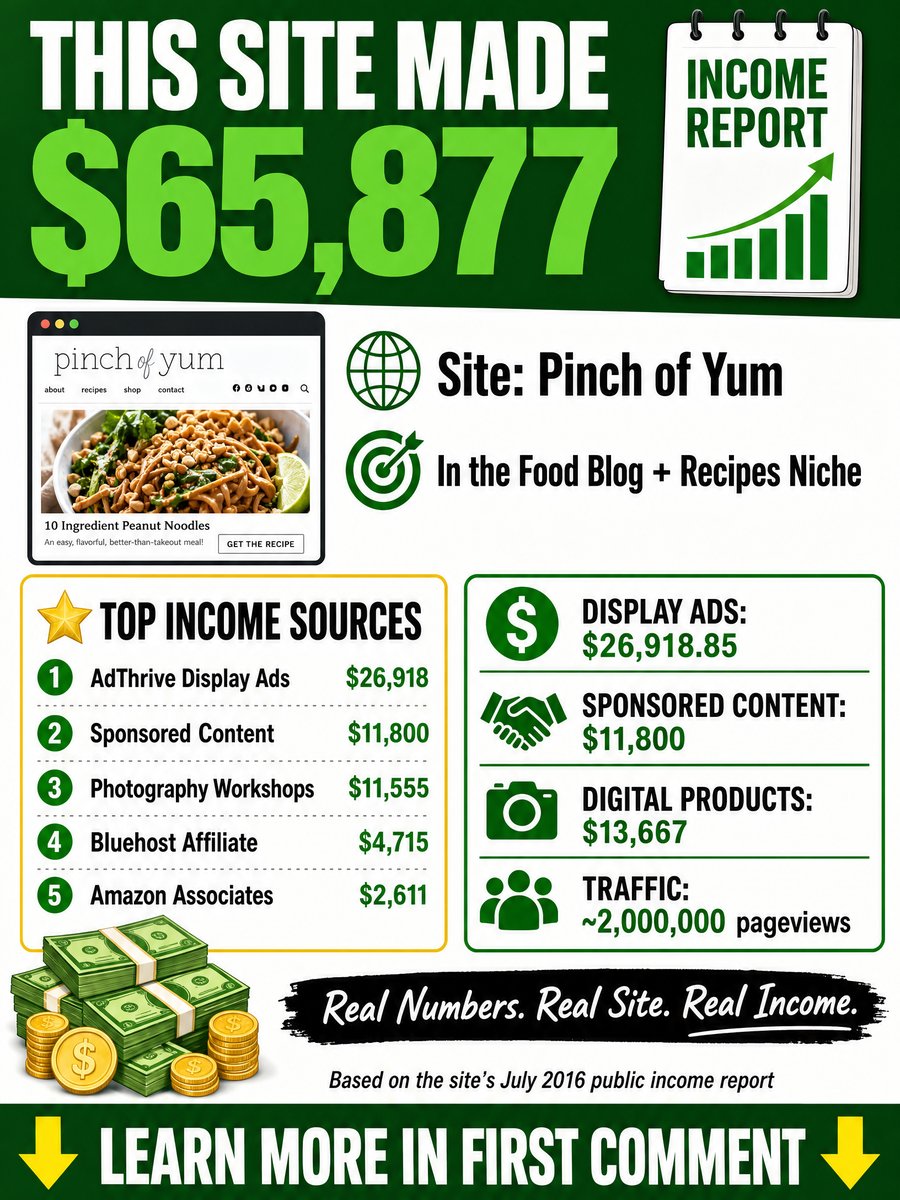
Food blogging is more than publishing recipes. Successful food websites combine recipe creation, SEO, photography, audience building, advertising, sponsorships, affiliates, and digital products.
Pinch of Yum demonstrates this model. Based on the July 2016 income report figures provided, the site generated about $65,877 from around 2 million pageviews, with revenue from display ads, sponsored content, photography workshops, Bluehost affiliates, and Amazon Associates.
The key lesson is that recipe traffic can support multiple income streams. Search-driven content can earn ad revenue, product-focused articles can generate affiliates, photography expertise can become paid products, and a trusted audience can attract brand partnerships.
Site Snapshot
| Metric | Details |
| Website | Pinch of Yum |
| Primary Niche | Food Blog + Recipes |
| Related Topics | Home Cooking, Food Photography, Recipe Development, Blogging |
| Revenue Figure Reported | $65,877 |
| Traffic Figure Reported | ~2,000,000 Pageviews |
| Largest Named Income Source | AdThrive Display Ads |
| Display Ads | $26,919 |
| Sponsored Content | $11,800 |
| Digital Products | $13,667 |
| Report Basis | July 2016 Public Income Report |
Why the Food Blog and Recipes Niche Is So Profitable
Food is an evergreen niche because people constantly search for recipes, meal ideas, cooking tips, and food inspiration. A strong recipe can attract traffic for years through search and social platforms.
The audience is also broad, including families, students, professionals, and home cooks. Since food is highly visual, quality photography can improve engagement, clicks, and audience growth.
Popular content areas include:
- Quick dinner recipes
- Healthy meals
- Pasta and noodle recipes
- Chicken recipes
- Vegetarian dishes
- Desserts
- Breakfast recipes
- Meal-prep ideas
- Family dinners
- Seasonal recipes
- Holiday cooking
- Kitchen tips
- Food photography
- Recipe blogging
This combination of evergreen search demand, strong visual appeal, repeat readership, and commercial opportunities makes recipe publishing an attractive content business.
Revenue Breakdown From the July 2016 Report
The report identifies several major revenue streams rather than relying on one source. That diversification is important because advertising, sponsorships, products, and affiliate programs can perform differently throughout the year.
The five largest individual income sources listed are:
| Top Income Source | Amount |
| AdThrive Display Ads | $26,918 |
| Sponsored Content | $11,800 |
| Photography Workshops | $11,555 |
| Bluehost Affiliate | $4,715 |
| Amazon Associates | $2,611 |
These five sources total less than the full $65,877 headline figure, which means the report’s top-five list does not represent every dollar of income generated during the period.
A separate summary groups some of the revenue into broader categories:
| Revenue Category | Amount |
| Display Ads | $26,919 |
| Sponsored Content | $11,800 |
| Digital Products | $13,667 |
| Traffic | ~2,000,000 Pageviews |
The $13,667 digital-products figure is larger than the $11,555 photography-workshop amount, indicating that workshops made up most, but not necessarily all, of that broader category.
The important takeaway is that Pinch of Yum was not simply an ad-supported recipe site. Advertising was the largest individual source, but sponsorships, educational products, and affiliates also made meaningful contributions.
How Pinch of Yum Makes Money
The Pinch of Yum model succeeds because different content types support different revenue streams:
- Display Advertising: Recipe traffic from search can generate scalable ad revenue.
- Sponsored Content: Brand partnerships allow companies to reach a large food-focused audience.
- Photography Education: Skills and expertise can be turned into workshops or digital products.
- Affiliate Marketing: Product recommendations can earn commissions when readers make purchases.
This diversified approach creates a stronger business than relying on a single income source.
Display Advertising Is the Largest Named Revenue Source
AdThrive Display Advertising generated approximately $26,918.85, making it the largest reported income source.
- Recipe traffic scales well: Visitors often spend time reading ingredients, instructions, substitutions, and related recipes, creating multiple ad opportunities.
- Evergreen content compounds: Hundreds of recipes can attract consistent traffic from searches like dinner ideas, desserts, and meal inspiration.
- Small wins add up: A publisher does not need one viral recipe; a large library of useful content can gradually create significant traffic and revenue.
Sponsored Content Adds Significant Revenue
Sponsored content contributed $11,800, making brand partnerships another major part of the business. Food publishers are attractive to advertisers because readers frequently make purchasing decisions involving groceries, kitchen products, cooking tools, and household goods.
Potential sponsorship categories naturally include:
- Food brands
- Grocery companies
- Kitchen appliances
- Cookware
- Meal services
- Ingredient companies
- Beverage brands
- Food-storage products
- Kitchen accessories
A sponsored recipe can integrate a product directly into something readers already want to make. That can be more engaging than a traditional banner advertisement because the brand becomes part of useful content.
However, sponsorships work best when they fit naturally. A publisher should still maintain editorial standards and clearly disclose paid partnerships. Trust is far more valuable than accepting every available sponsorship.
Photography Workshops Turn Expertise Into a Product
Photography workshops generated $11,555, showing how a publisher can monetize skills developed while building the website.
- Skill-based products: Food photography expertise can become workshops, courses, guides, presets, or educational resources.
- Two audiences: Recipes attract home cooks, while photography content attracts creators who want to improve their own work.
- Broader lesson: The skills gained while growing a content business can become valuable products themselves.
Affiliate Marketing Adds Commercial Revenue
Affiliate marketing also contributed meaningful income, with Bluehost ($4,715) and Amazon Associates ($2,611) listed as sources.
- Bluehost: Fits blogging content because aspiring food bloggers may need hosting.
- Amazon Associates: Fits recipe and kitchen content through recommendations for tools, appliances, and cooking products.
Best strategy: Affiliate links should match the reader’s intent and solve a problem rather than exist only for commissions.
Popular Affiliate Programs
The July 2016 report specifically identifies Bluehost and Amazon Associates, so these are the clearest affiliate examples connected to the Pinch of Yum business model.
Affiliate Program Breakdown
| Affiliate Program | Relevant Category | Income Reported |
| Bluehost | Web Hosting / Blogging | $4,715 |
| Amazon Associates | Kitchen Tools and General Products | $2,611 |
Bluehost makes sense for a food publication that also teaches aspects of blogging or content creation. A reader who wants to launch a recipe website needs hosting, a domain, and publishing tools.
Amazon Associates fits the consumer side of the business. Recipe publishers can naturally reference tools such as baking pans, blenders, food processors, knives, storage containers, or other kitchen equipment when relevant.
Since affiliate programs and commission structures change over time, creators should verify current terms before relying on any specific program. The more important lesson is to choose affiliate offers that fit the subject and solve genuine reader needs.
Content Strategy That Can Drive Two Million Pageviews
Reaching roughly 2 million pageviews requires a substantial content library and consistent publishing strategy. Recipe traffic generally comes from many individual searches rather than one broad keyword.
A successful food publisher can build clusters around ingredients, meal types, dietary preferences, cooking methods, and occasions. For example, one chicken recipe can lead to an entire collection of chicken dinners, meal-prep recipes, healthy chicken dishes, and quick weeknight meals.
Strong content categories might include:
- 30-minute dinners
- Easy pasta recipes
- Healthy lunches
- Vegetarian meals
- One-pot recipes
- Slow-cooker recipes
- Family dinners
- Meal-prep recipes
- Holiday desserts
- Summer recipes
- Comfort food
- Budget meals
Each category can contain dozens of related recipes, creating natural internal links and giving readers reasons to browse additional pages.
The content also needs to remain practical. Clear ingredients, understandable instructions, useful substitutions, and appealing photography matter more than filling pages with unnecessary text.
Food Photography Is a Major Competitive Advantage
Food blogging is a niche where photography strongly influences performance because images communicate taste, texture, and presentation.
- Better visuals improve engagement: High-quality photos can increase clicks, shares, saves, and brand recognition.
- Photography can become a product: Skills developed for recipes can create additional income through workshops or courses.
- Technique matters more than equipment: Lighting, composition, styling, editing, and consistency are often more important than owning expensive gear.
Keyword Opportunities
Recipe websites can target thousands of specific searches because food queries are highly varied. Instead of competing only for enormous keywords such as “dinner recipes,” a publisher can target more specific needs.
Potential keyword themes include:
- easy peanut noodles
- quick vegetarian dinner
- healthy noodle recipes
- easy weeknight meals
- chicken dinner ideas
- vegetarian meal prep
- easy pasta recipes
- healthy lunch ideas
- simple family dinners
- quick dinner recipes
- one-pot meals
- summer salad recipes
Longer and more specific searches often give newer publishers better opportunities to rank while still attracting readers with clear intent.
Recipe collections can then connect these individual pages into broader hubs such as “25 Easy Weeknight Dinners” or “20 Quick Vegetarian Recipes.”
SEO Strategy for a Food Blog
SEO is a major traffic opportunity for recipe websites because people constantly search for cooking ideas and instructions. A useful recipe can bring visitors for years when properly optimized.
- Match search intent: Give readers the exact recipe information they are looking for instead of unrelated content.
- Optimize the experience: Use clear titles, recipe details, internal links, fast images, mobile-friendly pages, and updated content.
- Build topic authority: Cover related recipes deeply rather than publishing random topics.
- Prioritize quality: SEO attracts visitors, but great recipes and visuals encourage them to return.
Why This Business Model Works
The Pinch of Yum model works because each part of the business reinforces the others. Recipes attract a large consumer audience. That audience generates advertising and sponsorship revenue. Strong photography improves recipe performance and becomes the foundation for workshops. Blogging experience creates opportunities for hosting affiliates. Kitchen-related content creates product-affiliate opportunities.
The model therefore has several advantages: food has evergreen demand, recipes can generate search traffic for years, photography performs well visually, advertisers value large food audiences, and publishers can develop products based on skills acquired while growing the website.
Most importantly, the business does not depend entirely on one source. If advertising revenue changes, sponsorships, affiliates, and products provide additional support.
Lessons for Content Creators
A new food blogger does not need millions of pageviews immediately. The focus should be building useful recipes around a clear niche, with strong instructions, original photography, consistent publishing, and SEO-friendly topics.
- Use relevant monetization: Recommend products that genuinely help readers, choose fitting sponsors, and create educational products based on real expertise.
- Prioritize trust: The most valuable recipe websites grow because readers return for reliable content, not just because they discover a single page through search.
Conclusion
The Pinch of Yum Food Blog and Recipes Website report demonstrates how a recipe publisher can combine high-volume traffic with several complementary revenue streams. According to the July 2016 figures, the site generated approximately $65,877 from around 2 million pageviews.
The largest named income source was AdThrive display advertising at roughly $26,918.85, followed by $11,800 in sponsored content and $11,555 from photography workshops. Bluehost contributed $4,715, while Amazon Associates contributed $2,611. A broader summary also lists $13,667 in digital products, showing that owned educational products played an important role alongside advertising and sponsorships.
The most useful lesson is that a food blog can become much more than a recipe archive. Strong recipes attract readers, visual content helps those recipes stand out, advertising monetizes scale, sponsorships monetize brand relationships, affiliates monetize relevant purchases, and expertise can be transformed into digital education.
Key Takeaway: Pinch of Yum shows how a Food Blog and Recipes Website can monetize through recipe traffic, ads, sponsorships, photography products, and affiliates. The July 2016 report’s 2 million pageviews and $65,877 revenue highlight the value of evergreen content and diversified income streams.
Making Sense of Cents Personal Finance and Make Money Website Makes $68,440 Per Month

Personal finance is a strong evergreen niche because people constantly search for ways to earn more, save money, reduce debt, invest, and improve their financial lives. A Personal Finance and Make Money Website can attract readers with different goals, from finding side hustles to comparing financial products.
The supplied June 2016 report for Making Sense of Cents shows the site generating $68,440 from approximately 425,000 pageviews, with affiliate marketing as the main driver. Major contributors included Bluehost, survey companies, financial products, cashback offers, display ads, and sponsored content.
The report breaks revenue into $52,280 from digital products and affiliate-related income, $14,400 from sponsored content, and $1,760 from display ads, totaling $68,440. The key lesson is that finance websites can generate significant revenue without massive traffic by attracting high-intent readers and monetizing through trusted recommendations, affiliates, sponsorships, and products.
Site Snapshot
Site Snapshot
| Metric | Details |
| Website | Making Sense of Cents |
| Domain | makingsenseofcents.com |
| Primary Niche | Personal Finance / Make Money |
| Related Topics | Saving Money, Debt, Side Hustles, Investing, Financial Independence |
| Revenue Figure Shown | $68,440 |
| Traffic Figure Shown | ~425,000 Pageviews |
| Largest Named Income Source | Bluehost Affiliate |
| Display Ads | $1,760 |
| Sponsored Content | $14,400 |
| Digital Products / Related Monetization | $52,280 |
| Report Basis | June 2016 Public Income Report |
Why the Personal Finance and Make Money Niche Is So Profitable
Personal finance has strong monetization potential because money affects nearly everyone. Readers constantly seek ways to save, earn, invest, and improve their financial decisions.
- High-value search intent: Some readers seek general advice, while others search for tools, financial products, or services they are ready to use.
- Multiple audience segments: A finance website can serve people focused on debt payoff, budgeting, investing, wealth building, or income growth.
- Make Money opportunities: Topics like side hustles, freelancing, blogging, online businesses, and remote work attract readers looking to increase income.
- Strong content areas: Budgeting, debt reduction, saving, investing, credit, financial independence, money stories, and income strategies can create evergreen traffic.
- Affiliate potential: Helpful recommendations for relevant tools and services can create revenue when they genuinely solve reader problems.
Revenue Breakdown From the Report
The report contains two useful views of the site’s monetization. One side lists several of the top individual income sources, while the summary panel groups the full $68,440 into three broader categories.
The full summary is particularly useful because its categories reconcile exactly with the headline revenue.
| Revenue Category | Amount |
| Digital Products / Related Monetization | $52,280 |
| Sponsored Content | $14,400 |
| Display Advertising | $1,760 |
| Total | $68,440 |
The report also identifies the following leading individual income sources:
| Top Income Source | Amount |
| Bluehost Affiliate | $36,270 |
| Survey Companies | $11,714 |
| MOTIF Investing | $1,104 |
| Ebates | $1,000 |
| Credible | $450 |
These five named sources total $50,538, which means they represent the leading contributors rather than the complete $52,280 category. The remaining amount appears to come from additional monetization that is not separately identified in the top-five panel.
That distinction matters because it prevents us from inventing a revenue source that the report does not provide.
How Making Sense of Cents Makes Money
The model relies mainly on performance-based revenue rather than advertising. Display ads contribute only $1,760 of the $68,440 total, showing that reader intent is more valuable than pageviews alone.
- Affiliate marketing drives revenue: Bluehost generates $36,270, with survey referrals and financial services adding more income.
- Sponsored content matters: The report shows $14,400 from sponsorships, highlighting the value of a trusted finance audience.
- Intent beats traffic volume: A smaller audience with strong financial goals can generate more revenue than a larger audience with low buying intent.
The key lesson is that personal finance websites succeed by connecting readers with useful products and services, not just maximizing ad impressions.
Why Bluehost Became Such a Powerful Affiliate Offer
The $36,270 Bluehost affiliate figure highlights the power of matching content with relevant products. Making Sense of Cents connects personal finance education with online business topics, creating a natural reason to recommend hosting services.
- Problem-to-product alignment: The content solves a reader’s problem, and the affiliate product becomes a useful next step.
- Relevance matters more than commission: The best affiliate opportunities come from products that genuinely help the audience, not simply the highest payouts.
- Strong niches connect needs with solutions: Successful affiliate content naturally introduces tools readers already need.
Survey Companies and Make Money Content
Survey companies contribute $11,714, making them the second-largest named income source in the report. This fits the Make Money niche because many beginners search for simple ways to earn extra income.
- Content opportunities: Articles can compare survey platforms, explain how they work, review earning potential, and highlight risks.
- Set realistic expectations: Surveys should be presented as small-income opportunities, not replacements for full-time work.
- Build trust: Honest content should explain limitations, time requirements, eligibility rules, and realistic outcomes.
- Long-term value: Readers are more likely to return when a publisher provides balanced recommendations instead of exaggerated claims.
Affiliate Programs and Offers Highlighted in the Report
The June 2016 report names several individual affiliate relationships, making it possible to discuss the monetization strategy without guessing which offers contributed to revenue. Because this is a historical report, publishers should verify whether any program, company, or brand still operates under the same structure before attempting to promote it today.
| Affiliate Offer Mentioned | Category | Revenue Shown |
| Bluehost | Web Hosting | $36,270 |
| Survey Companies | Make Money / Surveys | $11,714 |
| MOTIF Investing | Investing | $1,104 |
| Ebates | Cashback / Shopping | $1,000 |
| Credible | Financial Services | $450 |
What makes this mix interesting is its diversity. The site was not dependent on only one type of reader. Blogging content could support hosting referrals, side-hustle content could support survey referrals, investing content could lead to investment-related offers, and saving-money content could connect with cashback services.
That creates a stronger business than building the entire site around one commercial product. If one partnership changes, the publication still has other areas of monetization.
Sponsored Content Adds a Major Revenue Layer
Sponsored content contributes $14,400, far exceeding the $1,760 from display ads, showing the value of direct brand partnerships.
- Potential sponsors: Financial technology companies, education platforms, online businesses, productivity tools, and related services.
- Content formats: Sponsored articles, newsletters, brand features, social campaigns, and partnerships.
- Disclosure matters: Paid content should always be clearly identified to maintain reader trust.
- Protect credibility: Financial publications must prioritize editorial independence over short-term sponsorship revenue.
Content Strategy That Supports the Revenue Model
The strongest part of this business model is how closely content and monetization can be connected. Personal finance topics create opportunities at multiple stages of the reader journey without requiring every article to become a sales page.
Debt-payoff stories can attract readers through inspiration and search traffic. Saving-money articles can build trust. Side-hustle guides can introduce income opportunities. Blogging tutorials can lead to hosting recommendations. Investing content can introduce financial tools. Each part of the publication can serve a specific reader problem while supporting an appropriate monetization path.
The homepage’s debt-payoff story is a good example of content that can build credibility without immediately selling anything. Personal stories make abstract financial principles feel more achievable because readers can see a sequence of decisions and results.
A strong site should balance these personal stories with practical evergreen resources. Readers might first arrive through an inspirational debt article and later explore budgeting, side hustles, saving, or investing. That internal journey increases pageviews while strengthening the relationship with the brand.
Keyword Opportunities
The Personal Finance and Make Money niche has many evergreen keyword opportunities, but the best strategy is to organize content around real reader needs rather than isolated keywords.
- Informational topics: Debt payoff, saving money, budgeting, side hustles, extra income ideas, remote work, passive income, and beginner investing.
- Commercial topics: Blogging tools, financial services, cashback platforms, budgeting apps, hosting, and other relevant products.
- Balanced strategy: Educational content builds traffic and trust, while commercial content helps monetize readers ready to take action.
- Accuracy matters: Financial content should include clear explanations, realistic expectations, disclosures, and updated information because recommendations can affect important decisions.
SEO Strategy for a Personal Finance Website
SEO works well in personal finance because many money questions remain relevant for years. Readers continually search for saving, debt, income, and financial improvement strategies.
- Build topic clusters: Organize content around areas like debt payoff, budgeting, side hustles, investing, saving money, and financial habits.
- Use internal links: Connecting related topics helps readers explore more content and improves site structure.
- Update regularly: Financial products, companies, affiliate programs, and regulations change, so older content needs maintenance.
- Prioritize trust: Accurate information, transparency, and responsible recommendations help earn links, returning visitors, and long-term authority.
Traffic Strategy Behind 425,000 Pageviews
The report provides approximately 425,000 pageviews but does not specify exactly where that traffic came from. It would therefore be inappropriate to invent percentages for search, Pinterest, social media, direct visits, or email.
What can be said confidently is that a site with this business model benefits from diversified traffic. Organic search can bring readers to evergreen financial articles, while social platforms can distribute personal stories and side-hustle content. Email can keep readers connected after their initial visit, and direct traffic grows as the brand becomes recognizable.
Email is especially important because financial improvement is a long-term process. Someone who discovers the site while searching for debt advice may later need help with saving, investing, or increasing income. A newsletter allows the publication to maintain that relationship instead of depending on the reader to find the site again through Google.
This direct audience can also support affiliate promotions and sponsorships when recommendations remain useful and clearly disclosed.
Why This Business Model Works
Making Sense of Cents shows how a focused audience can generate strong revenue without relying only on massive traffic.
- Quality over volume: Around 425,000 pageviews can be valuable when each visitor has strong intent and relevant monetization opportunities.
- Strong niche advantages: Personal finance has evergreen demand, while Make Money topics attract action-oriented readers.
- Multiple revenue streams: Affiliate offers, sponsorships, financial products, surveys, cashback services, and ads create diversification.
- The key lesson: Publishers should not copy old affiliate programs but understand the problems readers need solved and recommend relevant current solutions.
Lessons for Content Creators
The main lesson is that monetization should follow the audience’s needs, not control the content. A finance website can cover debt, saving, side hustles, blogging, and investing because they all support the goal of improving financial lives.
- Solve specific problems: Choose a clear audience and create content based on real financial challenges.
- Build trust through honesty: Personal experiences can strengthen connection, but advice should avoid unrealistic promises.
- Use monetization naturally: Affiliate links should solve reader problems, sponsorships should fit the audience, and emails should provide value.
- Keep content updated: Financial topics, tools, and products change, so evergreen articles need regular maintenance.
- Protect credibility: Trust is the most important asset because readers rely on finance content for real decisions.
Conclusion
The Making Sense of Cents Personal Finance and Make Money Website report shows how a finance publication can generate strong revenue beyond display ads. In June 2016, the site generated $68,440 from about 425,000 pageviews, with $52,280 from affiliate and digital-product income, $14,400 from sponsorships, and $1,760 from ads.
The key lesson is not the specific offers but the strategy: create valuable financial content, understand reader needs, recommend relevant solutions transparently, and diversify revenue. Strong SEO, personal stories, affiliates, sponsorships, and an owned audience can turn trust into a sustainable business.
Key Takeaway: Making Sense of Cents shows that high-intent traffic can be more valuable than large traffic volume. In the reported $68,440 revenue period, only $1,760 came from ads, while most income came from affiliates and $14,400 from sponsorships. The key strategy is building trusted financial content and connecting readers with relevant solutions.
Gretchen Rubin Happiness and Habits Website Makes $80,000 Per Month
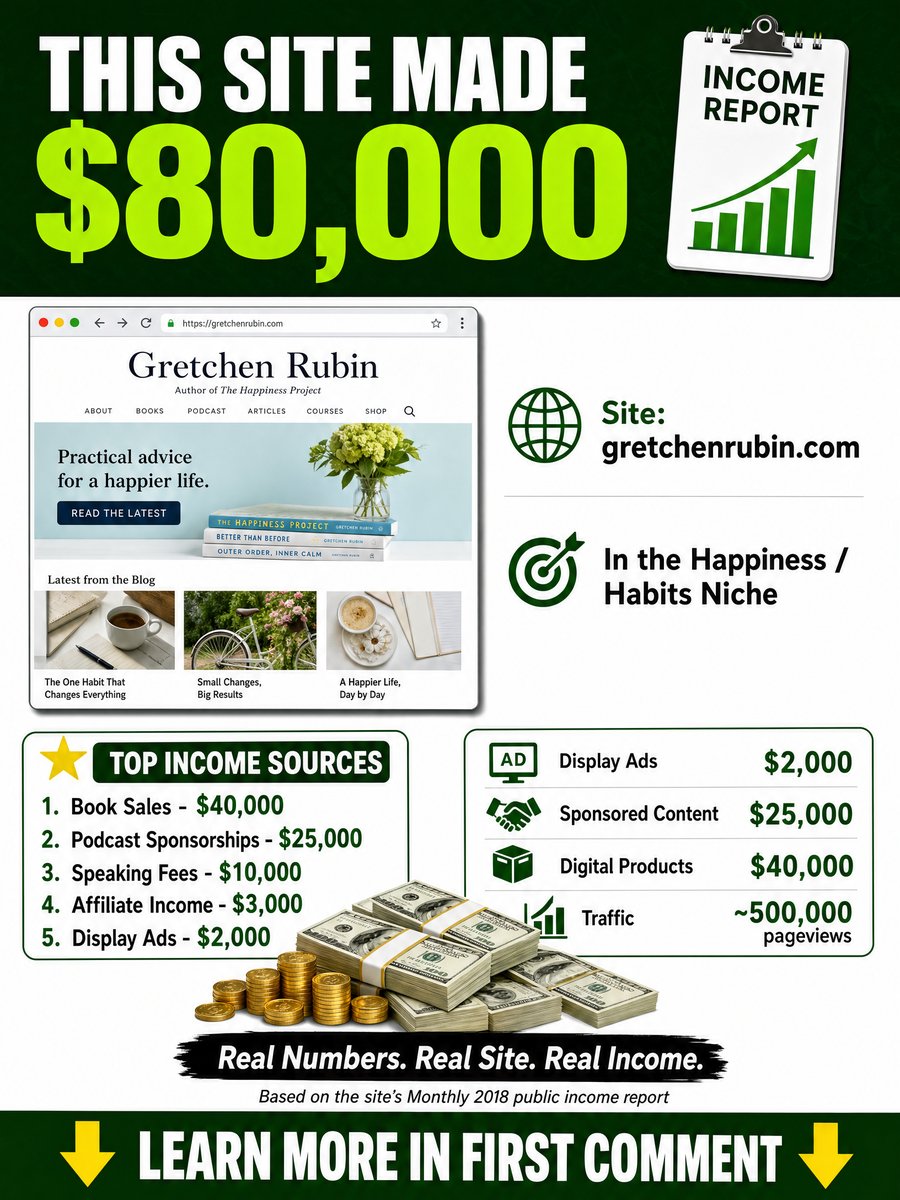
Happiness and habit-building are evergreen personal-development topics, giving creators opportunities to build loyal audiences through content, products, and media. The supplied report image features Gretchen Rubin and estimates $80,000/month from 500,000 pageviews, with revenue from books ($40,000), podcast sponsorships ($25,000), speaking ($10,000), affiliates ($3,000), and ads ($2,000).
The separate summary panel aligns with these categories, showing $40,000 in digital products, $25,000 in sponsored content, and $2,000 in ads. Based on the image’s 2018 public income report, these figures should be treated as estimates. The key lesson is that personal-development brands can monetize trust and expertise through books, podcasts, speaking, affiliates, and products rather than relying mainly on advertising.
Site Snapshot
Site Snapshot
| Metric | Details |
| Website | Gretchen Rubin |
| Domain Shown | gretchenrubin.com |
| Primary Niche | Happiness and Habits |
| Related Topics | Habits, Happiness, Personal Growth, Daily Routines, Behavior Change |
| Estimated Monthly Revenue Shown | $80,000 |
| Estimated Monthly Traffic Shown | ~500,000 Pageviews |
| Largest Income Source Shown | Book Sales |
| Primary Monetization | Books, Podcast Sponsorships, Speaking, Affiliates, Display Ads |
| Digital Products Summary | $40,000 |
| Report Basis Shown | Monthly 2018 Public Income Report |
Why the Happiness and Habits Niche Can Be Profitable
The Happiness and Habits niche works because it focuses on recurring challenges like productivity, routines, organization, and personal growth. Readers often return as new goals and habits emerge.
Its broad appeal also makes it valuable. Students, professionals, parents, entrepreneurs, and retirees can apply habit-building ideas to work, relationships, health, finances, creativity, and daily life.
Useful content areas include:
- Building better habits
- Breaking unwanted habits
- Morning and evening routines
- Goal setting
- Personal organization
- Productivity
- Happiness practices
- Decision-making
- Motivation
- Reading habits
- Relationships
- Time management
- Self-reflection
- Everyday behavior change
That breadth allows a publisher to generate evergreen search traffic while also building a recognizable philosophy that can support books, podcasts, courses, journals, and speaking opportunities.
Estimated Monthly Revenue Breakdown
The supplied image’s Top Income Sources section gives the clearest breakdown of the featured $80,000 total. The five categories add exactly to the headline figure, so they provide a straightforward picture of how the business model is presented.
| Revenue Source | Amount Shown |
| Book Sales | $40,000 |
| Podcast Sponsorships | $25,000 |
| Speaking Fees | $10,000 |
| Affiliate Income | $3,000 |
| Display Ads | $2,000 |
| Estimated Total | $80,000 |
The image also summarizes selected categories separately:
| Highlighted Metric | Amount Shown |
| Display Ads | $2,000 |
| Sponsored Content | $25,000 |
| Digital Products | $40,000 |
| Traffic | ~500,000 Pageviews |
The two panels are reasonably consistent. Book sales account for the same $40,000 shown as digital products, while podcast sponsorships correspond to the $25,000 sponsored-content category. The remaining $13,000 comes from speaking fees, affiliate income, and advertising.
The biggest takeaway is clear: this model earns very little from display advertising compared with the income generated from books, audio sponsorships, and expertise.
How a Happiness and Habits Website Makes Money
The image shows how a creator-led personal-development site can earn more from expertise and audience trust than from advertising alone.
- Book Sales ($40,000): The largest revenue source. Books work well in this niche because readers often want complete frameworks for habits, motivation, routines, and personal growth.
- Podcast Sponsorships ($25,000): Long-form audio builds stronger audience relationships, allowing creators to earn from sponsors while providing valuable content.
- Speaking Fees ($10,000): A recognized personal-development brand can generate income through conferences, workshops, and professional events.
- Affiliate Income ($3,000): Relevant recommendations such as books, productivity tools, journals, and resources can add another revenue stream.
- Display Ads ($2,000): The smallest source, showing that creator-led brands can rely more on trust, products, and intellectual property than ad impressions.
Why Books Are the Core Revenue Driver
The $40,000 book-sales figure highlights how free content can become valuable intellectual property. Articles introduce ideas, while books provide deeper frameworks, examples, and structured guidance.
- Books strengthen the brand: They can attract new readers, grow podcast audiences, create speaking opportunities, and increase authority.
- Original frameworks create more opportunities: A unique idea can expand into articles, books, podcasts, workshops, journals, or courses.
Creator-led websites succeed when they build recognizable concepts rather than only publishing general self-improvement advice.
Podcast Sponsorships Build Revenue Around a Loyal Audience
The report shows $25,000 from podcast sponsorships, making audio a major revenue source. Podcast value comes from listener trust and attention, not just traffic.
- Strong content fit: Happiness and habit topics work well in audio through routines, personal stories, listener questions, relationships, and behavior discussions.
- Extends audience relationships: Podcasts can support books, newsletters, events, and future products by keeping listeners engaged over time.
- Sponsor alignment matters: Successful sponsorships should match the audience’s interests and protect the trust that makes the podcast valuable.
Affiliate Marketing Opportunities
The report lists $3,000 in affiliate income, showing that recommendations can complement a personal-development brand when they are relevant.
- Natural product fit: Potential recommendations include books, audiobooks, journals, productivity tools, planners, and educational resources.
- Helpful over promotional: The best affiliate content solves a reader’s problem instead of adding unnecessary product links.
- Examples: Reading habit articles can recommend books or audiobooks, while habit-tracking content can suggest journals or planning tools.
- Trust comes first: In personal development, long-term audience relationships matter more than maximizing short-term commissions.
Popular Affiliate Programs
The supplied image confirms affiliate revenue but does not identify which affiliate programs generated the $3,000 shown. The programs below are therefore relevant opportunities for a Happiness and Habits publisher to consider, not confirmed Gretchen Rubin partnerships.
Affiliate Program Breakdown
| Affiliate Program | Relevant Category | Website |
| Amazon Associates | Books, Journals and General Products | https://affiliate-program.amazon.com |
| Bookshop.org | Books | https://bookshop.org |
| Audible Affiliates | Audiobooks | https://www.audible.com |
| Impact Marketplace | Lifestyle and Digital Brand Partnerships | https://impact.com |
Relevant affiliate opportunities may include Amazon Associates for product referrals, Bookshop.org for book commissions, Audible for audiobook referrals, and Impact for discovering brand partnerships. Since commissions and requirements can change, publishers should verify current program terms before creating promotional content.
Content Strategy That Can Drive 500,000 Pageviews
The image shows around 500,000 pageviews, suggesting the need for a large library of evergreen content. Happiness and habit topics work well because readers continually search for advice on routines, motivation, and personal growth.
A strong strategy combines searchable guides with unique creator-led ideas, such as original frameworks, observations, and personal experiments.
Useful content categories include:
- Habit formation
- Happiness
- Daily routines
- Personal organization
- Motivation
- Goal setting
- Productivity
- Relationships
- Reading
- Personal experiments
- Reflection exercises
- Simple behavior changes
This mix gives the site two valuable traffic sources. Search-friendly articles introduce new readers, while distinctive ideas create loyal followers who begin seeking the creator by name rather than relying on Google to rediscover the website.
Keyword Opportunities
A Happiness and Habits Website can target a broad collection of evergreen informational searches. Many people begin with a specific problem rather than searching for a particular author, which gives a new publication plenty of opportunities to reach readers before it becomes a recognized brand.
Potential high-interest topics include:
- how to build better habits
- how to break a bad habit
- morning routine ideas
- habit tracker ideas
- how to be more consistent
- how to stop procrastinating
- how to create a routine
- daily habits for happiness
- how to read more books
- productivity habits
- goal setting habits
- how to stay motivated
Commercial searches can be narrower and should stay relevant to the editorial mission. Examples might include best habit journals, best books about habits, best productivity books, best planners, or audiobook services for personal-development readers.
The goal is not to publish a commercial article for every possible product. A better strategy is to build authority around useful informational content first and introduce commercial recommendations where readers genuinely need additional resources.
SEO Strategy
SEO can work especially well in this niche because many questions are timeless. An article explaining how to create a consistent habit can remain relevant for years when it is well written and periodically refreshed. The same applies to routines, organization, motivation, and many general personal-development topics.
A strong SEO strategy should emphasize topical depth rather than publishing isolated articles. A habit cluster might cover starting habits, tracking habits, recovering after missing a day, environmental cues, motivation, routines, and common mistakes. These pieces can link naturally to one another and provide a more complete learning experience.
Useful SEO practices include:
- Building deep topic clusters
- Publishing practical evergreen guides
- Using clear examples
- Creating original frameworks
- Updating older articles
- Strengthening internal links
- Writing titles that accurately match search intent
- Publishing distinctive ideas worth citing
- Building recognizable author authority
The biggest competitive advantage is originality. Generic lists such as “10 habits of happy people” are easy to reproduce. A memorable framework or genuinely useful way of thinking about behavior is much harder to replace.
Why This Business Model Works
The Happiness and Habits Website model shown in the image works because it turns one area of expertise into several complementary formats. Articles attract readers, books package the ideas into structured intellectual property, podcasts maintain an ongoing relationship, and speaking monetizes the creator’s authority directly.
Several strengths make the model particularly attractive:
- Evergreen demand: People continually seek better habits and happier routines.
- Broad audience: Personal improvement applies across many demographics.
- Strong book potential: The subject translates naturally into long-form education.
- Podcast compatibility: Personal-development ideas work well in conversation.
- Speaking opportunities: Recognizable frameworks can support premium engagements.
- Low dependence on ads: Only $2,000 of the image’s $80,000 comes from display advertising.
- Direct audience relationships: Email, books, and podcasts strengthen loyalty.
- Multiple monetization channels: Revenue does not depend on a single platform.
The central lesson is that the value comes from trust and recognizable expertise, not simply traffic. Approximately 500,000 pageviews may introduce a significant audience, but the image suggests that the real economic engine is converting that attention into deeper relationships around books, audio, and ideas.
Lessons for Content Creators
A creator entering this niche should avoid trying to become another generic self-improvement blog. Personal-development content is crowded, and repeating familiar advice without a distinctive perspective makes it difficult to build lasting authority.
A stronger approach is to choose a clear subject, develop original frameworks, and repeatedly apply those ideas to practical problems. Over time, readers should be able to describe what makes the publication different rather than simply saying it publishes motivational articles.
Useful lessons from the model include:
- Develop original ideas: Distinctive frameworks create stronger brands.
- Use free content to build trust: Articles should provide genuine value before asking readers to buy anything.
- Create owned intellectual property: Books can become both revenue sources and authority builders.
- Build a podcast audience: Audio creates deeper and more frequent contact with followers.
- Grow an email list: Direct audience access supports every other monetization channel.
- Use affiliates selectively: Relevant recommendations strengthen trust; excessive promotion weakens it.
- Think beyond advertising: Expertise can produce far more value than ad impressions alone.
- Keep content practical: Readers return when ideas help them change real behavior.
The strongest creator-led businesses do not ask only how to monetize traffic. They ask how to become genuinely useful enough that readers want to continue following the work across several formats.
Conclusion
The Gretchen Rubin Happiness and Habits Website example shows how a personal-development brand can build a diversified business beyond ads. The supplied image estimates $80,000/month from 500,000 pageviews, with revenue from books ($40,000), podcasts ($25,000), speaking ($10,000), affiliates ($3,000), and ads ($2,000). Based on a 2018 public income report, these figures should be treated as estimates. The key lesson is that evergreen content can build trust and support books, podcasts, speaking, affiliates, and other products rather than relying mainly on advertising.
Key Takeaway: The report shows that a Happiness and Habits Website can create more value through expertise and trust than pageviews alone. Books and podcast sponsorships generate $65,000 of the $80,000 total shown, while ads contribute only $2,000. The strongest strategy is turning evergreen ideas into books, podcasts, speaking, email, affiliates, and other products.
Climbing Magazine Rock Climbing and Mountaineering Website Makes $80,000 Per Month

Rock climbing and mountaineering combine adventure, skill, travel, and expensive gear, creating strong opportunities for a Rock Climbing and Mountaineering Website. Readers seek equipment reviews, training, destinations, safety advice, and climbing stories, creating both traffic and buying intent.
The supplied image features Climbing Magazine, estimating $80,000/month from 1 million pageviews. Revenue includes $40,000 from ads, $25,000 from sponsorships, $12,000 from affiliates, $2,500 from subscriptions, and $500 from other sources. A separate $3,000 digital products figure appears to combine subscriptions and other revenue.
Based on the image’s 2018 public income report, these figures should be treated as estimates. The key lesson is that a climbing publication can build a strong business through advertising, sponsorships, affiliates, subscriptions, and valuable outdoor content.
Site Snapshot
Site Snapshot
| Metric | Details |
| Website | Climbing Magazine |
| Domain Shown | climbing.com |
| Primary Niche | Rock Climbing and Mountaineering |
| Related Niches | Gear, Training, Rock Climbing, Ice Climbing, Alpine Climbing, Adventure Travel |
| Estimated Monthly Revenue Shown | $80,000 |
| Estimated Monthly Traffic Shown | ~1,000,000 Pageviews |
| Largest Income Source Shown | Display Advertising |
| Primary Monetization | Display Ads, Sponsored Content, Affiliate Income, Digital Subscriptions |
| Report Basis Shown | Monthly 2018 Public Income Report |
Why the Rock Climbing and Mountaineering Niche Is Profitable
Rock climbing and mountaineering create a strong publishing opportunity because the audience is highly engaged and regularly researches skills, destinations, and equipment.
- Dedicated audience: Climbers often spend years improving technique, training, exploring destinations, and upgrading gear, creating long-term reader relationships.
- High-value equipment market: Products include shoes, harnesses, helmets, ropes, chalk bags, belay devices, backpacks, clothing, and advanced technical gear.
- Mountaineering expands opportunities: Alpine activities create demand for specialized equipment like crampons, ice axes, insulated clothing, tents, navigation tools, and emergency gear.
- Travel and destination content: Climbing areas, gyms, mountain regions, and international destinations provide strong editorial opportunities.
- Content categories: Training, techniques, gear reviews, destination guides, safety, athlete profiles, competitions, photography, videos, and climbing culture.
This variety makes the niche more flexible than a website focused on only one product category.
Estimated Monthly Revenue Breakdown
The detailed Top Income Sources panel in the supplied report provides a complete $80,000 breakdown. The individual figures add exactly to the headline revenue amount, making this panel the clearest source for interpreting the business model shown in the image.
| Revenue Source | Amount Shown |
| Display Ads | $40,000 |
| Sponsored Content | $25,000 |
| Affiliate Income | $12,000 |
| Digital Subscriptions | $2,500 |
| Other | $500 |
| Estimated Total | $80,000 |
The second panel summarizes selected monetization categories differently:
| Highlighted Metric | Amount Shown |
| Display Ads | $40,000 |
| Sponsored Content | $25,000 |
| Digital Products | $3,000 |
| Traffic | ~1,000,000 Pageviews |
The detailed list shows $2,500 in digital subscriptions plus $500 in other income. Those amounts total $3,000, matching the digital-products figure in the summary panel. That suggests the graphic may be rolling these smaller categories together, although the image does not explicitly confirm that interpretation.
How a Climbing Website Makes Money
The income model shown in the image demonstrates how several different types of climbing content can be monetized differently. High-volume editorial stories can produce advertising revenue, gear guides can earn affiliate commissions, recognized outdoor brands can fund sponsorships, and the most loyal readers can support subscription products.
- Display Advertising ($40,000): The largest source of income. High-traffic content like training guides, climbing news, destination stories, athlete profiles, and gear articles can generate significant ad revenue.
- Sponsored Content ($25,000): Outdoor brands may pay to reach a specialized audience that spends money on equipment, travel, and experiences.
- Affiliate Income ($12,000): Gear-focused content creates strong affiliate opportunities because climbers often research shoes, ropes, harnesses, and other equipment before buying.
- Digital Subscriptions ($2,500): Loyal readers may pay for exclusive content, archives, premium training resources, or specialized coverage.
The remaining $500 is listed simply as Other. Because the supplied image provides no explanation for that amount, it should not be assigned to merchandise, events, licensing, or another specific source without additional evidence.
Display Advertising Benefits From Broad Climbing Traffic
Display ads account for half of the $80,000 revenue total shown in the graphic, highlighting the value of broad editorial content beyond product searches.
- Informational content still earns: News, interviews, videos, destination stories, training guides, and adventure features can generate traffic even without immediate sales.
- Content libraries create scale: Topics like technique, training, history, famous routes, and outdoor culture can collectively build significant advertising value.
- Media vs. affiliate model: A strong publication can succeed by creating useful and engaging content, not just product recommendations.
- Brand strength matters: Broad editorial coverage can increase direct traffic and improve sponsorship opportunities.
Sponsored Content Can Become a Major Revenue Source
The report assigns $25,000 to sponsored content, showing the value of brand partnerships in outdoor media.
- Potential sponsors: Climbing gear companies, outdoor apparel brands, travel companies, tourism boards, cameras, fitness products, nutrition brands, and outdoor technology companies.
- Sponsorship formats: Branded gear guides, destination features, newsletters, videos, podcasts, athlete interviews, and training content.
- Examples: A tourism board could sponsor a climbing destination guide, while a gear brand could support equipment or skills content.
- Maintain trust: Sponsored content should be clearly disclosed, and commercial partnerships should not influence independent reviews.
Credibility is a publication’s most valuable asset, so protecting reader trust is essential for long-term sponsorship success.
Affiliate Marketing Works Naturally With Climbing Gear
Affiliate marketing contributes $12,000 according to the supplied image. The niche is well suited to affiliate commerce because climbers often conduct extensive research before investing in equipment.
A beginner might initially need shoes and a harness. As that reader progresses into outdoor sport climbing, they may purchase ropes, quickdraws, helmets, belay devices, and packs. A later transition into trad climbing creates another wave of purchases. Ice and alpine climbing create additional equipment categories again.
Potential affiliate content can cover:
- Climbing shoes
- Harnesses
- Climbing ropes
- Helmets
- Belay devices
- Carabiners
- Quickdraws
- Chalk and chalk bags
- Climbing backpacks
- Approach shoes
- Training boards
- Finger-training equipment
- Outdoor clothing
- Ice axes
- Crampons
- Alpine equipment
The most valuable commercial content usually solves a specific buying problem. “Best Climbing Shoes” is broad, whereas “Best Climbing Shoes for Beginners” or “Best Climbing Shoes for Wide Feet” addresses a more precise need.
The same principle applies throughout the gear ecosystem. A specialist website can create dozens of useful product guides without turning the entire publication into one repetitive list of affiliate links.
Popular Affiliate Programs
The supplied income report confirms $12,000 in affiliate revenue, but it does not name the specific programs Climbing Magazine used. The examples below should therefore be treated as affiliate programs, retailers, and networks that a climbing publisher could investigate rather than confirmed partnerships from the image.
Affiliate Program Breakdown
| Affiliate Program or Network | Relevant Category | Website |
| Amazon Associates | General Climbing and Outdoor Gear | https://affiliate-program.amazon.com |
| REI Co-op | Climbing and Outdoor Equipment | https://www.rei.com |
| Backcountry | Climbing, Alpine and Outdoor Gear | https://www.backcountry.com |
| evo | Outdoor Gear and Apparel | https://www.evo.com |
| AvantLink | Outdoor Affiliate Network | https://www.avantlink.com |
| Impact | Brand Partnership Network | https://impact.com |
| CJ Affiliate | Retail Affiliate Network | https://www.cj.com |
| Awin | Affiliate Network | https://www.awin.com |
| ShareASale | Retail and Outdoor Affiliate Network | https://www.shareasale.com |
Affiliate programs and terms can change, so publishers should verify current requirements before promoting products. In climbing content, safety and suitability matter more than commission size. Gear recommendations should prioritize fit, standards, intended use, and reader skill level over payouts.
Gear Reviews Need Firsthand Expertise
Climbing gear is highly technical, so valuable reviews need more than copied specifications. Readers want to know how equipment performs in real climbing situations.
- Shoes: Cover fit, stiffness, sensitivity, edging, comfort, durability, closure systems, and ideal climbing style.
- Harnesses: Discuss adjustability, gear loops, comfort, weight, and intended use.
- Ropes and alpine gear: Consider diameter, handling, durability, certifications, and specific climbing needs.
- Original testing matters: Field experience, photos, long-term use, comparisons, and clear methods help separate trusted reviews from basic affiliate content.
- Safety comes first: Reviews should provide useful information without suggesting gear replaces proper training, judgment, or safety practices.
Content Strategy That Can Drive One Million Pageviews
The report shows around 1 million pageviews, suggesting a climbing publication needs a broad content strategy beyond buying guides.
- Evergreen content: Tutorials, training guides, and beginner resources can attract search traffic for years.
- Timely content: News, athlete stories, competitions, achievements, and route updates encourage repeat visits.
- Content opportunities: Gear reviews, technique guides, strength training, destination stories, alpine expeditions, videos, and podcasts.
- Different roles for content: Training articles build SEO traffic, gear content earns affiliates, destination stories attract sponsors, and news strengthens brand authority.
A diverse editorial strategy creates a more sustainable business than trying to monetize every page the same way.
Keyword Opportunities
Rock climbing and mountaineering contain thousands of informational and commercial searches. A publisher can use broad beginner keywords to attract new participants while targeting more specific gear, technique, and destination searches for readers deeper into the sport.
Potential high-traffic informational keywords include:
- rock climbing
- climbing for beginners
- how to rock climb
- climbing techniques
- climbing training
- bouldering
- sport climbing
- mountaineering
- alpine climbing
- ice climbing
- climbing endurance
- how to belay
- climbing destinations
- climbing workouts
Commercial-intent opportunities include:
- best climbing shoes
- best beginner climbing shoes
- best climbing harness
- best climbing rope
- best climbing helmet
- best belay device
- best climbing backpack
- best approach shoes
- best climbing pants
- best climbing chalk
- best hangboard
- best ice axe
- best mountaineering boots
The strongest search strategy does not treat each keyword as an isolated opportunity. Related articles should be organized into clusters that help a reader progress through a topic.
For instance, a beginner climbing cluster could connect an introduction to climbing with articles on shoes, harnesses, gyms, basic terminology, training, and outdoor transition. This improves usability while creating logical internal links.
Building Strong Climbing Topic Clusters
A mature climbing publication can organize content into clusters that guide readers from beginners to experienced climbers.
- Beginner Climbing: Covers terminology, gyms, basic movement, gear selection, etiquette, and introductory safety.
- Training: Includes strength, endurance, mobility, recovery, technique drills, injury prevention, and training plans.
- Gear: Covers shoes, harnesses, ropes, helmets, belay devices, clothing, packs, and accessories.
- Mountaineering and Alpine: Focuses on preparation, equipment, navigation, route planning, and expedition content.
- Ice Climbing: Covers specialized gear, techniques, destinations, and training.
- Destinations: Explores climbing regions, routes, travel planning, seasons, and local culture.
These clusters help transform a publication into a complete learning resource rather than just a news site.
Climbing Travel Creates Additional Commercial Opportunities
Travel is a natural extension of the climbing niche because many climbers plan trips around specific destinations. The image’s “Patagonia Uncovered” feature reflects how adventure and travel content can strengthen a climbing publication.
- Destination content opportunities: Cover climbing areas, seasons, access, accommodations, transportation, guides, local culture, and trip preparation.
- Popular topics: Patagonia, Yosemite, Joshua Tree, Squamish, Kalymnos, the Alps, bouldering destinations, and major mountaineering regions.
- Business value: Travel guides can attract sponsors, advertisers, backlinks, and readers beyond gear-focused content.
- Keep information updated: Permits, closures, access rules, and safety conditions can change, so destination content requires regular maintenance.
SEO Strategy for a Climbing Publication
SEO works well for climbing content because beginners, athletes, and gear buyers constantly search for techniques, training, and equipment advice.
- Differentiate with expertise: Generic articles are easy to copy, so strong publications should use original experience, photos, testing, and examples.
- Key SEO practices: Build evergreen guides, topic clusters, internal links, updated gear content, original visuals, clear authorship, and authoritative backlinks.
- Maintain accuracy: Update gear reviews as products change and regularly review educational content for clarity.
- Create valuable resources: Tools like training calculators, gear checklists, grading guides, and trip planners can attract links and repeat visitors.
The best SEO strategy combines search intent with genuine climbing knowledge.
Safety and Editorial Responsibility Matter
Climbing content requires higher editorial standards because incorrect advice about ropes, belaying, anchors, or mountaineering can have serious consequences.
- Do not replace instruction: Articles should support learning, not substitute for qualified training or hands-on practice.
- Use expert review: Safety-related content should involve experienced writers and clearly explain limitations.
- Separate opinions from safety: Gear reviews should distinguish comfort and performance from actual safety requirements.
- Build trust through accuracy: Careful, reliable reporting helps climbing publications earn long-term reader loyalty.
Digital Subscriptions Create Direct Reader Revenue
The image lists $2,500 from digital subscriptions, which is smaller than ads and sponsorships but valuable because it comes directly from readers.
- Premium offerings: Publications can offer exclusive articles, interviews, archives, digital magazines, training content, and member newsletters.
- Differentiation is essential: Since free climbing content is widely available, subscriptions require unique value.
- Long-term benefit: Even a small subscriber base can reduce reliance on advertisers and strengthen reader relationships.
Estimated Traffic Strategy
The report image gives an overall figure of approximately 1,000,000 pageviews, but it does not specify how those visits are divided among Google, direct traffic, social media, email, referrals, or other channels. Any exact percentage breakdown would therefore be speculation rather than information from the supplied image.
A mature Rock Climbing and Mountaineering Website could use several complementary channels:
| Traffic Channel | Main Opportunity |
| Organic Search | Training, technique, gear and beginner guides |
| Direct Traffic | News, features and loyal readers |
| Email Newsletter | Returning audiences and seasonal content |
| YouTube and Video | Technique, gear demonstrations and adventure stories |
| Social Media | Climbing photography, short videos and news |
| Referral Traffic | Outdoor publications, climbing communities and destination resources |
The niche is particularly well suited to video and photography. Climbing movement is easier to understand visually, while mountain landscapes and athletic achievements naturally perform well on social platforms.
The ideal model does not depend entirely on any one channel. Search can provide discovery, visual media can build awareness, and email plus direct traffic can create long-term audience retention.
Why This Business Model Works
The climbing model shown in the image works because different audience behaviors support different revenue streams. A news reader produces advertising impressions, a gear shopper can generate affiliate income, a loyal reader may subscribe, and an outdoor brand may pay for sponsorship access to the entire community.
Several structural advantages make the niche attractive:
- Expensive equipment: Climbers buy specialized gear across multiple disciplines.
- Passionate audience: Participants often remain engaged for years.
- Evergreen education: New climbers continually need beginner and training information.
- Adventure travel: Destinations expand the content and sponsorship opportunity.
- Premium sponsors: Outdoor brands value a focused audience.
- Visual storytelling: Photography and video naturally complement the subject.
- Multiple disciplines: Rock, bouldering, ice, alpine, and mountaineering create content depth.
- Subscription potential: Loyal readers may pay for premium journalism or resources.
- Strong affiliate intent: Gear decisions often involve significant research.
The real strength comes from combining these advantages rather than depending entirely on one source of revenue.
Lessons for Content Creators
A new climbing publisher does not need to compete immediately with a large magazine covering every mountain sport. A narrower starting position can make it easier to develop genuine authority.
A creator might focus on beginner climbing, bouldering, climbing training, equipment testing, climbing destinations, alpine skills, or another defined segment. Once that area has depth and recognition, the site can expand into adjacent topics.
Several lessons from the model are especially useful:
- Build genuine expertise: Climbing readers value firsthand knowledge.
- Treat safety content seriously: Use appropriate expertise and avoid oversimplifying technical instruction.
- Create original gear reviews: Testing and field experience are difficult for generic competitors to replicate.
- Build evergreen education: Training and beginner guides can generate recurring traffic.
- Use commercial content selectively: Affiliate recommendations should solve real reader problems.
- Develop destination coverage: Travel content expands both audience and sponsorship opportunities.
- Invest in visual media: Original photography and video can strengthen the brand significantly.
- Grow an email list: Direct distribution reduces dependence on algorithms.
- Diversify income: Advertising, affiliates, sponsors, and subscriptions create a stronger business together.
- Protect reader trust: A specialist outdoor publication depends on credibility more than aggressive monetization.
The strongest climbing website should remain useful even if every affiliate link were removed. Monetization works best when it sits on top of genuine editorial value rather than replacing it.
Conclusion
The Climbing Magazine Rock Climbing and Mountaineering Website example shows how a specialist outdoor publication can build a diversified digital business through education, gear content, travel, news, and community.
The supplied image estimates $80,000/month from 1 million pageviews, with $40,000 from ads, $25,000 from sponsorships, $12,000 from affiliates, $2,500 from subscriptions, and $500 from other sources. A separate $3,000 digital products figure appears to combine the smaller categories.
The key lesson is that climbing publications can combine media and commerce. Strong content builds trust and traffic, while gear reviews, sponsorships, and subscriptions create additional revenue opportunities. New creators should focus on expertise, useful content, and audience trust before expanding monetization.
Key Takeaway: The report presents a Rock Climbing and Mountaineering Website earning $80,000/month from 1 million pageviews, with revenue from ads, sponsorships, affiliates, subscriptions, and other sources. The niche works because it combines passionate audiences, expensive gear, travel, and evergreen education. The strongest strategy is building trusted expertise and monetizing through ads, affiliates, sponsorships, and premium content while maintaining technical accuracy and safety.