marcus campbell
Copyblogger Content Marketing and Copywriting Website Makes $80,000 Per Month

The Copyblogger Content Marketing and Copywriting Website example shows how an education-focused site can monetize beyond traffic. The supplied image estimates about $80,000/month from 500,000 pageviews, with revenue from online courses ($40,000), SaaS ($25,000), affiliates ($10,000), sponsorships ($4,000), and ads ($1,000). The separate $65,000 digital products figure matches courses plus SaaS, making the breakdown consistent.
Based on the image’s 2017 public income report, these figures should be treated as report estimates rather than current verified earnings. The key lesson is that free educational content can build authority, which can later be monetized through courses, software, affiliates, sponsorships, and other owned products.
Site Snapshot
Site Snapshot
| Metric | Details |
| Website | Copyblogger |
| Domain Shown | copyblogger.com |
| Primary Niche | Content Marketing and Copywriting |
| Related Topics Shown | Writing, Storytelling, Branding, Content Strategy |
| Estimated Monthly Revenue Shown | $80,000 |
| Estimated Monthly Traffic Shown | ~500,000 Pageviews |
| Largest Income Source Shown | Online Courses |
| Primary Monetization | Courses, SaaS Revenue, Affiliate Income, Sponsorships, Display Ads |
| Digital Products Summary | $65,000 |
| Report Basis Shown | Monthly 2017 Public Income Report |
Why the Content Marketing and Copywriting Niche Is So Profitable
The Content Marketing and Copywriting niche is valuable because it connects directly to business growth. Companies need better copy, content, emails, landing pages, SEO articles, and marketing systems to attract customers and increase sales.
The audience includes freelancers, bloggers, entrepreneurs, marketers, agencies, and business owners, creating multiple monetization opportunities. Many readers are also willing to invest in courses, software, tools, books, and memberships, making the niche more valuable than one focused only on display ads.
Popular content areas include:
- Copywriting techniques
- Content marketing strategy
- Blog writing
- Email marketing
- Storytelling
- Brand messaging
- Sales-page copy
- Landing-page optimization
- Headline writing
- Search-friendly content
- Freelance writing
- Audience building
- Content strategy
- Digital product creation
- Online business education
The combination of evergreen educational demand and commercially valuable readers makes this niche particularly suitable for a product-led publishing model.
Estimated Monthly Revenue Breakdown
The detailed Top Income Sources section in the supplied image provides a clear breakdown of the $80,000 headline amount. Unlike some report graphics where different panels categorize the numbers differently, this image is internally consistent. The $40,000 in online-course revenue plus $25,000 in SaaS revenue equals the $65,000 digital-products figure shown separately on the right.
| Revenue Source | Amount Shown |
| Online Courses | $40,000 |
| SaaS Revenue | $25,000 |
| Affiliate Income | $10,000 |
| Sponsorships | $4,000 |
| Display Ads | $1,000 |
| Estimated Total | $80,000 |
The summary panel on the right side of the image shows the following:
| Highlighted Metric | Amount Shown |
| Display Ads | $1,000 |
| Sponsored Content | $4,000 |
| Digital Products | $65,000 |
| Traffic | ~500,000 Pageviews |
The $65,000 digital-products category appears to combine the two largest sources in the detailed list: $40,000 in online courses and $25,000 in SaaS revenue. The remaining $15,000 comes from $10,000 in affiliate income, $4,000 in sponsorships, and $1,000 in display advertising, producing the full $80,000 total shown in the graphic.
How Copyblogger Makes Money
The most striking aspect of this report is how little of the featured revenue comes from ordinary display advertising. Only $1,000 of the $80,000 total is attributed to display ads. Instead, the overwhelming majority comes from owned educational products and software. This makes Copyblogger a strong example of an authority-driven content business rather than a traditional traffic-first advertising website.
- Online courses: The image attributes $40,000 to online courses, making education the largest individual revenue source. This fits the niche naturally because copywriting and content marketing are skills that readers can learn through structured training. Free articles introduce concepts, while paid courses can provide complete frameworks, exercises, systems, and step-by-step instruction.
- SaaS revenue: The report lists $25,000 from SaaS revenue. Software-as-a-Service can create recurring subscription income, which is particularly powerful because revenue does not depend on generating a brand-new sale every month. A content business with a relevant software product can combine media authority with recurring product economics.
- Affiliate income: Affiliate marketing contributes $10,000. A marketing audience regularly purchases email software, website tools, hosting, design platforms, analytics products, SEO tools, writing software, and other business services. This gives the site numerous opportunities to monetize useful product recommendations.
- Sponsorships: The image shows $4,000 in sponsorship revenue. Marketing and SaaS companies may pay to reach an audience of writers, entrepreneurs, marketers, and business owners, particularly when the publication has built credibility and a targeted readership.
- Display advertising: Only $1,000 is attributed to ads. This relatively small figure reinforces the central lesson of the report: in an expertise-driven niche, selling valuable products to a highly relevant audience can produce substantially more revenue than monetizing raw pageviews.
Online Courses Are the Largest Revenue Source
The report’s $40,000 online-course figure shows how educational content can become a valuable product business. Readers often want measurable improvements in writing, marketing, or business results, making structured courses more valuable than free articles. A free post may cover one skill, while a premium course can provide a complete system covering research, messaging, copywriting, editing, sales pages, email campaigns, and client growth. The value comes from offering a clear learning path.
Potential course topics in this niche include:
- Copywriting for beginners
- Content marketing strategy
- Email copywriting
- Sales-page writing
- Blogging for business
- Storytelling for marketers
- Freelance writing
- SEO content writing
- Brand messaging
- Digital product marketing
- Audience building
- Conversion-focused content
Courses can also increase revenue per visitor dramatically. A content website may earn only a small amount from each advertising impression, but even a modest percentage of readers purchasing premium education can produce substantial revenue.
SaaS Revenue Makes the Business More Scalable
The image lists $25,000 in SaaS revenue, making software the second-largest income source.
- Recurring revenue model: Unlike one-time course purchases, software subscriptions can create ongoing revenue from customers.
- Content supports product growth: Articles can attract people with recurring problems, while software provides a long-term solution.
- Potential SaaS categories: Content-marketing tools could include publishing workflows, email marketing, analytics, planning, website management, or membership systems.
- No specific product confirmed: The image does not identify the SaaS product behind the revenue figure, so no specific platform should be assumed.
- Key business lesson: Owning both an audience and a recurring-revenue product allows each reader to become a potential long-term customer.
This also explains why the image groups $65,000 as digital products, showing a business driven mainly by education and products rather than advertising.
Affiliate Marketing Adds Another Revenue Layer
Affiliate income contributes $10,000 in the supplied report, making it the third-largest individual income stream. This niche naturally supports affiliate marketing because writers, marketers, bloggers, and online entrepreneurs use numerous digital products to do their work.
Potential affiliate categories include:
- Email marketing platforms
- Web hosting
- WordPress tools
- SEO software
- Writing tools
- Editing software
- Marketing automation
- Landing-page builders
- Website builders
- Analytics platforms
- Online course platforms
- Design software
- CRM platforms
- Productivity software
Affiliate content works best when recommendations solve a real problem. For example, email guides can mention email tools, website articles can compare hosting, and planning guides can review content software. The strongest reviews explain benefits, limitations, alternatives, and who the product is best for, building trust beyond a single sale.
Popular Affiliate Programs
The supplied report image confirms $10,000 in affiliate income, but it does not identify the individual programs used by Copyblogger. The options below should therefore be treated as relevant affiliate opportunities for a Content Marketing and Copywriting Website to investigate, not as confirmed Copyblogger partnerships.
Affiliate Program Breakdown
| Affiliate Program or Network | Relevant Category | Website |
| ConvertKit | Email Marketing | https://convertkit.com |
| ActiveCampaign | Email Marketing and Automation | https://www.activecampaign.com |
| Kinsta | Managed WordPress Hosting | https://kinsta.com |
| WP Engine | WordPress Hosting | https://wpengine.com |
| Elementor | Website Building | https://elementor.com |
| Semrush | SEO and Marketing Software | https://www.semrush.com |
| Grammarly | Writing and Editing | https://www.grammarly.com |
| PartnerStack | SaaS Partnership Network | https://partnerstack.com |
| Impact | Affiliate and Partnership Network | https://impact.com |
| CJ Affiliate | Affiliate Network | https://www.cj.com |
Affiliate programs change over time, so publishers should verify current commissions, rules, and requirements before promoting products. Recommendations should prioritize usefulness and fit rather than the highest payout, since trust matters more than short-term earnings.
Sponsored Content and Brand Partnerships
The supplied image shows $4,000 in sponsorships, while the summary box labels the same amount as sponsored content. This is smaller than product revenue but still demonstrates how targeted business audiences can attract direct advertiser interest.
Potential sponsors can include SaaS companies, web-hosting providers, marketing platforms, writing software, design tools, analytics products, online education businesses, and other companies serving entrepreneurs or marketers.
Sponsored opportunities might include:
- Sponsored tutorials
- Newsletter placements
- Webinar partnerships
- Podcast sponsorships
- Product demonstrations
- Sponsored reports
- Branded educational content
- Event partnerships
The strongest sponsorships should fit the site’s editorial mission. A product used by writers or marketers can feel relevant within a Copyblogger-style publication, while an unrelated advertiser may weaken the reader experience.
Clear disclosure is essential. Readers should be able to distinguish independent editorial recommendations from paid promotional content without ambiguity.
Why Display Advertising Is Such a Small Part of Revenue
The report shows around 500,000 pageviews but only $1,000 from display ads, highlighting a business model focused on products and audience relationships.
- Content as an acquisition tool: Articles attract readers, build trust, improve search visibility, and introduce people to paid offers.
- Higher-value monetization: Courses, software, and affiliate products can generate more revenue per customer than advertising impressions.
- Better user experience: Less dependence on ads allows a cleaner website focused on subscriptions, education, and returning visitors.
Key lesson: A valuable audience can be worth far more than raw traffic when monetized through trusted products and services.
Content Strategy That Can Drive 500,000 Pageviews
The image emphasizes content marketing mastery through topics like storytelling, brand building, and content strategy. A strong website should combine beginner-friendly education with advanced guides and software-related content to attract readers, build trust, and convert visitors into customers.
High-potential content categories include:
- Copywriting fundamentals
- Headline writing
- Content strategy
- Blogging
- Storytelling
- Email marketing
- Persuasive writing
- Sales copy
- Landing pages
- Brand messaging
- Audience research
- Content promotion
- SEO writing
- Freelance writing
- Content monetization
- Online business
The strongest content should teach something meaningful even if the reader never buys a product. Free education builds the trust that makes premium education more valuable later.
Keyword Opportunities
A Content Marketing and Copywriting Website can target a large number of evergreen educational searches as well as commercially valuable queries involving software, education, and professional services. The niche is especially attractive because many readers are actively trying to solve business problems rather than simply satisfy curiosity.
Potential high-traffic informational keywords include:
- copywriting
- content marketing
- how to write better
- copywriting for beginners
- content strategy
- storytelling in marketing
- how to write headlines
- blog writing
- persuasive writing
- email copywriting
- brand storytelling
- content marketing strategy
- freelance writing
- how to start a blog
Commercial keywords can include:
- best copywriting course
- best content marketing course
- best email marketing software
- best writing software
- best SEO tools for writers
- best website hosting
- best landing page builder
- best online course platform
- best editing software
- best marketing automation tool
Commercial content should explain decision criteria rather than simply ranking products. Readers need to understand differences in pricing, complexity, audience, limitations, integrations, and intended use.
That level of analysis is particularly important when recommending business software because switching costs can be significant once a company has committed to a platform.
Building Content Marketing Topic Clusters
A strong topic-cluster strategy helps a content marketing website build authority by guiding readers from beginner concepts to advanced skills.
- Copywriting Cluster: Covers persuasive writing, headlines, calls to action, sales pages, landing pages, editing, audience research, and copy examples.
- Content Marketing Cluster: Includes strategy, planning, blogging, distribution, promotion, analytics, content repurposing, and audience growth.
- Storytelling Cluster: Focuses on brand stories, customer stories, case studies, narrative structure, and marketing storytelling techniques.
- Email Marketing Cluster: Covers subject lines, newsletters, welcome sequences, sales emails, segmentation, list building, and automation.
- Professional Writing Cluster: Addresses freelancing, finding clients, pricing, portfolios, productivity, contracts, and career growth.
These connected clusters help serve different audiences while naturally supporting courses, software, and other products.
SEO Strategy
Content marketing websites prove their expertise through their own content strategy. Evergreen articles on SEO, headlines, copywriting, storytelling, and audience growth can attract consistent search traffic because these topics remain relevant over time.
Important SEO practices include:
- Publishing comprehensive educational guides
- Building deep topical clusters
- Updating software reviews and comparisons regularly
- Creating original examples
- Publishing frameworks worth referencing
- Strengthening internal linking
- Developing distinctive editorial viewpoints
- Earning links through genuinely useful resources
- Maintaining strong author identity
- Refreshing evergreen articles when practices change
Original intellectual property is particularly important. A memorable framework, methodology, research study, or teaching model is far harder to replicate than another generic article about “10 copywriting tips.”
This type of proprietary thinking can generate backlinks, branded searches, course demand, and long-term authority simultaneously.
Email Marketing Is Central to the Business Model
An education-driven content business becomes much stronger when it can move readers from search engines into an owned audience. Email provides that connection.
A person searching for a headline-writing tutorial may visit once and disappear. If that reader joins an email list, the publication can continue delivering education, introduce additional articles, recommend tools, and eventually present relevant courses or products.
Potential lead magnets include:
- Copywriting checklist
- Headline formula guide
- Content strategy template
- Editorial calendar
- Email sequence template
- Brand messaging worksheet
- Storytelling framework
- Content audit checklist
An email subscriber can become more valuable over time because their relationship with the brand is not tied to a single search query.
Email also supports course launches, SaaS adoption, affiliate promotions, sponsorships, webinars, and product announcements. For a business where $65,000 of the $80,000 shown is attributed to digital products, direct audience ownership is likely much more strategically important than maximizing advertising impressions.
Digital Products Are the Core of the Business
The image’s $65,000 digital-products figure is perhaps the clearest summary of the entire business model. More than four-fifths of the $80,000 total comes from online courses and SaaS revenue.
This illustrates the difference between building a website and building a digital business. A website can earn from traffic, but a digital business uses content to attract a market and then creates its own products for that market.
Potential digital products in this niche include:
- Copywriting courses
- Content marketing courses
- Writing workshops
- Membership communities
- Editorial templates
- Content-planning systems
- Prompt libraries
- Premium newsletters
- Marketing software
- Publishing tools
- Content workflow platforms
Owned products create greater control over pricing and customer experience than third-party advertising. They can also increase margins and create recurring relationships when the product uses a subscription model.
The challenge is that products must genuinely solve problems. A large audience does not automatically guarantee product success. The strongest products emerge from recurring reader needs that the publisher understands deeply through years of content interaction.
Why SaaS Can Create Long-Term Revenue
Software revenue is powerful because subscriptions can create ongoing income instead of one-time sales.
- Recurring revenue: SaaS products continue generating income as long as customers keep using them.
- Solve ongoing problems: The best software targets repeated needs like publishing, planning, email, analytics, memberships, or website management.
- Built-in audience advantage: A content site already attracts people facing these problems, making customer acquisition easier.
- Better monetization question: Instead of asking how to monetize readers, ask what recurring problem the audience needs solved.
- Content + SaaS creates leverage: Useful content can attract users while software provides a long-term solution.
Estimated Traffic Strategy
The supplied report image gives an overall figure of approximately 500,000 pageviews but does not identify how those pageviews are distributed among Google, direct traffic, email, social media, or referrals. Any exact percentages would therefore be estimates rather than facts from the image.
A mature Content Marketing and Copywriting Website could reasonably rely on a combination of channels:
| Traffic Channel | Main Opportunity |
| Organic Search | Evergreen copywriting and marketing education |
| Email Newsletter | Repeat readers and product launches |
| Direct Traffic | Brand recognition and returning audiences |
| Referral Traffic | Mentions from marketing and business publications |
| Social Media | Short-form writing and marketing education |
| Podcasts and Video | Deeper educational content and authority building |
Search can introduce new readers, but email and direct traffic are especially important when owned products generate most revenue. A publisher selling courses or software benefits greatly from visitors returning repeatedly, because purchasing decisions may take far longer than a single browsing session.
Why Brand Authority Matters More Than Raw Traffic
The report’s revenue distribution shows that 500,000 pageviews alone do not explain the $80,000 income figure. The real driver is what the audience thinks of the brand and whether readers trust its expertise enough to purchase premium education or software.
A generic site receiving 500,000 pageviews from low-intent informational content might earn dramatically less. Copyblogger’s model, as represented in the image, derives most value from converting a relevant audience into product customers.
Brand authority can be strengthened through:
- Distinctive teaching frameworks
- High editorial standards
- Consistent publishing
- Recognizable writers
- Original research
- Case studies
- Books
- Podcasts
- Email education
- Professional communities
Over time, readers may begin visiting the publication directly rather than discovering every article through Google. That branded demand is much more resilient than traffic based entirely on individual keyword rankings.
Why This Business Model Works
The Content Marketing and Copywriting Website model shown in the report works because free content and paid products complement one another. Articles demonstrate expertise and attract audiences. Courses package that expertise into structured education. SaaS creates recurring revenue. Affiliate recommendations monetize relevant third-party tools. Sponsorships monetize access to the audience, while display advertising provides a small additional layer.
Several advantages make the model particularly strong:
- High-value audience: Readers are often professionals or business owners.
- Evergreen demand: Businesses continually need better content and messaging.
- Premium education: Skills-based courses can command substantial prices.
- Recurring SaaS revenue: Software creates ongoing customer relationships.
- Strong affiliate opportunities: Marketers use numerous paid tools.
- Low dependence on ads: The business is not vulnerable solely to ad-rate changes.
- Owned audience potential: Email supports long-term monetization.
- Scalable intellectual property: One course can serve many customers.
- Broad topic expansion: Copywriting naturally connects to SEO, email, branding, and entrepreneurship.
The central advantage is that useful free education increases the value of the paid products rather than competing with them.
Lessons for Content Creators
A creator entering the Content Marketing and Copywriting niche should focus on expertise and valuable products, not just pageviews. A smaller, targeted audience can be more profitable than large traffic supported only by ads.
Strong differentiation comes from original frameworks, examples, case studies, research, and practical systems rather than generic content.
Important lessons include:
- Teach before selling: High-quality free content establishes credibility.
- Build an email audience: Direct distribution is essential for product-led businesses.
- Create owned products: Courses and software can dramatically increase revenue per reader.
- Solve recurring problems: Recurring problems are especially suitable for SaaS.
- Use affiliates strategically: Recommend tools that genuinely fit the audience.
- Build topic clusters: Deep coverage creates stronger authority than random articles.
- Publish original frameworks: Distinctive intellectual property is difficult to copy.
- Reduce dependence on ads: Higher-value monetization can create a better reader experience.
- Maintain transparency: Affiliate and sponsored relationships should be disclosed clearly.
- Think beyond pageviews: Audience trust and customer value matter more than raw traffic alone.
A content business becomes much stronger when every article contributes to a larger ecosystem instead of existing only to earn an ad impression.
Conclusion
The Copyblogger Content Marketing and Copywriting Website example shows how educational content can grow into a high-value digital business. The supplied image estimates $80,000/month from 500,000 pageviews, with revenue from courses ($40,000), SaaS ($25,000), affiliates ($10,000), sponsorships ($4,000), and ads ($1,000). The model highlights that products and expertise can generate more value than advertising alone. A focused audience, strong content, software, affiliates, and premium offerings can create a profitable business without requiring massive traffic.
Key Takeaway: The Copyblogger report shows that the biggest opportunity in the Content Marketing and Copywriting niche comes from products, not ads. Of the $80,000 total, $65,000 comes from courses and SaaS, with affiliates adding another $10,000. The strongest strategy is to use evergreen content to build trust and monetize expertise through courses, software, affiliates, sponsorships, and digital products.
Wellness Mama Natural Health and Holistic Parenting Website Makes $80,000 Per Month
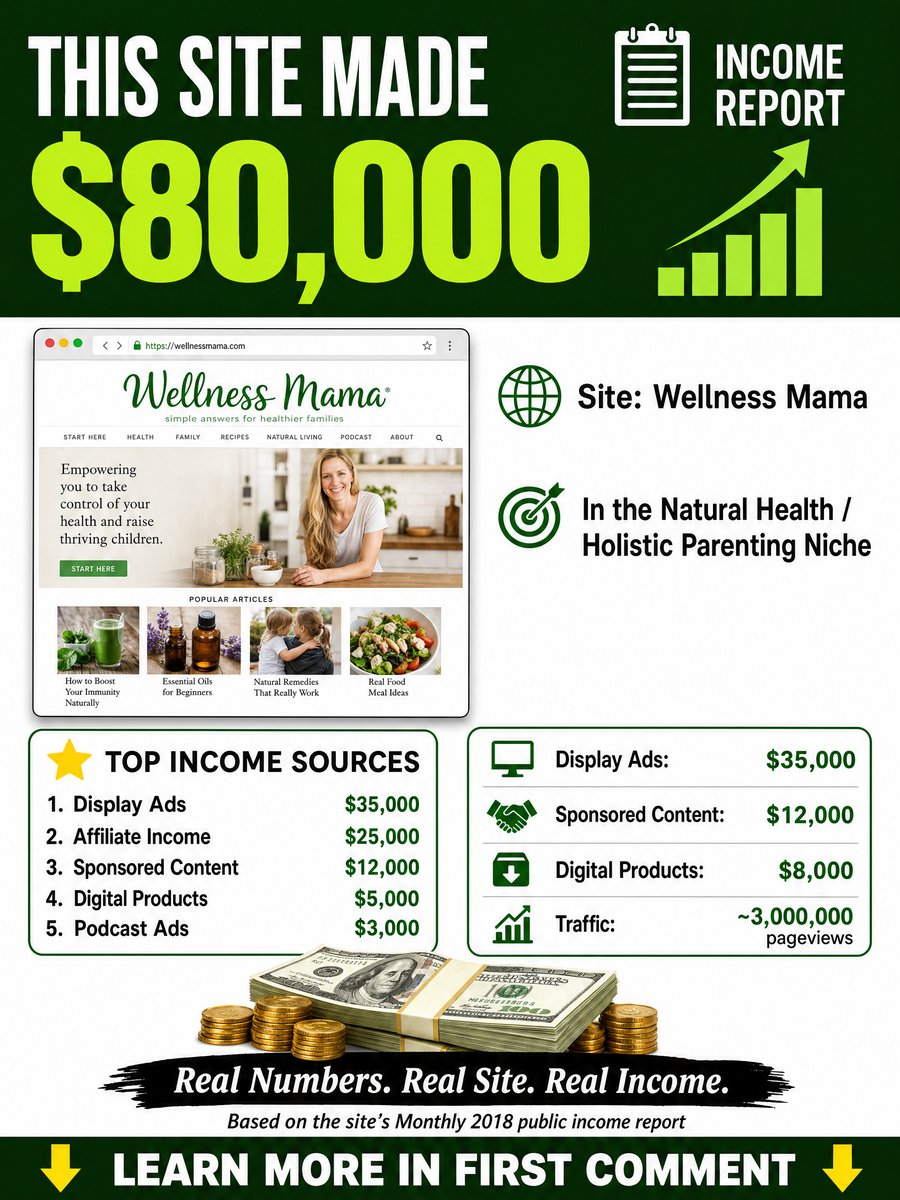
Health, nutrition, parenting, and natural living are evergreen topics with strong search demand. A Natural Health and Holistic Parenting Website can combine these interests and monetize through ads, affiliates, sponsorships, digital products, and audio content.
The supplied report image features Wellness Mama, estimating about $80,000/month from 3 million pageviews. The detailed breakdown shows $35,000 from ads, $25,000 from affiliates, $12,000 from sponsorships, $5,000 from digital products, and $3,000 from podcast ads. A separate summary panel shows broader categories, but the detailed list provides the clearest breakdown.
This report explores the niche’s monetization model, content strategy, SEO opportunities, affiliate potential, podcast growth, and the importance of responsible health publishing.
Site Snapshot
Site Snapshot
| Metric | Details |
| Website | Wellness Mama |
| Domain Shown | wellnessmama.com |
| Primary Niche | Natural Health and Holistic Parenting |
| Related Topics Shown | Health, Family, Recipes, Natural Living, Podcast |
| Estimated Monthly Revenue Shown | $80,000 |
| Estimated Traffic Shown | ~3,000,000 Pageviews |
| Largest Income Source Shown | Display Advertising |
| Primary Monetization | Display Ads, Affiliate Income, Sponsored Content, Digital Products, Podcast Ads |
| Report Basis Shown | Monthly 2018 Public Income Report |
Why the Natural Health and Holistic Parenting Niche Is So Profitable
The Natural Health and Holistic Parenting niche is valuable because it connects with major consumer categories like food, household products, wellness, education, and family needs. A trusted publication can influence many purchasing decisions.
The audience also has strong long-term potential. Readers may return for recipes, parenting advice, natural living, and wellness content, creating opportunities for newsletters, podcasts, affiliates, and digital products.
Popular content areas in this niche can include:
- Healthy family recipes
- Meal planning
- Ingredient guides
- Family wellness routines
- Natural living
- Household product comparisons
- Parenting resources
- Family organization
- Food preparation
- Personal care
- Sleep routines
- Fitness and movement
- Podcast interviews
- Evidence-based wellness education
The image itself illustrates this breadth through visible article topics involving immunity, essential oils, natural remedies, and real-food meal ideas. Those themes show the kind of content the publication uses, but health-related claims should always be evaluated carefully rather than repeated simply because they appear in a lifestyle article.
Estimated Monthly Revenue Breakdown
The image’s detailed Top Income Sources panel provides the clearest explanation of the $80,000 headline figure. The five listed sources add exactly to $80,000, so they should be treated as the primary revenue breakdown when analyzing the graphic.
| Revenue Source | Amount Shown |
| Display Ads | $35,000 |
| Affiliate Income | $25,000 |
| Sponsored Content | $12,000 |
| Digital Products | $5,000 |
| Podcast Ads | $3,000 |
| Estimated Total | $80,000 |
The right-side summary panel presents the business somewhat differently:
| Highlighted Metric | Amount Shown |
| Display Ads | $35,000 |
| Sponsored Content | $12,000 |
| Digital Products | $8,000 |
| Traffic | ~3,000,000 Pageviews |
The image does not explicitly explain why digital products are $5,000 in the detailed list but $8,000 in the summary. Because $5,000 in digital products plus $3,000 in podcast ads equals $8,000, the summary may be grouping those categories together. That is an interpretation, however, not something the source states directly, so it is more accurate to keep both panels visible rather than silently rewriting the numbers.
How Wellness Mama Makes Money
The business model shown in the image combines traffic-based revenue with higher-value audience monetization:
- Display Advertising ($35,000): The largest revenue source. With around 3 million pageviews, informational content can generate significant ad revenue even from readers who are not ready to buy.
- Affiliate Income ($25,000): Wellness and parenting content naturally connects with products like kitchen tools, books, household items, personal care products, and educational resources. The best recommendations solve real reader problems.
- Sponsored Content ($12,000): Brands targeting parents, families, and wellness audiences may pay to reach a trusted community through sponsored articles or campaigns.
- Digital Products ($5,000): A wellness site can create owned products such as meal plans, recipe collections, printable guides, family resources, and educational materials.
- Podcast Ads ($3,000): Audio content builds deeper audience relationships and creates another monetization channel beyond website traffic.
Display Advertising Benefits From Broad Evergreen Content
The $35,000 display-ad figure shows how broad informational content can generate revenue even when readers are not ready to buy.
- Evergreen traffic adds up: Articles about recipes, parenting, family routines, and natural living can attract consistent search traffic over time.
- Trust drives long-term value: A good user experience encourages visitors to return, subscribe, listen to podcasts, and purchase recommended products.
- Content supports multiple revenue streams: High-volume informational articles can become the foundation for ads, affiliates, sponsorships, and owned products.
Affiliate Marketing Opportunities
The image shows $25,000 in affiliate income, making product recommendations a major revenue source.
- Strong buying intent: Family and wellness readers often research products related to food, household needs, children, and personal care before purchasing.
- Potential categories: A site could cover kitchen tools, cookware, storage, books, educational products, fitness items, and wellness-related products.
- Trust matters: Wellness recommendations require careful research, as commissions should never outweigh evidence or safety.
- Focus on solving problems: Useful content like meal-prep guides, product comparisons, and transparent reviews can help readers make better decisions while generating affiliate revenue.
- Disclose partnerships: Clear affiliate disclosures maintain trust and keep recommendations reader-focused.
Popular Affiliate Programs
The supplied image confirms $25,000 in affiliate income, but it does not identify the specific programs responsible for that revenue. The following examples therefore represent relevant affiliate opportunities that a Natural Health and Holistic Parenting publisher could investigate, not programs confirmed by the image as being used by Wellness Mama.
Affiliate Program Breakdown
| Affiliate Program or Network | Relevant Category | Website |
| Amazon Associates | Books, Kitchen and Household Products | https://affiliate-program.amazon.com |
| Thrive Market | Grocery and Household Shopping | https://thrivemarket.com |
| iHerb | Wellness and Personal Care Products | https://www.iherb.com |
| Vitacost | Wellness and Household Products | https://www.vitacost.com |
| Impact | Brand and Retail Partnerships | https://impact.com |
| CJ Affiliate | Affiliate Network | https://www.cj.com |
| Awin | Retail and Lifestyle Affiliate Network | https://www.awin.com |
| ShareASale | Retail and Lifestyle Brands | https://www.shareasale.com |
Affiliate terms, commissions, and requirements can change, so publishers should verify current program details before promoting products. In wellness, credibility matters most—avoid unsupported health claims and prioritize trusted recommendations over short-term commissions.
Sponsored Content and Brand Partnerships
The report image shows $12,000 from sponsored content, highlighting the value of direct brand partnerships. Family wellness audiences are attractive because readers often make household purchasing decisions. Potential sponsors may include food, kitchen, household, personal-care, education, fitness, and family-focused brands that genuinely match the audience.
Sponsored campaigns could take several forms:
- Sponsored educational articles
- Recipe partnerships
- Newsletter sponsorships
- Podcast sponsorships
- Product demonstrations
- Branded video
- Seasonal family guides
- Sponsored giveaways
The strongest partnerships are those that make sense even without the payment. If a brand conflicts with the site’s editorial standards or requires exaggerated claims, the sponsorship can damage more long-term value than it creates in immediate revenue. Clear labeling is also essential. Readers should be able to distinguish sponsored material from independent editorial recommendations without ambiguity.
Digital Products Can Diversify Revenue
The image shows digital products as another revenue source, listing $5,000 in the detailed panel and $8,000 in the summary box. This suggests the business also monetizes through owned products rather than relying only on ads and sponsors. Digital products allow publishers to control pricing, branding, and customer relationships while providing deeper solutions than individual free articles.
Potential products in this niche include:
- Meal-planning templates
- Recipe collections
- Family routine planners
- Grocery planning resources
- Household organization systems
- Printable checklists
- Educational workshops
- Premium newsletters
- Wellness journals
- Family activity guides
The strongest digital products usually come from repeated audience questions. If readers continually struggle with weekly meal planning, for example, a useful planning system may have more value than simply publishing another list of recipes.
Owned products also help reduce dependence on advertising algorithms, affiliate commission changes, and sponsored-campaign availability.
Podcast Advertising Adds Another Audience Channel
The report lists $3,000 in podcast advertising, which may be smaller than other revenue sources but still provides strategic value.
- Builds deeper engagement: Podcasts allow longer conversations and stronger audience relationships compared with short website visits.
- Fits the niche well: Health, family, and lifestyle topics can work well through interviews, parenting discussions, nutrition topics, recipe stories, and expert conversations.
- Supports other revenue streams: A podcast can promote articles, newsletters, books, affiliate products, and digital resources while generating sponsorship income.
- Requires careful credibility: Health-related episodes should consider guest qualifications and avoid presenting unsupported claims as medical evidence.
Content Strategy That Can Drive 3 Million Pageviews
The reported 3 million pageviews suggest a broad content library covering recipes, parenting, wellness, lifestyle, and household topics. A diverse content strategy helps attract search traffic while allowing readers to discover related resources across the brand.
High-potential content categories include:
- Family recipes
- Healthy meal ideas
- Meal preparation
- Ingredient education
- Parenting routines
- Family organization
- Household products
- Natural living
- Personal care
- Fitness and movement
- Sleep habits
- Podcast interviews
- Evidence-based wellness education
- Food preparation techniques
A successful strategy should distinguish low-risk lifestyle content from higher-risk medical topics. An article about organizing a pantry requires different editorial controls from an article discussing disease, treatment, supplements, or children’s health. That distinction becomes essential as the site grows.
Keyword Opportunities
The Natural Health and Holistic Parenting niche contains enormous search demand because it combines several content categories that people research repeatedly. A publisher can target informational terms for traffic while using carefully selected commercial queries to generate affiliate revenue.
Potential high-traffic informational keywords include:
- healthy family meals
- easy healthy recipes
- meal planning for families
- healthy snacks for kids
- natural living
- family wellness
- healthy breakfast ideas
- family meal prep
- simple healthy dinners
- household organization
- healthy habits for families
- parenting routines
Potential commercial keywords can include:
- best blender for family meals
- best food processor
- best meal prep containers
- best cookware
- best family cookbooks
- best water filter
- best reusable food storage
- best kitchen tools
- best healthy cooking appliances
- best family meal planner
Commercial search intent can be highly valuable, but product recommendations should be based on transparent criteria rather than commission potential. For wellness-related products in particular, publishers should avoid implying that an ordinary consumer product can prevent, treat, or cure medical conditions without reliable evidence.
Building Strong Topic Clusters
Topic clusters can turn a wellness blog into an organized authority site by connecting related content and improving user navigation.
- Family Recipes: Covers breakfasts, dinners, snacks, meal prep, batch cooking, lunch ideas, freezer meals, and seasonal recipes. Product recommendations can naturally include cookware and kitchen tools.
- Natural Living: Focuses on low-waste habits, household routines, ingredient awareness, organization, and practical sustainability.
- Family Wellness: Includes sleep, movement, meal routines, stress management, and evidence-based lifestyle education.
- Parenting and Family: Covers routines, schedules, responsibilities, organization, and household systems.
This structure helps readers discover related content while making it easier for search engines to understand the site’s expertise.
SEO Strategy for a Health and Wellness Publisher
SEO in health-related niches requires extra care because content can influence real health decisions. Strong publishers should prioritize accurate sources, expert review, clear authorship, and trustworthy information over sensational claims or short-term rankings.
Important SEO and editorial practices include:
- Publishing comprehensive evergreen guides
- Using reliable scientific and medical references for health claims
- Identifying authors clearly
- Using qualified medical review when appropriate
- Separating personal experience from established evidence
- Updating articles as guidance changes
- Correcting outdated information
- Avoiding unsupported cure or treatment claims
- Building strong internal links
- Creating original recipes, photographs, and practical tools
Health articles should also communicate uncertainty when evidence is mixed. “Some evidence suggests” is different from “this works,” and responsible publishing should preserve that distinction. A high-quality wellness site can still rank strongly without exaggerating claims. In fact, credibility is one of the most defensible competitive advantages in the niche.
Medical Accuracy and Reader Trust
The natural-health focus of this niche makes strong editorial standards essential. Topics like immunity, essential oils, and natural remedies require careful handling because “natural” does not always mean safe or effective.
- Health claims need evidence: Natural products can cause allergies, interact with medications, or be unsuitable for certain people, including children and pregnant individuals.
- Use expert guidance: Higher-risk health topics should rely on credible evidence and qualified review. Serious conditions should be addressed by healthcare professionals.
- Trust drives growth: Accurate, responsible content builds reader confidence, leading to more returning visitors, subscribers, recommendations, and stronger commercial value.
Trust is a long-term business asset.
Estimated Traffic Strategy
The report image provides an overall traffic figure of approximately 3 million pageviews, but it does not specify what percentage comes from Google, direct visitors, social media, newsletters, or referrals. Any exact source breakdown would therefore be an estimate rather than information derived from the image.
A successful Natural Health and Holistic Parenting Website could reasonably use several acquisition channels together:
| Traffic Channel | Main Opportunity |
| Google Search | Recipes, family wellness and evergreen how-to content |
| Recipes, household ideas and visual lifestyle content | |
| Email Newsletter | Repeat visits and direct audience relationships |
| Direct Traffic | Returning readers and brand recognition |
| Podcast | Deeper audience engagement |
| Social Media | Recipes, family tips and short-form educational content |
| Referral Traffic | Mentions from other family, food and wellness publications |
Search can attract readers with specific questions, while visual platforms are especially useful for recipes and household content. Email and podcasts then help transform those one-time visitors into a recurring audience. A diversified traffic strategy also makes the business less vulnerable to changes on any single platform.
Email Marketing Can Increase Reader Lifetime Value
Email is especially valuable in this niche because families face recurring problems every week. Readers need meals, routines, household systems, wellness information, and parenting resources continuously rather than once.
Potential newsletter lead magnets include:
- Weekly family meal planner
- Grocery checklist
- Family routine template
- Healthy recipe collection
- Household organization checklist
- Meal-prep calendar
- Family wellness journal
An email list helps a wellness publication maintain direct relationships with readers through recipes, articles, podcasts, guides, and product recommendations. It also supports digital products and affiliate revenue while reducing reliance on search traffic. Over time, a strong email audience becomes a valuable business asset.
Why This Business Model Works
The Natural Health and Holistic Parenting model works because it combines enormous evergreen audience demand with multiple monetization channels. Families repeatedly search for meals, household solutions, parenting information, products, and wellness education, giving the publication numerous opportunities to remain relevant.
Several structural advantages make the model particularly attractive:
- Large family audience: Parenting and household topics affect millions of readers.
- Evergreen demand: Families continually need recipes, routines, and practical advice.
- Commercial product opportunities: Kitchen, household, food, and lifestyle purchases support affiliate content.
- High pageview potential: Broad informational coverage can create substantial ad inventory.
- Brand sponsorship opportunities: Family and lifestyle brands want targeted audiences.
- Podcast compatibility: Wellness and parenting topics work well in long-form conversation.
- Owned-product potential: Planners, guides, recipes, and educational products can diversify revenue.
- Strong repeat behavior: Readers can return weekly or even daily for new information.
The model becomes strongest when the site treats reader trust as the foundation of monetization rather than something that can be traded away for higher short-term commissions.
Lessons for Content Creators
A new publisher should avoid competing through volume alone. The stronger strategy is to focus on a specific audience, solve real family problems, and build trusted expertise. Health content also requires greater responsibility than general lifestyle topics. As the stakes increase, publishers need stronger research, accuracy, and editorial standards.
Key lessons include:
- Choose a defined audience: Know whether the site serves parents, busy families, wellness-focused households, or another specific group.
- Build deep topic clusters: Recipes, family routines, natural living, and wellness can support extensive evergreen libraries.
- Use evidence carefully: Do not turn anecdotes into medical claims.
- Invest in original content: Recipes, photography, testing, and firsthand experience create differentiation.
- Use affiliates responsibly: Recommend products because they fit the reader’s needs.
- Disclose sponsorships clearly: Commercial relationships should never be hidden.
- Build an email list: Direct audience access reduces dependence on algorithms.
- Use podcasts strategically: Audio can deepen trust and add sponsorship inventory.
- Develop owned products: Planners, guides, and other resources can diversify income.
- Prioritize long-term credibility: Trust is more valuable than any single affiliate commission.
A publication that consistently helps families make better-informed decisions can build a much stronger business than one designed merely to maximize clicks.
Conclusion
The Wellness Mama Natural Health and Holistic Parenting Website example shows how family-wellness content can combine large-scale traffic with multiple revenue streams. Recipes, parenting, natural living, podcasts, and wellness education can attract a wide audience.
According to the supplied image, the site generates about $80,000 from 3 million pageviews, with $35,000 from ads, $25,000 from affiliates, $12,000 from sponsorships, $5,000 from digital products, and $3,000 from podcast ads. A separate $8,000 digital products figure appears in the image, but its relationship to the detailed breakdown is unclear.
The key lesson is that a strong wellness publication grows through evergreen content, affiliates, ads, sponsorships, products, email, and podcasts. However, long-term success depends most on building reader trust through accurate and responsible information.
Key Takeaway: The Wellness Mama report shows a diversified Natural Health and Holistic Parenting Website model with revenue from ads, affiliates, sponsorships, digital products, and podcasts alongside about 3 million pageviews. The strongest strategy is combining evergreen family content, trusted recommendations, email, podcasts, sponsorships, and owned resources while making credibility the foundation of the business.
The Minimalists Minimalism and Simple Living Website Makes $80,000 Per Month
Minimalism has grown into a broader lifestyle philosophy covering money, consumption, relationships, and intentional living. This makes a Minimalism and Simple Living Website a strong niche for evergreen content and a highly engaged audience.
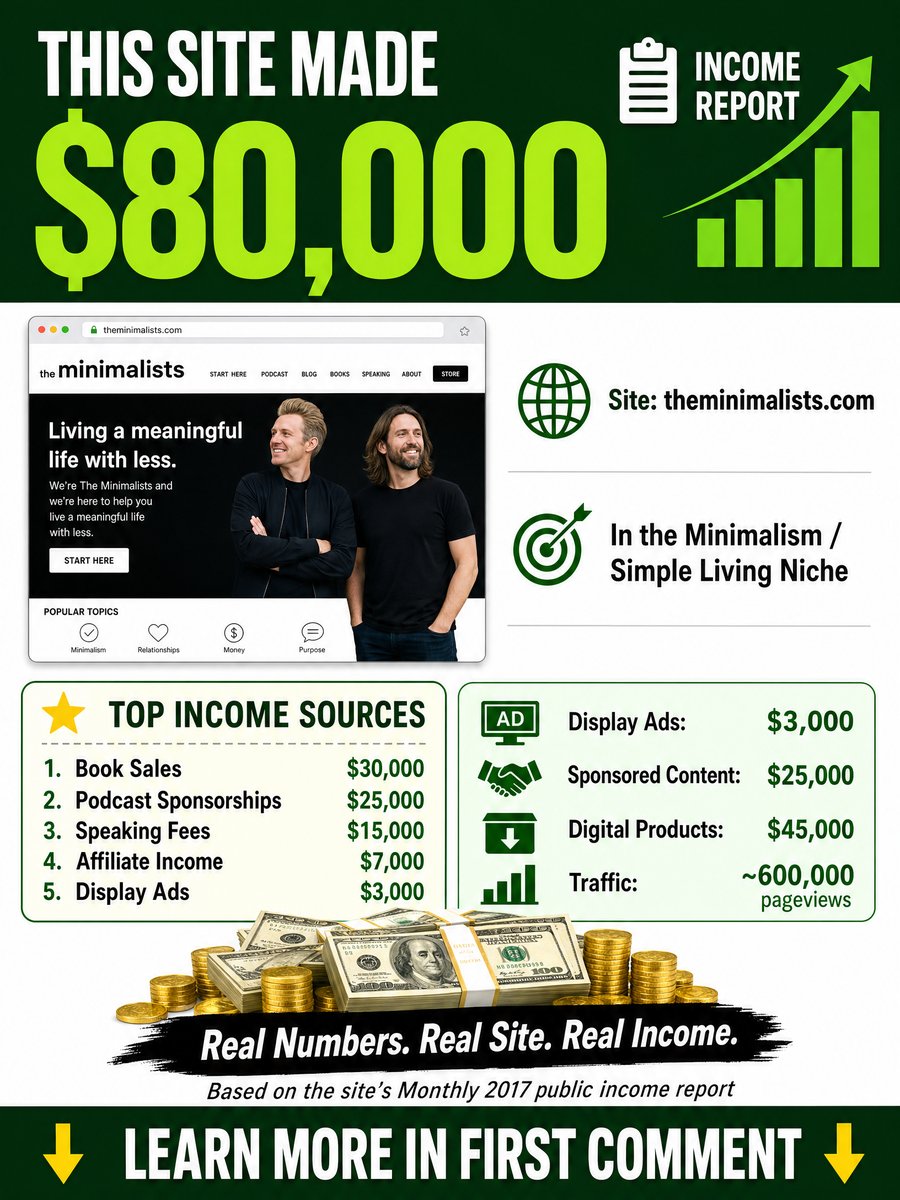
The supplied report image uses The Minimalists as an example, showing approximately $80,000 in monthly income and 600,000 pageviews. The listed revenue sources are $30,000 from books, $25,000 from podcast sponsorships, $15,000 from speaking, $7,000 from affiliates, and $3,000 from ads. A separate panel shows $45,000 in digital products, but the image does not explain how that figure relates to the main breakdown.
This report explores how a minimalism-focused publication can monetize through books, podcasts, sponsorships, affiliates, digital products, SEO content, and audience trust rather than relying mainly on advertising.
Site Snapshot
| Metric | Details |
| Website | The Minimalists |
| Domain Shown | theminimalists.com |
| Primary Niche | Minimalism and Simple Living |
| Related Topics Shown | Relationships, Money, Purpose |
| Revenue Figure Shown | $80,000 |
| Traffic Figure Shown | ~600,000 Pageviews |
| Largest Income Source Shown | Book Sales |
| Primary Monetization | Books, Podcast Sponsorships, Speaking, Affiliate Income, Display Ads |
| Report Basis Shown | Monthly 2017 Public Income Report |
Why the Minimalism and Simple Living Niche Is So Profitable
Minimalism attracts readers because it connects with multiple goals, including reducing clutter, saving money, simplifying life, and making intentional choices. This creates a broader content niche than the name suggests. The audience is often highly engaged because minimalism is tied to personal values. Long-term trust can lead to opportunities in books, podcasts, courses, newsletters, speaking, and relevant affiliate products.
Popular content areas can include:
- Minimalist living
- Decluttering
- Intentional living
- Simple living
- Frugal habits
- Meaningful consumption
- Digital minimalism
- Minimalist homes
- Relationships and boundaries
- Personal priorities
- Money and lifestyle
- Downsizing
- Capsule wardrobes
- Mindful purchasing
- Lifestyle design
This diversity is valuable because the publication does not need to depend entirely on product reviews or search-engine traffic. The brand itself can eventually become the primary asset.
Estimated Monthly Revenue Breakdown
The detailed “Top Income Sources” section of the supplied graphic gives the clearest breakdown of the $80,000 figure. Every amount below is taken directly from that section of the image.
| Revenue Source | Amount Shown |
| Book Sales | $30,000 |
| Podcast Sponsorships | $25,000 |
| Speaking Fees | $15,000 |
| Affiliate Income | $7,000 |
| Display Ads | $3,000 |
| Total Shown | $80,000 |
The right-side summary box separately displays the following figures:
| Highlighted Metric | Amount Shown |
| Display Ads | $3,000 |
| Sponsored Content | $25,000 |
| Digital Products | $45,000 |
| Traffic | ~600,000 Pageviews |
The $25,000 sponsored-content figure matches the podcast-sponsorship amount in the detailed list. The image does not explain the $45,000 digital-products figure, so it should not be added separately. The safest interpretation is that the two sections categorize revenue differently.
How The Minimalists Website Makes Money
The revenue breakdown shows a model that relies more on expertise, trust, and audience relationships than traditional advertising.
- Books ($30,000): The largest revenue source. Minimalism fits well with books because readers often want a complete framework covering possessions, money, relationships, priorities, and lifestyle choices.
- Podcast Sponsorships ($25,000): Podcasts create deeper audience connections, making the listeners valuable to sponsors compared with one-time website visitors.
- Speaking Fees ($15,000): A strong content platform can build authority that leads to conferences, workshops, corporate events, and other speaking opportunities.
- Affiliate Income ($7,000): Provides an additional revenue stream through relevant recommendations like books, tools, financial resources, and lifestyle products.
- Display Ads ($3,000): A smaller portion of revenue, showing that businesses can earn more by building direct audience relationships rather than relying mainly on ad traffic.
Why Books Can Become the Core Product
The $30,000 book-sales figure highlights the power of owned intellectual property. A strong book can build authority, attract new audiences, support podcasts and speaking opportunities, and generate long-term revenue.
Minimalism works well for evergreen books because readers continue seeking ways to reduce clutter, spend intentionally, and create simpler lives.
Potential book themes in the broader niche include:
- Minimalism for beginners
- Decluttering systems
- Intentional spending
- Simple living
- Digital minimalism
- Downsizing
- Minimalism with children
- Financial simplicity
- Purpose-driven living
- Intentional relationships
A strong content creator can use free articles to introduce individual ideas while the book provides the complete framework.
Why Podcast Sponsorships Are So Valuable
The image shows $25,000 from podcast sponsorships, highlighting the value of building an audience beyond written content. Podcasts create stronger relationships through repeated, long-form interactions, making the audience attractive to sponsors.
A minimalism podcast can discuss subjects such as:
- Simplifying possessions
- Money habits
- Relationships
- Meaningful work
- Consumer culture
- Mental clutter
- Technology use
- Lifestyle changes
- Personal stories
- Financial independence
Suitable sponsors could come from several categories, but sponsorships should align with the publication’s stated values. A minimalist brand that promotes endless unnecessary consumption would create an obvious credibility problem. The strongest sponsorship model therefore prioritizes relevance and trust over accepting every available advertiser.
Speaking Fees Turn Content Authority Into Premium Revenue
The $15,000 speaking-fee figure shows how expertise can create revenue beyond pageviews. A trusted minimalism creator can gain opportunities to speak about intentional living, productivity, money, consumer behavior, and lifestyle design.
Potential speaking environments can include:
- Conferences
- Corporate events
- Universities
- Community organizations
- Retreats
- Workshops
- Professional associations
- Media events
Speaking is less scalable than a digital product because each engagement requires time. However, revenue per engagement can be substantially higher than revenue from thousands of ordinary website visitors.
Speaking can also strengthen the wider business. Event attendees may buy books, subscribe to a podcast, join an email list, or become regular readers afterward.
Affiliate Marketing Opportunities
Affiliate marketing contributes $7,000 in the supplied breakdown, though the specific programs are not identified. For a minimalism publisher, the best affiliate strategy focuses on recommending fewer, higher-value products that align with intentional living rather than encouraging unnecessary purchases.
Potential affiliate categories include:
- Books
- Audiobooks
- Financial planning tools
- Budgeting software
- Sustainable household products
- Durable travel gear
- Organization products
- Digital productivity tools
- Educational programs
- Ethical marketplaces
Commercial content could focus on carefully selected resources rather than publishing endless “best product” lists.
Popular Affiliate Programs
A Minimalism and Simple Living Website can investigate several affiliate networks and programs that provide access to books, educational products, household products, or other resources aligned with intentional consumption. These are examples to research, not programs confirmed by the supplied image as being used by The Minimalists.
Affiliate Program Breakdown
| Affiliate Program or Network | Relevant Category | Website |
| Amazon Associates | Books and General Products | https://affiliate-program.amazon.com |
| Bookshop.org | Books | https://bookshop.org |
| Audible | Audiobooks | https://www.audible.com |
| Impact | Brands and Digital Services | https://impact.com |
| Awin | Retail and Lifestyle Affiliate Network | https://www.awin.com |
| CJ Affiliate | Affiliate Network | https://www.cj.com |
| ShareASale | Lifestyle and Retail Brands | https://www.shareasale.com |
Program availability, commissions, geographic eligibility, and promotional requirements can change. Publishers should always confirm current terms directly before investing substantial content around a specific affiliate relationship. The strongest approach is to recommend fewer products with greater editorial confidence. In minimalism, “you probably don’t need this” can sometimes build more trust than another affiliate link.
Content Strategy That Can Attract 600,000 Pageviews
The report image shows around 600,000 pageviews, proving that traffic can fuel a broader business beyond ads. Minimalism websites can combine evergreen SEO guides with personal stories, opinions, and philosophy to attract readers and build long-term loyalty.
High-potential content areas include:
- How to become a minimalist
- How to declutter your home
- Minimalist habits
- How to stop buying unnecessary things
- Digital decluttering
- Minimalist budgeting
- Simple living ideas
- Minimalist wardrobe
- Minimalist home organization
- Intentional spending
- Minimalism and relationships
- Minimalism with children
- Simple living and purpose
The strongest content does more than provide another decluttering checklist. It helps readers understand why they want fewer possessions and what they hope to gain in return.
That deeper positioning creates a much stronger brand than generic home-organization content.
Keyword Opportunities
Minimalism offers broad informational search demand, while commercial opportunities tend to appear around books, tools, organization products, and services that help readers simplify particular areas of life. A successful site should balance the two rather than trying to turn every visitor into an immediate buyer.
Potential informational keywords include:
- minimalism
- minimalist lifestyle
- simple living
- how to become a minimalist
- decluttering tips
- how to simplify your life
- intentional living
- minimalist home
- minimalist wardrobe
- minimalist habits
- digital minimalism
- minimalist budgeting
Commercially oriented keywords could include:
- best minimalism books
- best decluttering books
- minimalist planner
- budgeting app for simple living
- best organization tools
- capsule wardrobe essentials
- minimalist travel gear
- simple living books
These commercial terms should still be approached carefully. The value of the brand comes from helping readers make better decisions, not encouraging consumption simply because a product offers an affiliate commission.
Building Minimalism Topic Clusters
A strong minimalism website should organize content into connected themes, helping readers move naturally from one topic to another while improving SEO and user experience.
- Getting Started With Minimalism: Covers the basics, first steps, misconceptions, decluttering projects, and realistic expectations.
- Home and Possessions: Focuses on decluttering, organizing, downsizing, clothing, storage, and mindful buying.
- Money: Explores spending habits, budgets, debt, lifestyle inflation, intentional purchases, and financial freedom.
- Digital Minimalism: Covers smartphones, social media, notifications, email, subscriptions, and reducing digital distractions.
- Relationships and Purpose: Addresses boundaries, commitments, career choices, time management, values, and meaningful living.
This structure expands minimalism beyond possessions and reflects its broader focus on lifestyle, money, relationships, and purpose.
SEO Strategy
Minimalism has strong evergreen SEO potential because people will continue searching for ways to declutter, simplify, spend less, and build better habits. A successful strategy requires deep, authentic content and strong topic coverage rather than generic advice repeated across the web.
Important SEO practices include:
- Publishing comprehensive beginner resources
- Building topic clusters around home, money, relationships, and purpose
- Using personal experience and original examples
- Updating evergreen articles when recommendations change
- Creating strong internal links
- Publishing distinctive essays worth citing
- Maintaining clear author identity
- Developing useful tools and checklists
- Building branded search demand
Brand strength matters particularly in this niche. Readers may begin by searching “how to declutter,” but the long-term goal is for them eventually to search specifically for the publication, podcast, authors, or books. That transition from generic search traffic to branded demand can make the business considerably more resilient.
Email Marketing and Direct Audience Building
Email is particularly valuable for a philosophy-driven publication because minimalism is rarely a one-day transformation. Readers may spend months or years changing habits, reducing possessions, adjusting spending, and thinking differently about priorities. A newsletter can maintain that relationship by sending essays, practical challenges, podcast episodes, book recommendations, and new resources directly to subscribers.
Potential lead magnets include:
- 30-day minimalism challenge
- Decluttering checklist
- Simple living worksheet
- Minimalist budget planner
- Digital declutter checklist
- Intentional spending worksheet
- Capsule wardrobe planner
A direct email audience also strengthens book launches, podcast distribution, events, and speaking opportunities. Instead of depending entirely on Google or social-media algorithms, the publication can communicate directly with people who have already expressed interest. That is especially important for a business model where books, speaking, and sponsorships generate substantially more revenue than display advertising.
Why Display Ads Are Only a Small Part of the Model
The image shows about 600,000 pageviews but only $3,000 in display ads, highlighting that a media brand does not need to rely heavily on advertising.
- Less focus on ads: Excessive ads can hurt user experience, slow pages, and conflict with a minimalist brand.
- Audience matters more than impressions: Traffic can be used to build trust and drive higher-value revenue through books, sponsorships, speaking, and other products.
The revenue mix reflects an authority-driven business model rather than an ad-first publishing approach.
Why This Business Model Works
The Minimalism and Simple Living model is attractive because it transforms content into a broader intellectual-property and media business. Articles introduce the ideas, the podcast deepens the relationship, books package the philosophy, speaking monetizes expertise, sponsors pay for access to the audience, and affiliate recommendations provide an additional supporting stream.
Several structural advantages make the model strong:
- Evergreen subject matter: People continually seek simpler lifestyles.
- Deep audience identification: Minimalism can become part of a reader’s values.
- Strong book potential: The philosophy translates naturally into long-form products.
- Podcast compatibility: Reflective lifestyle subjects work well in audio.
- Speaking opportunities: Recognized expertise can command premium fees.
- Low dependence on ads: The business is not tied exclusively to pageview economics.
- Multiple adjacent topics: Money, purpose, relationships, and digital life expand the audience.
- Direct monetization: Books and events allow the brand to monetize without a third-party advertiser.
The business becomes especially powerful when the audience trusts the creators rather than merely visiting individual articles.
Lessons for Content Creators
A new minimalism publisher should avoid generic decluttering content and build a distinct perspective instead. Defining a clear focus—such as minimalist homes, financial simplicity, family life, sustainability, or digital minimalism—helps create a memorable brand.
Several lessons from the model are particularly useful:
- Build a philosophy, not just a keyword site: Give readers a clear reason to identify with the publication.
- Create owned intellectual property: Books and digital resources can outperform advertising.
- Use multiple formats: Articles, podcasts, books, newsletters, and speaking can reinforce one another.
- Keep monetization aligned with values: Excessive product promotion can undermine a minimalist brand.
- Prioritize direct audience relationships: Email and podcasts reduce dependence on search algorithms.
- Develop recognizable expertise: Authority creates opportunities beyond pageviews.
- Publish evergreen content: Foundational minimalism questions remain relevant for years.
- Use affiliates selectively: Recommend only products or services that genuinely support the reader’s goals.
- Protect reader trust: Commercial partnerships should always be transparent.
- Think beyond traffic: A smaller loyal audience can sometimes be more valuable than a larger anonymous one.
This is one of the clearest examples of why a content business should not measure success exclusively by pageviews.
Conclusion
The Minimalism and Simple Living Website model shows how a lifestyle brand can generate revenue beyond display ads by monetizing trust, expertise, and audience relationships. The supplied image estimates $80,000 in revenue from 600,000 pageviews, with income from books, podcast sponsorships, speaking, affiliates, and ads. It also shows separate digital-product and sponsorship categories that should be treated independently because the breakdown is unclear. The key lesson is that a strong minimalism brand can grow through evergreen content, books, podcasts, partnerships, and direct audience connections rather than relying mainly on advertising.
Key Takeaway: The report shows that a Minimalism and Simple Living Website can succeed through trust and expertise rather than traffic alone. With only $3,000 from display ads, the main opportunity is building a loyal audience and monetizing through books, podcasts, speaking, affiliates, sponsorships, and owned products.
Powder Magazine Skiing and Snow Sports Website Makes $90,000 Per Month

Skiing and snow sports offer a strong publishing opportunity because they combine passionate audiences, expensive gear, travel, seasonal demand, and highly visual content. A successful website can cover ski resorts, equipment, snow conditions, techniques, competitions, and mountain culture.
The supplied report image features Powder Magazine in the Skiing and Snow Sports niche, showing approximately $90,000 in revenue and 1.2 million monthly pageviews. The listed revenue sources are $50,000 from display ads, $28,000 from sponsored content, $10,000 from affiliate income, $1,500 from subscriptions, and $500 from other revenue. A separate section shows $2,000 in digital products, but the relationship between categories is unclear, so the figures should be treated separately.
This report explores the business model behind snow-sports publications, including content strategy, SEO opportunities, affiliate marketing, sponsorships, seasonal traffic, travel content, equipment reviews, and how a ski-focused website can grow into a valuable digital media business.
Site Snapshot
Site Snapshot
| Metric | Details |
| Website | Powder Magazine |
| Domain Shown | powder.com |
| Primary Niche | Skiing and Snow Sports |
| Secondary Niches | Ski Gear, Resorts, Snowboarding, Travel, Mountain Lifestyle |
| Estimated Monthly Revenue Shown | $90,000 |
| Estimated Monthly Traffic Shown | ~1,200,000 Pageviews |
| Largest Revenue Source Shown | Display Advertising |
| Primary Monetization | Display Ads, Sponsored Content, Affiliate Income, Digital Subscriptions |
| Report Basis Shown | Monthly 2018 Public Income Report |
Why the Skiing and Snow Sports Niche Is So Profitable
The skiing and snow-sports niche combines a passionate audience with high-value purchases. Skiers spend heavily on equipment, travel, clothing, resorts, and experiences, creating strong opportunities for advertisers and affiliates.
The niche also covers more than gear, including resorts, snow conditions, techniques, safety, fitness, and travel planning. This allows publishers to attract readers throughout the entire buying journey.
Popular content areas include:
- Ski resort guides
- Ski and snowboard gear reviews
- Ski buying guides
- Winter travel destinations
- Powder skiing
- Ski technique
- Snowboarding
- Ski clothing and layering
- Mountain weather
- Ski trip planning
- Professional skiing
- Ski photography and video
- Resort news
- Backcountry equipment
- Winter adventure travel
This broad range of topics allows a snow-sports publisher to monetize both high-volume informational traffic and lower-volume searches with strong commercial intent.
Estimated Monthly Revenue Breakdown
The most important numbers in the supplied graphic appear in its Top Income Sources section. Those five sources add exactly to the $90,000 headline amount, making them the clearest representation of the report’s revenue model.
| Revenue Source | Amount Shown |
| Display Ads | $50,000 |
| Sponsored Content | $28,000 |
| Affiliate Income | $10,000 |
| Digital Subscriptions | $1,500 |
| Other | $500 |
| Estimated Total | $90,000 |
The separate summary box on the right side of the image shows:
| Highlighted Metric | Amount Shown |
| Display Ads | $50,000 |
| Sponsored Content | $28,000 |
| Digital Products | $2,000 |
| Traffic | ~1,200,000 Pageviews |
The $2,000 digital-products figure is not separately itemized in the detailed income list. Since the image does not explain the relationship, it is better to preserve the source exactly as presented. What is clear is that display advertising and sponsored content account for the overwhelming majority of the $90,000 total shown.
How a Skiing and Snow Sports Website Makes Money
A publication in this niche can monetize readers at several different stages of their journey. Someone reading a ski-resort story may primarily generate advertising revenue, while someone comparing skis or goggles may be much more valuable through an affiliate relationship. Brands may also pay directly for access to an established skiing audience through sponsorships and branded campaigns.
- Display advertising: The image lists display ads at $50,000, making advertising the largest revenue source. Snow-sports websites can generate large numbers of pageviews from resort stories, news, equipment coverage, professional skiing, destination articles, weather-related content, and general mountain culture. These visitors may not all be shopping at that moment, but the aggregate traffic can still create substantial advertising inventory.
- Sponsored content: Sponsored content contributes $28,000 according to the report. Skiing is highly attractive to advertisers because the audience overlaps with outdoor recreation, travel, automotive, action cameras, apparel, tourism, fitness, food and beverage, and premium lifestyle products. A respected publication can therefore sell partnerships that extend far beyond traditional ski manufacturers.
- Affiliate income: The image assigns $10,000 to affiliate marketing. This is a natural fit because ski equipment is expensive and complicated. Consumers frequently research products before purchasing, creating opportunities for detailed gear comparisons, buying guides, and reviews.
- Digital subscriptions: The report lists $1,500 from digital subscriptions. Reader-supported revenue can complement advertising by monetizing particularly loyal followers who want premium editorial content, archives, special issues, exclusive photography, or other enhanced experiences.
- Other revenue: The remaining $500 is categorized simply as “Other.” The image does not identify exactly what it represents, so it should not be assigned to merchandise, events, licensing, or another category without supporting evidence.
Display Advertising Benefits From High-Volume Editorial Content
The $50,000 display-ad figure shows that snow-sports websites can monetize informational content, not just product-driven articles. Stories about storms, athletes, ski regions, and mountain culture can attract large audiences and generate valuable ad impressions.
A broad editorial publication could build traffic around subjects such as:
- Resort rankings
- Snowfall stories
- Professional skier profiles
- Ski competitions
- Mountain photography
- Snowboarding news
- Ski films
- Destination features
- Resort openings
- Ski culture
This type of content helps establish the publication as a media brand rather than merely a shopping website. That distinction can increase both repeat readership and sponsorship value.
Sponsored Content Can Be Extremely Valuable
Sponsored content is the second-largest income stream shown in the image at $28,000. For a specialist lifestyle publication, sponsorships can become highly profitable because brands are purchasing access to a defined community rather than generic internet traffic.
Potential sponsor categories include:
- Ski manufacturers
- Snowboard brands
- Winter apparel companies
- Outdoor retailers
- Ski resorts
- Tourism boards
- Airlines
- Hotels and lodges
- Action camera brands
- Vehicle manufacturers
- Sunglasses and goggles
- Watches
- Energy and nutrition brands
A ski publication can earn sponsorship revenue through resort features, destination guides, gear stories, videos, newsletters, and events. Sponsored content should always be clearly disclosed to maintain reader trust. Strong brands often value partnerships with trusted niche publications because of their highly relevant audience.
Affiliate Marketing Fits Ski Gear Naturally
Affiliate marketing can work especially well because skiing requires a large amount of specialized equipment. Many purchases are expensive enough that consumers research extensively before buying, creating strong commercial search intent.
Popular affiliate categories include:
- Skis
- Snowboards
- Ski boots
- Bindings
- Helmets
- Goggles
- Ski jackets
- Ski pants
- Base layers
- Gloves
- Ski socks
- Backpacks
- Ski poles
- Boot bags
- Roof racks
- Action cameras
- Avalanche equipment
- Travel bags
An equipment-focused article should not simply publish a generic list of products. The strongest buying guides explain which products fit particular skill levels, snow conditions, budgets, and styles of skiing.
For example, instead of only publishing “Best Skis,” a publisher could develop articles such as:
- Best skis for beginners
- Best powder skis
- Best all-mountain skis
- Best skis for women
- Best skis for East Coast conditions
- Best ski boots for wide feet
- Best ski goggles for flat light
- Best helmets for resort skiing
- Best ski bags for air travel
- Best ski jackets for cold weather
These narrower topics generally align more closely with what the reader actually needs to decide.
Popular Affiliate Programs
The supplied image confirms $10,000 in affiliate income, but it does not identify which specific affiliate programs Powder Magazine used. The examples below should therefore be treated as relevant merchants and networks that a skiing or outdoor publisher could investigate, not as confirmed Powder Magazine partners. Affiliate terms, eligibility, commissions, and program availability can change, so publishers should always verify current details directly before promoting an offer.
Affiliate Program Breakdown
| Affiliate Program or Network | Relevant Category | Website |
| evo | Ski, Snowboard and Outdoor Gear | https://www.evo.com |
| Backcountry | Ski and Outdoor Equipment | https://www.backcountry.com |
| REI Co-op | Outdoor and Winter Gear | https://www.rei.com |
| Amazon Associates | General Ski Accessories | https://affiliate-program.amazon.com |
| AvantLink | Outdoor Affiliate Network | https://www.avantlink.com |
| Impact | Affiliate and Partnership Network | https://impact.com |
| CJ Affiliate | Affiliate Network | https://www.cj.com |
| Awin | Affiliate Network | https://www.awin.com |
| ShareASale | Affiliate Network | https://www.shareasale.com |
A successful ski affiliate strategy focuses on relevance, not just commission size. Recommendations should match the reader’s needs, such as linking resort guides to travel gear or beginner guides to helmets, clothing, and equipment. Affiliate content works best when it naturally solves problems discussed in the article.
Content Strategy That Can Drive 1.2 Million Pageviews
The image estimates around 1.2 million pageviews, suggesting a broad media publication rather than a site built only on product reviews. A strong strategy would combine evergreen SEO guides with seasonal content like snowfall updates, destination features, and skiing news to attract and retain readers.
High-potential editorial categories include:
- Resort guides
- Gear reviews
- Ski buying guides
- Snowboard content
- Technique tutorials
- Beginner skiing
- Ski travel
- Mountain culture
- Athlete interviews
- Powder skiing
- Professional competition
- Winter photography
- Resort news
- Weather and snowfall stories
The advantage of this mixture is that different content formats serve different business purposes. A beginner tutorial can generate long-term search traffic. A resort feature can support travel partnerships. A gear review can produce affiliate revenue. A professional-skiing story can strengthen the brand and increase returning readership.
Keyword Opportunities
A Skiing and Snow Sports Website can target both broad informational searches and commercially valuable product searches. The key is to avoid treating every keyword as an isolated article. Strong publishers organize keywords into connected topic clusters that guide the reader through a subject.
Potential high-traffic informational keywords include:
- skiing for beginners
- how to ski
- best ski resorts
- skiing tips
- powder skiing
- ski vacation
- skiing in Japan
- snowboarding for beginners
- ski resort guide
- how to choose skis
- ski trip packing list
- ski conditions
Commercial keywords can include:
- best beginner skis
- best all-mountain skis
- best ski boots
- best ski goggles
- best ski helmets
- best ski jackets
- best ski gloves
- ski bag reviews
- best powder skis
- best snowboard boots
- best ski roof rack
- best action camera for skiing
Commercial articles can generate considerably more revenue per reader because the visitor is often actively researching a purchase.
Building Skiing Topic Clusters
A strong skiing website can organize content into clear topic clusters that match the reader’s journey:
- Beginner Skiing Cluster: Covers choosing skis, selecting boots, understanding trail ratings, learning basic turns, using lifts, safety tips, clothing, and preparing for a first ski trip.
- Gear Cluster: Includes skis, boots, bindings, helmets, goggles, outerwear, gloves, poles, ski bags, avalanche gear, and accessories.
- Travel and Resorts Cluster: Covers ski destinations, family resorts, luxury and budget trips, lodging, transportation, seasonal conditions, and international skiing.
- Snowboarding Cluster: Focuses on snowboard equipment, techniques, destinations, and related beginner-to-advanced topics.
- Powder and Advanced Skiing Cluster: Covers deep snow techniques, specialized gear, backcountry topics, and challenging terrain.
This structure follows how readers naturally progress from learning the sport to improving skills and planning experiences.
Ski Resort and Travel Content Creates Additional Revenue Opportunities
Travel is one of the strongest commercial extensions of the skiing niche because a ski trip can involve substantially more spending than a single equipment purchase. Readers may need airfare, lodging, lift tickets, transportation, restaurants, insurance, rentals, guides, and destination-specific equipment.
The screenshot itself prominently shows a feature titled “The 50 Best Ski Resorts in North America” as well as a Japan travel story. These examples demonstrate how resort and destination content fits naturally within the site’s editorial identity.
Potential travel topics include:
- Best ski resorts in North America
- Best ski resorts for beginners
- Best family ski resorts
- Best ski resorts in Japan
- Best ski towns
- Budget ski vacations
- Luxury ski resorts
- Best resorts for powder
- How to plan a ski trip
- Ski vacation packing list
Travel content can generate advertising revenue while also creating opportunities for tourism sponsorships and, where suitable, commercial partnerships with travel-related services.
Gear Reviews Should Be Based on Real Use Cases
Ski gear reviews should do more than repeat prices and specifications. They should help readers choose products based on their skill level, terrain, conditions, and goals.
- Skis: Discuss factors like width, length, flex, rocker profile, stability, turning, terrain, and skier level.
- Boots: Cover fit, flex, width, comfort, and intended use.
- Goggles: Explain lens quality, ventilation, helmet compatibility, and visibility.
- Build trust: Firsthand testing, original photos, and clear review methods help specialist publications stand out from generic affiliate content.
Trusted reviews create returning readers and long-term audience value, not just one-time purchases.
Seasonal Traffic Is Both an Opportunity and a Risk
Snow sports have predictable seasonal traffic patterns, with interest usually rising before winter and during strong snowfall periods.
- Prepare ahead: Update gear guides before buying season, refresh resort content before travel planning, and create holiday gift guides for seasonal demand.
- Reduce off-season drops: Cover topics like ski fitness, equipment care, offseason training, travel planning, gear previews, and athlete stories.
- Use seasonality strategically: The goal is not to remove seasonal changes but to build a content calendar that benefits from them.
SEO Strategy
SEO works well for evergreen ski topics because beginners ask similar questions every season. Guides on choosing skis, learning basics, selecting gear, and preparing for trips can stay valuable for years with updates. Product reviews need more frequent refreshes as equipment models and technology change.
Important SEO practices include:
- Building comprehensive topic clusters
- Publishing detailed beginner guides
- Updating gear comparisons before each season
- Creating resort and destination guides
- Using internal links between related topics
- Publishing original equipment photography
- Demonstrating firsthand expertise
- Updating outdated products
- Targeting long-tail commercial searches
- Creating useful comparison tables
Evergreen educational content and current commercial content should be treated differently. The basics of carving a turn may change little, while a “best skis” article requires consistent maintenance.
Estimated Traffic Strategy
The supplied report provides an overall figure of approximately 1.2 million pageviews, but it does not show how traffic is divided among search, social media, direct visitors, newsletters, referrals, or other sources. Any exact percentage breakdown would therefore be an assumption rather than information from the image.
A strong Skiing and Snow Sports Website could build traffic through several complementary channels:
| Traffic Channel | Primary Opportunity |
| Google Search | Evergreen skiing guides, gear reviews and resorts |
| Direct Traffic | Returning readers and brand loyalty |
| Email Newsletter | Seasonal updates, stories and gear content |
| YouTube | Technique videos, travel and equipment testing |
| Social Media | Ski photography, clips and snow conditions |
| Referral Traffic | Outdoor publications, resorts and communities |
Search can bring readers with specific questions, while social and video benefit from skiing’s highly visual nature. Email helps retain those visitors once they have discovered the publication.
Video and Photography Can Strengthen the Brand
Skiing is a highly visual niche, giving publishers opportunities beyond text-based content.
- Multiple content formats: Powder runs, mountain views, resorts, athletes, and gear demonstrations work well in photos, videos, articles, and social content.
- Repurpose content: A gear review can become a written guide, video, social clips, newsletter content, and comparisons. Destination guides can include photos, maps, and travel resources.
- Expand sponsorship opportunities: Multi-format content strengthens the brand and creates more ways to work with partners.
- Build audience loyalty: Strong photography and storytelling can attract readers even when they are not actively searching for information.
Email Marketing Can Turn Seasonal Visitors Into Regular Readers
A major challenge for seasonal websites is retaining readers between individual searches. Email provides a direct relationship that can continue throughout the ski season and into the offseason.
Potential lead magnets include:
- First ski trip checklist
- Ski packing list
- Ski gear checklist
- Beginner ski guide
- Resort planning worksheet
- Ski layering guide
- Ski boot fitting checklist
Once subscribed, readers could receive new resort guides, snowfall stories, gear reviews, seasonal preparation advice, interviews, and disclosed commercial recommendations.
Email becomes particularly valuable before major buying periods because a publisher can reach readers directly rather than waiting for them to return through search.
Why Digital Subscriptions Still Matter
The image shows only $1,500 in digital subscription revenue, but direct reader income can still reduce reliance on ads and platforms.
- Possible subscription benefits: Premium articles, archives, photography, digital magazines, newsletters, or exclusive content.
- Brand strength matters: A generic ski website may struggle to charge readers, while an established publication with trusted writers, photographers, and unique content has a better chance.
- SEO alone is not enough: Building a strong brand is essential for creating loyal paying audiences.
Why This Business Model Works
The Skiing and Snow Sports Website model shown in the report is attractive because several different economic drivers reinforce one another. High-volume editorial content creates advertising revenue, passionate readers increase sponsorship value, expensive equipment creates affiliate opportunities, and loyal followers can support subscription products.
Several structural advantages stand out:
- Expensive equipment: Skiers routinely purchase high-ticket gear.
- Strong travel spending: Ski vacations involve lodging, transportation, and resort costs.
- Passionate audience: Skiing often becomes part of a reader’s identity and lifestyle.
- Premium sponsorships: Outdoor and lifestyle brands value highly targeted audiences.
- Visual storytelling: Photography and video are natural fits for the subject.
- Evergreen beginner demand: New skiers continually enter the market.
- Seasonal buying peaks: Winter creates concentrated commercial demand.
- Multiple revenue sources: Ads, sponsors, affiliates, subscriptions, and other products can coexist.
The model works particularly well because different content formats monetize different forms of reader intent. A powder story can produce advertising impressions, a ski review can generate affiliate revenue, and a resort feature can attract sponsorship interest.
Lessons for Content Creators
Creators entering the Skiing and Snow Sports niche should focus on genuine expertise rather than trying to imitate the scale of an established publication immediately. A smaller website can succeed by becoming exceptionally useful within one subcategory and expanding once authority has been established.
Important lessons include:
- Start with a defined angle: Beginner skiing, gear, resorts, ski travel, or another specialty can provide clearer positioning.
- Publish firsthand content: Real experience improves credibility, particularly for equipment reviews.
- Build evergreen resources: Beginner guides and technique articles can generate traffic every season.
- Update commercial content: Gear changes frequently and outdated recommendations reduce trust.
- Use visual media: Original skiing photography and video provide major competitive advantages.
- Develop travel coverage: Resort content creates additional commercial opportunities.
- Build direct readership: Email reduces dependence on search algorithms.
- Create brand partnerships carefully: Sponsorships should never compromise editorial credibility.
- Disclose affiliate relationships: Transparency protects long-term reader trust.
- Diversify revenue: Advertising alone leaves the business vulnerable to market changes.
The strongest strategy is to create a publication readers would want to visit even if there were no affiliate links. Once that trust exists, monetization becomes much easier.
Conclusion
The Powder Magazine Skiing and Snow Sports example shows how a passionate outdoor audience can support a diversified media business through ski news, gear reviews, travel, education, and visual content. The supplied image estimates around $90,000 from 1.2 million pageviews, with revenue from ads, sponsorships, affiliates, subscriptions, and other sources. While these figures should be treated as estimates, the niche’s mix of high-value products, travel, strong communities, and seasonal demand creates multiple opportunities for publishers who build trusted authority.
Key Takeaway: A Skiing and Snow Sports Website can become a valuable media business by combining large-scale editorial traffic with premium sponsorships and gear-focused content. The supplied report highlights revenue from ads, sponsorships, and affiliates, showing how audience growth and commercial intent can work together. A strong strategy is to build ski expertise, create evergreen guides, publish trusted reviews, develop destination content, and diversify income across multiple channels.
Millennial Money Personal Finance and FIRE Website Made $98,000

Most personal finance websites focus on basic budgeting and savings tips, but Millennial Money built a broader platform around financial independence, investing, side hustles, and FIRE (Financial Independence Retire Early). This approach attracts both informational readers and commercially valuable audiences interested in financial tools, services, and products.
The supplied report image places Millennial Money in the Personal Finance and FIRE niche, showing approximately $98,000 in revenue and around 500,000 pageviews. It highlights affiliate income as the largest source, followed by consulting, ads, book sales, and sponsorships.
The image states these figures come from a 2017 annual public income report, so the $98,000 should not automatically be described as monthly revenue. This report explores the business model, monetization strategies, SEO approach, affiliate opportunities, and growth potential of a personal finance website.
Site Snapshot
The supplied graphic presents Millennial Money as a broad personal finance publication focused on helping readers save money, invest, make more money, and pursue financial independence. Its positioning is particularly valuable because it serves readers across different stages of the wealth-building journey rather than depending on one narrow financial topic.
Site Snapshot
| Metric | Details |
| Website | Millennial Money |
| Primary Niche | Personal Finance / FIRE |
| Secondary Niches | Saving Money, Investing, Make Money, Side Hustles, Early Retirement |
| Estimated Revenue Shown | $98,000 |
| Estimated Traffic Shown | ~500,000 Pageviews |
| Top Income Sources Shown | Affiliate Income, Consulting, Display Ads, Book Sales, Sponsorships |
| Other Highlighted Monetization Categories | Display Ads, Sponsored Content, Digital Products |
| Report Basis | Based on the site’s 2017 Annual public income report |
Why the Personal Finance and FIRE Niche Is So Profitable
Personal finance is a valuable publishing niche because people constantly search for ways to save money, invest, increase income, reduce debt, and plan for retirement. These needs create strong evergreen demand across different economic conditions.
FIRE adds long-term audience potential because readers often explore topics like investing, taxes, side hustles, real estate, passive income, and lifestyle design over many years. A strong website can support readers throughout their financial journey.
The niche also combines informational and transactional searches. A reader learning how to save may later search for financial products, allowing publishers to monetize through different channels.
Popular content opportunities include:
- Budgeting and money management
- Saving strategies
- Index fund investing
- Financial independence
- Early retirement
- Side hustles
- Passive income
- Retirement accounts
- Frugal living
- Career income growth
- Financial goal setting
- Wealth-building systems
This broad but connected subject matter creates thousands of potential evergreen articles while also supporting high-value commercial content.
Revenue Overview Based on the Image
The supplied image contains two monetization panels. The first identifies the site’s Top Income Sources, and those figures add exactly to the $98,000 total displayed in the headline. The second panel summarizes selected categories such as display advertising, sponsored content, digital products, and traffic.
The clearest revenue breakdown shown in the image is:
| Top Income Source | Amount |
| Affiliate Income | $45,000 |
| Consulting | $25,000 |
| Display Ads | $15,000 |
| Book Sales | $8,000 |
| Sponsorships | $5,000 |
| Total Shown | $98,000 |
The right-side summary box separately shows:
| Highlighted Monetization Metric | Amount |
| Display Ads | $15,000 |
| Sponsored Content | $5,000 |
| Digital Products | $33,000 |
| Traffic | ~500,000 Pageviews |
The graphic does not clearly explain how the $33,000 digital-products category overlaps with consulting and book sales, so combining those figures would be misleading. The safest approach is to use the top-income list as the main $98,000 breakdown and treat the second panel as a separate summary of selected revenue categories. Income graphics should be presented as shown when categories do not clearly match, rather than creating totals the source does not provide.
How Millennial Money Makes Money
Millennial Money’s model demonstrates why finance publishing can generate substantial revenue without requiring tens of millions of monthly pageviews. The audience is commercially valuable, and the site appears to monetize readers through several mechanisms rather than depending solely on advertising.
- Affiliate income: The image lists affiliate marketing as the largest individual revenue source at $45,000. Finance lends itself naturally to affiliate partnerships because readers routinely need investing tools, banking products, budgeting software, insurance services, and other financial platforms. A reader researching financial independence may eventually open an investment account, choose a savings product, buy software, or use another recommended service.
- Consulting: Consulting accounts for $25,000 in the image, making it the second-largest revenue source. This is important because it shows how expertise can be monetized beyond pageviews. A trusted financial or online-business brand may be able to offer strategy sessions, consulting packages, educational support, or other higher-value services to people who want more personalized assistance.
- Display advertising: The image assigns $15,000 to display ads. A site attracting roughly 500,000 pageviews can generate meaningful advertising revenue, particularly in a commercially valuable niche such as finance. Informational articles about budgeting, investing, saving, and retirement can therefore contribute revenue even when visitors do not purchase anything.
- Book sales: Book sales contribute $8,000 according to the graphic. Books fit personal finance especially well because readers often want a complete system rather than isolated articles. A book can organize financial concepts into a structured roadmap while simultaneously strengthening the author’s authority and brand recognition.
- Sponsorships: The image shows $5,000 from sponsorships and also identifies $5,000 of sponsored content in the summary panel. Financial technology companies, banking platforms, investment services, software businesses, and related brands may pay to reach a relevant finance audience. Clear disclosure remains essential so readers can distinguish sponsored campaigns from independent editorial recommendations.
The right-side summary also highlights $33,000 in digital products. The image does not provide enough detail to determine exactly which products make up that amount, but digital monetization in this niche could theoretically include books, premium guides, courses, templates, calculators, workshops, or other educational resources.
Popular Affiliate Programs
Affiliate marketing is a major opportunity in the Personal Finance and FIRE niche because readers often seek tools for saving, investing, budgeting, and wealth building. The supplied image does not identify Millennial Money’s specific affiliate partners, so the examples below should be viewed as potential opportunities rather than confirmed partnerships. Publishers should always verify current program terms, commissions, and requirements before promoting products.
Affiliate Program Breakdown
| Affiliate Program or Network | Category | Website |
| Empower | Retirement and Financial Planning | https://www.empower.com |
| Acorns | Investing and Saving | https://www.acorns.com |
| SoFi | Banking, Investing and Loans | https://www.sofi.com |
| Betterment | Automated Investing | https://www.betterment.com |
| M1 | Investing and Portfolio Tools | https://m1.com |
| Impact | Affiliate and Partnership Network | https://impact.com |
| CJ Affiliate | Affiliate Network | https://www.cj.com |
| FlexOffers | Affiliate Network with Finance Advertisers | https://www.flexoffers.com |
| Awin | Affiliate Network | https://www.awin.com |
| ShareASale | Affiliate Network | https://www.shareasale.com |
The best affiliate strategy is to recommend products that genuinely help readers, not simply those with the highest commissions. In personal finance, trust is essential because recommendations affect real money decisions. Affiliate links work best when they naturally support the content, such as savings tools in budgeting guides, investing platforms in portfolio articles, or planning software in retirement content. Comparison topics like “best investing app” or “best budgeting software” often attract fewer visitors but higher-value readers who are ready to choose a solution.
Content Strategy That Fits Millennial Money
The image shows a content structure built around saving, investing, making money, and FIRE. This works because it follows the natural path to wealth building: managing expenses, growing savings, investing wisely, increasing income, and achieving financial independence. A strong Personal Finance and FIRE website should not be a random collection of money tips. Its content should guide readers through connected financial goals and help them progress to deeper financial knowledge.
High-potential content topics include:
- How to save more money every month
- How to build an emergency fund
- Best index funds for beginners
- How to start investing
- How much money is needed to retire early
- FIRE number calculations
- Side hustles for professionals
- Passive income strategies
- How to increase your savings rate
- Financial independence case studies
- Retirement account explanations
- Frugal living without sacrificing quality of life
Personal stories can be particularly effective in this niche because readers often want proof that a financial strategy can work in real life. A detailed explanation of how someone increased income, reduced expenses, invested consistently, or reached financial independence can be more engaging than abstract advice alone.
At the same time, case studies should not imply that every reader will experience identical results. Income, taxation, investment returns, cost of living, career opportunities, and personal circumstances differ dramatically.
Keyword Opportunities
A Personal Finance and FIRE Website can target a large combination of educational and commercial searches. The strongest strategy is to build clusters around major financial problems rather than chasing disconnected keywords simply because they have search volume.
Informational topics can attract readers early in their financial journey, while commercial topics monetize readers who are comparing products or ready to take action.
Potential high-traffic informational keywords include:
- financial independence
- FIRE movement
- how to retire early
- how to save money
- how to invest for beginners
- passive income ideas
- side hustle ideas
- index fund investing
- budgeting for beginners
- frugal living
- how much to save for retirement
- financial freedom
Potential commercial keywords include:
- best brokerage account
- best investing app
- best budgeting app
- best high-yield savings account
- best robo advisor
- investing platform comparison
- best retirement calculator
- best tax software
- best personal finance books
- best money management software
Commercial articles should remain genuinely useful. Readers should understand how options differ, who each product is best suited for, what limitations exist, and when a different solution may be more appropriate.
Building Personal Finance Topic Clusters
Topic clusters help turn a personal finance blog into an authoritative resource by organizing content around connected financial goals instead of isolated trending topics.
- Saving Money Cluster: Covers budgeting, emergency funds, reducing expenses, housing costs, grocery savings, subscriptions, savings rates, and major purchases.
- Investing Cluster: Includes brokerage accounts, index funds, ETFs, diversification, asset allocation, retirement accounts, risk management, compound growth, and common investing mistakes.
- Making Money Cluster: Focuses on career growth, salary negotiation, freelancing, online businesses, consulting, side hustles, and scalable income opportunities.
- FIRE Cluster: Connects everything through topics like savings rates, FIRE numbers, withdrawal strategies, lifestyle design, Lean FIRE, Coast FIRE, and financial independence planning.
This structure creates a clear reader journey, improves content discovery, and allows natural internal linking between related topics.
SEO Strategy
SEO works well in personal finance because many topics are evergreen. Readers will continue searching for budgeting, investing, saving, income growth, and financial independence advice for years.
However, finance content requires strong editorial standards. Publishers should prioritize accuracy, reliable sources, transparent authorship, and responsible language while avoiding guaranteed claims about financial outcomes.
Important SEO practices include:
- Publishing comprehensive evergreen guides
- Building clusters around saving, investing, earning, and FIRE
- Updating financial content when laws, contribution limits, products, or rules change
- Using clear internal linking
- Creating original examples and calculators
- Publishing transparent comparison methodology
- Providing clear authorship and editorial information
- Earning backlinks through useful research and resources
- Keeping commercial content current
Original tools can provide an especially strong competitive advantage. A FIRE calculator, compound-interest tool, retirement savings calculator, savings-rate calculator, or budget template gives readers a reason to return and can attract natural backlinks.
Estimated Traffic Strategy
The supplied image only shows approximately 500,000 pageviews and does not provide traffic sources. Any breakdown of Google, email, social, or referral traffic would be an estimate.
For a Personal Finance and FIRE website, SEO is likely a major channel because financial topics have strong long-term search demand. Email is also valuable because readers often follow financial goals over many years.
A mature traffic strategy could therefore use several channels:
| Traffic Channel | Main Opportunity |
| Organic Search | Evergreen finance guides and product comparisons |
| Email Newsletter | Repeat readership and direct distribution |
| Direct Traffic | Brand loyalty and returning visitors |
| Social Media | Financial education and shareable insights |
| Referral Traffic | Mentions from finance publishers and communities |
| Podcasts and Video | Trust-building and deeper education |
Diversification is important because relying entirely on one platform exposes the business to algorithm changes. Search can be the discovery engine while email and direct readership become long-term audience assets.
Email Marketing Opportunities
Email fits the FIRE niche exceptionally well because financial independence is not usually achieved after reading one article. It can take years of saving, investing, career development, and financial planning. A newsletter gives the publication an opportunity to maintain a relationship throughout that process.
Useful lead magnets could include:
- FIRE number calculator
- Monthly budget template
- Net-worth tracker
- Investment checklist
- Financial independence roadmap
- Side-hustle worksheet
- Savings-rate calculator
- Retirement planning checklist
Subscribers can then receive educational articles, financial updates, new calculators, product comparisons, book recommendations, and appropriately disclosed affiliate promotions.
Email can also support owned products. A publisher launching a book, course, template, community, or consulting service has a much stronger starting position when it already has a trusted subscriber audience.
Digital Product Opportunities
The graphic’s separate $33,000 digital-products figure highlights how important owned products can become in a finance business. Although the image does not explain exactly what products generated that amount, the broader category demonstrates an important principle: publishers do not have to remain dependent on advertisers and affiliate partners.
Potential digital products for a Personal Finance and FIRE site include:
- Budget spreadsheets
- Net-worth trackers
- FIRE planning calculators
- Financial independence courses
- Investing education
- Side-hustle training
- Retirement planning workbooks
- Premium newsletters
- Financial goal planners
- Savings challenges
Owned products typically require more development than affiliate articles, but they offer greater control over pricing, positioning, customer experience, and revenue margins.
The best products normally emerge from recurring audience problems. If hundreds of readers repeatedly ask how to calculate a FIRE number, a calculator or workbook may be more useful than creating another generic article on the subject.
Why Consulting Can Be So Valuable
The image’s $25,000 consulting figure shows how a content site can build trust and generate higher-value services beyond ads.
- Content builds relationships: Readers may discover articles through search, follow the newsletter, read resources, and eventually seek personalized help.
- Higher value per customer: Consulting is less scalable than advertising because it requires time, but each client can generate significantly more revenue.
- Insights improve the business: Client questions can inspire new courses, books, templates, and content ideas.
- Follow regulations: Financial publishers must clearly separate general education from personalized financial advice and follow relevant legal requirements.
Why Book Sales Strengthen the Brand
The report image attributes $8,000 to book sales, showing that books can play an important role in a finance brand’s revenue strategy.
- More than direct income: Books can attract new readers, grow an email list, create speaking opportunities, and strengthen authority.
- Good fit for finance education: Books allow complex topics like FIRE, investing, money habits, side hustles, and wealth building to be explained in depth.
- Long-term brand asset: A strong book can support other products, services, and audience growth beyond royalties.
Why This Business Model Works
The Millennial Money model shown in the image works because it combines valuable content with several different ways to monetize reader intent. Some visitors generate advertising revenue. Others click affiliate links. A smaller group may buy books or digital products. High-value customers may purchase consulting or other premium services.
This creates stronger economics than a website dependent on one source of revenue.
Several characteristics make the model particularly attractive:
- Universal demand: Nearly everyone wants better financial outcomes.
- Evergreen problems: Saving, investing, retirement, and income growth remain relevant.
- High-value affiliates: Finance products can support attractive referral economics.
- Strong trust potential: Readers may remain with a respected publication for years.
- Premium services: Expertise can be monetized through consulting and education.
- Owned products: Books and digital resources reduce dependence on third-party platforms.
- Commercial search intent: Many readers actively compare financial products.
- Multiple monetization channels: Revenue is not dependent on advertising alone.
The combination of broad traffic potential and high revenue per qualified reader is what makes personal finance one of digital publishing’s most commercially powerful categories.
Lessons for Content Creators
A creator entering the Personal Finance and FIRE niche should resist the temptation to cover every financial subject immediately. The space is competitive, and a focused positioning can make it easier to build genuine authority. A publication might specialize initially in FIRE for young professionals, investing for beginners, side hustles, debt freedom, or another clearly defined audience before expanding.
The strongest long-term strategy is to solve real financial problems and let monetization develop around those solutions.
Key lessons include:
- Choose a clear audience: Define who the publication is specifically helping.
- Prioritize useful education: Build trust before trying to monetize every page.
- Develop topic clusters: Cover important financial subjects deeply.
- Use affiliate marketing responsibly: Recommend products based on suitability rather than commission alone.
- Build an email list: Create a direct relationship with readers.
- Develop owned products: Books, templates, calculators, and courses can diversify revenue.
- Use real examples carefully: Case studies are powerful when they do not imply guaranteed results.
- Maintain financial accuracy: Update articles when products, laws, or rules change.
- Diversify revenue: Combine advertising, affiliates, products, and appropriate services.
- Think long term: Financial trust can take years to establish and minutes to lose.
The core competitive advantage is not simply publishing more articles. It is becoming a resource readers trust when making meaningful financial decisions.
Conclusion
The Millennial Money report shows how a Personal Finance and FIRE website can become a diversified digital business. The image presents around 500,000 pageviews and $98,000 in revenue, with income from affiliates, consulting, ads, books, and sponsorships. It also highlights digital products separately, but since the categories do not fully align, the figures should be treated as separate estimates rather than combined. The report is based on a 2017 annual income report, so the $98,000 should not automatically be described as monthly revenue. The broader lesson is that finance publishers can build long-term businesses by combining evergreen content with affiliates, services, products, sponsorships, and advertising.
Key Takeaway: Millennial Money shows how a Personal Finance and FIRE Website can earn beyond display ads. With affiliate marketing ($45,000) and consulting ($25,000) as major revenue sources, the model proves that a trusted audience can be more valuable than traffic alone. New publishers should focus on evergreen financial content, build audience trust, use affiliates responsibly, and gradually add products, sponsorships, and services.
How an Affiliate Marketing and SEO Education Website Can Build a $100,000-Per-Month Business

An affiliate marketing and SEO website can grow beyond referral commissions into a diversified digital education business. By building expertise, earning trust, and creating courses, training, tools, and resources, publishers can monetize their knowledge in multiple ways. The Authority Hacker example in the supplied image illustrates this approach.
The image presents Authority Hacker as generating about $100,000 per month from 300,000 pageviews, with revenue from online courses, affiliate income, display ads, sponsorships, and coaching. However, these figures come from the supplied graphic and should be treated as estimates rather than independently verified current earnings.
Authority Hacker is a real and active company founded by Gael Breton and Mark Webster in 2014. The business has evolved over time, showing how SEO expertise can develop into a broader education-focused brand.
Site Snapshot
| Metric | Information |
| Site | Authority Hacker |
| Niche | Affiliate Marketing / SEO / Online Business |
| Monthly Revenue Shown in Image | ~$100,000 |
| Monthly Traffic Shown in Image | ~300,000 Pageviews |
| Largest Revenue Source Shown | Online Courses — $60,000 |
| Affiliate Income Shown | $25,000 |
| Display Ads Shown | $10,000 |
| Sponsorships Shown | $4,000 |
| Coaching Shown | $1,000 |
| Report Period Claimed by Image | Monthly 2019 Public Income Report |
What Is Authority Hacker?
Authority Hacker was founded by Gael Breton and Mark Webster in 2014 after they transitioned from running an agency to creating educational resources for online business owners. The company says it has helped more than 15,000 customers and built its reputation by testing strategies before teaching them.
The brand became known for SEO, content marketing, affiliate marketing, link building, and authority website strategies. Its growth shows how free educational content can build an audience that becomes more valuable than advertising alone.
Since 2019, Authority Hacker has evolved toward AI-powered growth systems and automation for established businesses. This highlights an important lesson: successful content businesses must adapt their products and strategies as technology and markets change.
Understanding the $100,000 Monthly Revenue Figure
The supplied image estimates Authority Hacker earns around $100,000 per month, with revenue from online courses ($60,000), affiliate income ($25,000), display ads ($10,000), sponsorships ($4,000), and coaching ($1,000). These figures add up exactly to the reported total.
The image also includes a summary panel showing $10,000 from ads, $4,000 from sponsorships, and $61,000 from digital products, which appears to combine courses and coaching. Since the affiliate figure is not included in that summary, the detailed income table provides the most complete breakdown.
| Revenue Source | Monthly Amount Shown | Share of $100,000 |
| Online Courses | $60,000 | 60% |
| Affiliate Income | $25,000 | 25% |
| Display Ads | $10,000 | 10% |
| Sponsorships | $4,000 | 4% |
| Coaching | $1,000 | 1% |
| Total | $100,000 | 100% |
These figures should not be interpreted as Authority Hacker’s present-day revenue. They represent the historical model described by the supplied image, while the company’s current products and positioning are substantially different.
Online Courses: $60,000 Per Month
Online courses are the largest revenue source in the supplied image, generating an estimated $60,000 per month (60% of the reported total). This highlights the difference between monetizing traffic and monetizing expertise.
- Traffic-based model: Display ads earn revenue mainly from pageviews, meaning publishers often need large amounts of traffic to generate significant income.
- Expertise-based model: Premium courses can generate hundreds or thousands of dollars from a single customer, allowing a smaller but highly targeted audience to produce substantial revenue.
Authority Hacker built its reputation around SEO, affiliate marketing, authority websites, and online business education. Over time, the company shifted its focus as the content-site landscape changed, moving toward AI and automation resources such as its AI Accelerator. The broader lesson remains the same: free content builds an audience, while premium education turns that audience into higher-value revenue.
Affiliate Marketing: $25,000 Per Month
Affiliate marketing is the second-largest revenue source in the image, generating about $25,000 per month. It works well with SEO and education websites because readers often need tools to apply what they learn.
For example, keyword research articles can recommend SEO tools, email tutorials can mention email platforms, and website guides can include hosting, analytics, or conversion software.
Relevant affiliate categories can include:
- SEO software: Keyword research, rank tracking, backlink analysis, and site-audit platforms.
- Web hosting: Hosting and managed WordPress services.
- Email marketing: Newsletter and marketing automation platforms.
- Website tools: Themes, page builders, plugins, and optimization software.
- Analytics: Reporting, attribution, and conversion tools.
- AI tools: Content, research, automation, coding, and productivity platforms.
- Business software: Project management, CRM, outreach, and workflow tools.
Affiliate recommendations work best when they naturally support useful educational content. Trust grows when readers believe recommendations are based on value, not just commissions. Authority Hacker also emphasizes that its content is educational, not a guarantee of results, and encourages readers to do their own research because online business practices change frequently.
Display Advertising: $10,000 Per Month
The image estimates around $10,000 per month from display advertising, representing 10% of the reported $100,000 total. While valuable, it is much smaller than the revenue attributed to courses and affiliate marketing.
- Traffic alone is not the main driver: General publishers often rely heavily on large pageview numbers because each visitor has lower commercial value.
- Expert audiences are more valuable: SEO and business-focused websites can earn more from a smaller audience because readers are more likely to buy software, courses, memberships, and tools.
With an estimated 300,000 monthly pageviews, advertising would serve as supporting income rather than the main business engine. The greater value of the traffic comes from converting readers into customers for higher-value offers.
Sponsorships: $4,000 Per Month
The supplied graphic estimates around $4,000 per month from sponsorships. This revenue stream fits well with marketing-focused publications because brands like SEO tools, software companies, hosting providers, and business services want access to targeted audiences.
- Sponsorship opportunities: Publishers can sell newsletter placements, podcast sponsorships, webinars, sponsored articles, video integrations, or event partnerships.
- Owned audiences create value: A strong email list, podcast, or community allows publishers to reach readers directly instead of depending only on search traffic or ad networks.
- Audience quality matters: A smaller audience of business owners or marketers can be more valuable to sponsors than a larger but less targeted audience.
Authority Hacker’s broader media presence demonstrates the importance of building a recognizable audience, not just chasing pageviews.
Coaching: $1,000 Per Month
Coaching is the smallest revenue source in the image at approximately $1,000 per month, but it shows another way expertise can be monetized.
- High-value guidance: Experts in SEO, affiliate marketing, conversion optimization, or business systems can offer personalized support to customers who need direct help.
- Limited scalability: Coaching depends on the creator’s time, unlike courses or digital products that can be sold repeatedly.
- Useful for growth: Early coaching and consulting can reveal customer problems and questions, which can later inspire articles, templates, courses, tools, or other scalable products.
Why Affiliate Marketing and SEO Content Can Be Valuable
Affiliate marketing and SEO attract a valuable audience because readers are often looking for solutions to business goals like increasing traffic, improving rankings, boosting conversions, or building better systems.
- High commercial intent: These audiences often need software, training, tools, or services, creating more monetization opportunities than general informational content.
- Content can support multiple revenue streams: A useful tutorial can attract search traffic, build trust, recommend relevant products, grow an email list, and lead readers toward premium offers.
The stronger strategy is not just publishing SEO articles with ads. It is building an ecosystem where free content builds authority and paid products solve more valuable problems.
Content Strategy for an Affiliate Marketing and SEO Website
A successful website in this niche needs valuable educational content, not just product reviews. The best strategy is to solve real marketing and website problems through tutorials, experiments, case studies, comparisons, industry insights, and practical workflows. Organizing content into topic clusters helps readers explore related resources and builds long-term authority.
Strong content categories include:
- Affiliate marketing
- Search engine optimization
- Keyword research
- Content strategy
- Link building
- Conversion optimization
- Email marketing
- Website monetization
- AI and automation
- Marketing software
- Online business systems
- Case studies and experiments
Authority Hacker’s current positioning continues this educational approach even though the subject matter has evolved. The company’s present site describes its work as testing systems internally and then teaching what has been validated, with current material increasingly focused on AI-enabled business growth.
Keyword Opportunities
An affiliate marketing and SEO publication can target both informational and commercial search queries. Informational searches bring users into the website earlier in their learning process, while commercial searches attract visitors who are evaluating software or other paid solutions. A healthy content strategy generally needs both.
Informational keyword ideas include:
- how affiliate marketing works
- how to start affiliate marketing
- SEO for beginners
- how to do keyword research
- how to build backlinks
- how to increase organic traffic
- content marketing strategy
- affiliate website examples
- how to monetize a website
- how to improve Google rankings
Commercial-intent keywords like “best SEO tools,” “keyword research tools,” “email marketing software,” and software comparisons may attract fewer visitors but often bring higher-value audiences closer to purchasing. However, keyword selection should also consider search intent, expertise, competition, and the ability to create genuinely useful content.
Building Topical Authority
Topical authority comes from covering a subject deeply and connecting related content in a useful structure. Instead of targeting random keywords, an affiliate marketing website can create content clusters that guide readers from beginner topics to advanced strategies.
- Example cluster: A keyword research section could include beginner guides, search intent, long-tail keywords, competitor analysis, keyword clustering, tool comparisons, and real case studies.
- Internal linking improves the experience: Connected resources help readers continue learning without needing to search for every next step.
- Original experience builds stronger authority: Real examples, experiments, screenshots, data, lessons, and results create content that is harder for competitors to copy.
Email Marketing as a Core Business Asset
Email is especially valuable for education businesses because most visitors will not buy a course or software on their first visit. An email list allows publishers to continue providing value and build long-term relationships.
- Owned audience matters: Authority Hacker’s current website highlights an audience of over 80,000 email subscribers, showing the importance of direct communication.
- Lead magnets attract subscribers: Smaller websites can offer useful resources like SEO checklists, keyword templates, content brief templates, affiliate launch guides, or free mini-courses.
- Email supports monetization: Subscribers can receive educational content, case studies, product recommendations, and updates that gradually build trust and encourage purchases.
YouTube and Podcast Opportunities
SEO and online-business education work well across multiple formats because many topics benefit from demonstrations, interviews, and detailed explanations.
- Repurpose content: One research project can become a blog article, YouTube tutorial, podcast episode, newsletter, and social media posts.
- Reach different audiences: Multiple formats allow people to learn through their preferred channels while increasing the value of each piece of research.
Authority Hacker shows the value of diversification, with its podcast expanding its reach beyond written content. A strong content business should build relationships across multiple platforms instead of relying on one channel alone.
Creating Digital Products
The image’s $60,000 course figure demonstrates why digital products can dramatically change the economics of a niche website. A publisher that only earns advertising revenue monetizes attention indirectly, while a publisher selling its own education captures substantially more value when readers need deeper assistance.
Possible products for an SEO and affiliate marketing publication include:
- Online courses
- Premium communities
- SEO templates
- Content brief systems
- Keyword research spreadsheets
- Outreach templates
- Marketing SOPs
- Automation workflows
- Reporting dashboards
- Training libraries
Digital products should solve problems that free articles cannot solve efficiently. A paid course should not simply package information already available elsewhere. Its value can come from organization, implementation guidance, tested systems, templates, community support, or access to expertise. Authority Hacker’s present AI Accelerator follows this broader model by combining educational material, community, and implementation resources around AI and automation.
Why Diversified Monetization Matters
The key lesson from the income model is not the $100,000 revenue figure, but the diversification behind it. The reported income comes from five sources: courses, affiliate commissions, advertising, sponsorships, and coaching.
- Diversification reduces risk: Affiliate rates can change, ad revenue can fluctuate, search traffic can decline, and products can become outdated.
- Adaptation is essential: Authority Hacker’s shift from traditional SEO courses toward AI and automation shows why digital businesses must evolve with changing markets.
The main takeaway is that successful content businesses are built on multiple revenue streams rather than relying on one model forever.
How a New Website Could Apply This Model
A new publisher should not begin by trying to reproduce a $100,000-per-month business immediately. A more realistic approach is to establish expertise around a specific problem, build a library of genuinely useful content, develop an email audience, and introduce monetization gradually.
The progression could look like this:
- Choose a focused audience: Target a defined type of marketer or online-business owner rather than everyone interested in making money online.
- Build expert content: Publish tutorials, experiments, case studies, and useful resources.
- Develop owned distribution: Build an email list rather than depending entirely on search traffic.
- Introduce relevant affiliates: Recommend products that genuinely help readers implement the strategies being taught.
- Create a small digital product: Use recurring audience problems to determine what people may pay to solve.
- Expand into premium education: Develop courses, communities, templates, or systems only after validating demand.
- Diversify traffic: Add video, podcasting, partnerships, social distribution, and direct audience channels.
- Continuously update the model: Retire products and strategies when market conditions make them less useful.
This approach is slower than simply publishing affiliate articles, but it creates a more defensible business because the publisher is building expertise, audience relationships, intellectual property, and products simultaneously.
Conclusion
The Authority Hacker affiliate marketing and SEO model shows how educational content can grow into a larger digital business. The supplied image estimates around $100,000/month from 300,000 pageviews through courses, affiliate income, ads, sponsorships, and coaching, though these figures should be treated as reported estimates rather than independently verified results. The broader lesson is that specialized expertise can be monetized beyond advertising by combining free content, affiliate recommendations, audience building, and premium products that solve valuable problems.
Key Takeaway: An Affiliate Marketing and SEO Website can become a valuable digital education business by combining free content with courses, affiliate partnerships, ads, sponsorships, and premium services. The supplied Authority Hacker example shows that owned products can generate more value than relying only on traffic, with courses accounting for most reported revenue. However, success today requires adapting through original expertise, strong content, email audiences, multiple channels, trusted recommendations, and products that solve real customer problems.
Surfing and Beach Lifestyle Website Makes $100,000 Per Month

A surfing website can be much more than a collection of wave photos and travel stories. A strong Surfing and Beach Lifestyle Website can combine surf news, destination content, gear reviews, photography, videos, and lifestyle coverage into a diversified publishing business. Because surfers spend money on equipment, travel, clothing, accessories, subscriptions, and outdoor products, the niche supports several monetization methods at once.
According to the supplied report image, the featured Surfer Magazine model is presented as generating approximately $100,000 per month while attracting roughly 1.5 million monthly pageviews. The report image shows display advertising as the largest source of income, followed by sponsored content, affiliate income, digital subscriptions, and other revenue.
The image also states that the figures are based on the site’s Monthly 2018 public income report. Since the image is the source provided here, the figures below are reproduced from it as presented and should be treated as report-image estimates rather than independently verified financial statements.
In this Surfing and Beach Lifestyle Website report, we’ll break down the niche, revenue model, content strategy, affiliate opportunities, SEO keywords, traffic methods, and why a surfing publication can build substantial value from both a loyal audience and high-intent gear buyers.
Site Snapshot
| Metric | Details |
| Website | Surfer Magazine |
| Primary Niche | Surfing and Beach Lifestyle |
| Secondary Niches | Surf Travel, Surf Gear, Photography, Surf News, Videos, Beach Culture |
| Estimated Monthly Revenue | ~$100,000 |
| Estimated Monthly Traffic | ~1,500,000 Pageviews |
| Largest Revenue Source Shown | Display Advertising |
| Primary Monetization | Display Ads, Sponsored Content, Affiliate Income, Digital Subscriptions |
| Report Period Shown | Monthly 2018 Public Income Report |
Why the Surfing and Beach Lifestyle Niche Is So Profitable
Surfing is both a sport and a lifestyle, giving publishers more monetization opportunities than a narrow hobby website. Readers search for more than surfing techniques—they also research boards, wetsuits, accessories, destinations, competitions, professional surfers, photography, travel, and beach culture. This creates multiple audience segments, from beginners looking for starter gear and lessons to experienced surfers comparing equipment, travelers planning surf trips, and fans following events and media.
Popular content includes:
- Beginner surfing guides
- Surfboard reviews
- Wetsuit comparisons
- Surf travel destinations
- Professional surfing news
- Wave photography
- Surf gear guides
- Beach lifestyle content
- Surf technique tutorials
- Ocean safety
- Surf videos
- Competition coverage
Because the niche combines informational traffic with product and travel intent, publishers have multiple ways to earn revenue from the same audience.
Estimated Monthly Revenue Breakdown
The supplied report image lists the following income sources:
| Revenue Source | Estimated Monthly Revenue |
| Display Ads | $55,000 |
| Sponsored Content | $30,000 |
| Affiliate Income | $12,000 |
| Digital Subscriptions | $2,500 |
| Other | $500 |
| Estimated Total | $100,000 |
The right-side summary in the image also shows Digital Products: $3,000, which appears to combine the $2,500 digital subscriptions and $500 other income shown in the detailed list. The detailed income-source list is the clearest breakdown because it adds exactly to the stated $100,000 monthly total.
How a Surfing Website Makes Money
Display Advertising
The report image attributes $55,000 per month to display advertising, making it the largest revenue source in the model.
Surfing publications can attract significant informational traffic through news, travel stories, interviews, surf photography, competitions, and educational guides. Much of that audience may not be immediately looking to purchase a product, but large pageview volume can still generate advertising revenue.
A surfing website can publish thousands of topics with broad appeal, including:
- Famous surf breaks
- Surfing competitions
- Wave conditions
- Surfer interviews
- Surf photography
- Beginner tips
- Destination stories
- Ocean culture
- Beach lifestyle
- Environmental issues
This kind of content helps attract large audiences and creates substantial advertising inventory.
Sponsored Content
The image estimates $30,000 per month from sponsored content.
This makes sense for a lifestyle niche because surfing attracts brands far beyond surfboard manufacturers.
Potential sponsors include:
- Surfboard brands
- Wetsuit companies
- Outdoor apparel companies
- Sunglasses brands
- Action camera manufacturers
- Travel companies
- Vehicle manufacturers
- Sunscreen brands
- Surf resorts
- Tourism boards
- Watches
- Footwear companies
Sponsorship opportunities could include sponsored articles, destination features, branded videos, gear launches, social-media campaigns, and newsletter placements. A publication with a respected audience can charge more because brands are purchasing access to a specific culture, not just anonymous traffic.
Affiliate Marketing
The report image assigns approximately $12,000 per month to affiliate income.
Surfing has strong affiliate potential because the sport requires equipment and many products are expensive enough that readers research carefully before buying.
Popular affiliate categories include:
- Surfboards
- Wetsuits
- Fins
- Surf leashes
- Board bags
- Traction pads
- Surf wax
- Roof racks
- Waterproof watches
- Action cameras
- Sunglasses
- Reef-safe sunscreen
- Changing robes
- Beach bags
- Travel gear
Product reviews can be especially valuable when they target specific buying situations rather than broad generic terms.
For example, a publisher could create:
- Best beginner surfboards
- Best surfboards for small waves
- Best 3/2 wetsuits
- Best cold-water wetsuits
- Best surf watches
- Best surfboard travel bags
- Best roof racks for surfboards
- Best surf fins
- Best surf leashes
- Best waterproof cameras for surfing
These searches often come from readers who are much closer to making a purchase.
Digital Subscriptions
The image shows approximately $2,500 per month from digital subscriptions.
Subscriptions can work well for established publishing brands because loyal readers may pay for premium access, exclusive photography, special features, archives, digital magazines, or members-only editorial content.
Possible subscription benefits include:
- Exclusive feature stories
- Premium surf photography
- Digital magazine issues
- Archive access
- Subscriber newsletters
- Interviews
- Travel guides
- Member discounts
Direct reader revenue can become strategically valuable because the publisher is less dependent on advertising algorithms.
Other Revenue
The report estimates around $500 per month from other sources, which could include merchandise, events, photography licensing, print products, books, or other brand extensions. Since the image does not specify the exact source, it should simply be treated as the reported “Other” revenue category.
Popular Affiliate Programs
A Surfing and Beach Lifestyle Website can monetize through outdoor retailers, surf brands, travel partners, and large affiliate networks.
Affiliate Program Breakdown
The Surfing and Beach Lifestyle niche offers strong affiliate marketing opportunities because readers regularly purchase surf accessories, outdoor equipment, travel gear, action cameras, and related products. Gear reviews, surf travel guides, product comparisons, and equipment recommendations can naturally support relevant affiliate offers.
| Affiliate Program | Category | Website |
| Amazon Associates | Surf Accessories and General Gear | https://affiliate-program.amazon.com |
| evo | Action Sports and Surf Gear | https://www.evo.com |
| Backcountry | Outdoor Gear | https://www.backcountry.com |
| REI Co-op | Outdoor and Travel Gear | https://www.rei.com |
| GoPro | Action Cameras | https://gopro.com |
| AvantLink | Outdoor Affiliate Network | https://www.avantlink.com |
| Impact | Affiliate Network | https://impact.com |
| CJ Affiliate | Affiliate Network | https://www.cj.com |
| Awin | Affiliate Network | https://www.awin.com |
| ShareASale | Affiliate Network | https://www.shareasale.com |
Affiliate availability and commission structures can change, so publishers should always verify current terms before building content around a program.
Content Strategy That Can Drive 1.5 Million Pageviews
A Surfing and Beach Lifestyle Website needs more than gear reviews. The strongest strategy combines evergreen search content with timely editorial coverage.
High-performing content can include:
- Beginner surfing guides
- Surfboard buying guides
- Wetsuit reviews
- Destination guides
- Surf travel itineraries
- Professional surfing news
- Surfer interviews
- Surf photography
- Competition coverage
- Surf fitness
- Ocean safety
- Surf forecasting education
- Beach lifestyle features
- Environmental stories
This balance creates both search traffic and returning readers. Evergreen content helps attract new visitors through Google, while timely editorial content gives regular readers a reason to return frequently.
Keyword Opportunities
A Surfing and Beach Lifestyle Website can target both informational and commercial search intent.
High-Traffic Keywords
- surfing
- how to surf
- surfing for beginners
- surf spots
- surf travel
- best surf destinations
- surfing techniques
- surfboard sizes
- surf forecast
- beach lifestyle
- surfing competitions
- surf photography
Commercial Keywords
- best beginner surfboard
- best surfboard
- best wetsuit
- best surf watch
- best surfboard bag
- best surf fins
- surfboard roof rack
- best surf leash
- wetsuit reviews
- GoPro for surfing
- best sunscreen for surfers
- surf gear
Commercial keywords are especially valuable because readers are often researching products immediately before buying.
SEO Strategy
A strong surfing website can build SEO authority by organizing content into clear topical clusters.
Rather than publishing unrelated articles, the site can build deep coverage around major subjects such as:
- Beginner surfing
- Surfboards
- Wetsuits
- Surf travel
- Surf competitions
- Surf fitness
- Surf safety
- Surf photography
- Surf culture
Key SEO strategies include:
- Publishing detailed evergreen tutorials.
- Creating specific product comparison articles.
- Updating gear guides regularly.
- Building internal links between related articles.
- Publishing original surf photography.
- Creating destination content with useful local information.
- Earning links from travel and outdoor publications.
- Refreshing old content when products or destinations change.
- Using descriptive titles that match search intent.
Original expertise is particularly valuable in this niche because first-hand surfing experience is difficult to replace with generic content.
Beginner Surfing Content Cluster
A beginner section could become a large traffic generator on its own.
Possible articles include:
- How to surf for beginners
- How to choose your first surfboard
- Beginner surf etiquette
- How to paddle a surfboard
- How to pop up on a surfboard
- How to read waves
- How to choose a wetsuit
- Surfing safety tips
- Best beginner surf destinations
- Common surfing mistakes
These articles can link naturally to gear reviews, travel guides, and educational content. This creates a useful reader journey from beginner education to commercial product recommendations.
Surf Gear Content Cluster
Gear is one of the strongest monetization areas in the niche.
Potential content includes:
- Beginner surfboards
- Shortboards
- Longboards
- Soft-top surfboards
- Wetsuits
- Surf fins
- Leashes
- Traction pads
- Surf watches
- Board bags
- Roof racks
- Surf wax
- Changing robes
The best gear content should explain which products are suitable for specific conditions and experience levels. A product should not simply be ranked first because it has the highest affiliate commission.
Surf Travel Content Cluster
Travel creates another major opportunity.
Popular destination content could cover:
- Hawaii
- Bali
- Portugal
- Costa Rica
- Australia
- California
- Mexico
- Fiji
- France
- Canary Islands
Travel articles could include the best surf season, beginner-friendly breaks, accommodation areas, local transportation, board rentals, surf schools, and travel preparation. Travel content can potentially monetize through hotels, tours, travel insurance, rental vehicles, and gear affiliates in addition to display advertising.
Surf Photography and Video
The screenshot itself emphasizes photography with a “Photo Gallery” section, highlighting how important visual storytelling is to surfing media.
Surfing is naturally visual.
A publication can use original photography and video to create:
- Wave galleries
- Surfer profiles
- Destination stories
- Equipment demonstrations
- Surf technique videos
- Competition coverage
- Travel documentaries
- Gear testing videos
Strong visual content can improve social-media performance while building brand identity.
It can also create additional sponsorship opportunities.
YouTube Traffic Opportunities
Surfing is particularly suited to video.
Topics such as paddling, popping up, reading waves, board selection, wetsuit fit, and surf etiquette are easier to demonstrate visually.
A website could repurpose major articles into videos such as:
- How to choose a beginner surfboard
- How to pop up correctly
- Surfboard shapes explained
- Wetsuit thickness guide
- Best surf destinations for beginners
- Surfboard fin configurations explained
YouTube can provide another traffic source while directing viewers toward product reviews, newsletters, and website content.
Social Media Traffic
Visual platforms can be valuable because surfing provides naturally compelling photography and video.
Possible social content includes:
- Wave clips
- Surf photography
- Board comparisons
- Destination reels
- Technique tips
- Professional surfer highlights
- Gear demonstrations
- Beach lifestyle content
Social media can help build brand awareness even when individual posts do not directly generate affiliate revenue.
Email Newsletter Strategy
A Surfing and Beach Lifestyle Website should also build an email list.
Possible lead magnets include:
- Beginner surfing checklist
- Surf trip packing list
- Surfboard sizing guide
- Wetsuit temperature chart
- Surf travel planner
The newsletter can then distribute new stories, product reviews, surf news, destination features, and sponsored recommendations. Email gives a publisher a direct audience relationship and reduces dependence on search engines and social networks.
Estimated Traffic Sources
The supplied report image provides approximately 1.5 million pageviews, but it does not provide a source-by-source traffic breakdown. A reasonable traffic strategy for a surfing publication would use multiple channels rather than relying entirely on one source.
| Traffic Channel | Main Opportunity |
| Google Search | Evergreen tutorials, gear and destinations |
| Direct Traffic | Returning readers and brand loyalty |
| Social Media | Surf photography and short videos |
| YouTube | Technique, reviews and travel |
| Returning audience and promotions | |
| Referral Traffic | Outdoor and surf publications |
The exact percentage from each source cannot be determined from the supplied image.
Why Sponsorships Matter So Much
The supplied report estimates $30,000/month from sponsored content, representing about 30% of the total revenue model. This shows that niche publications can earn more by building a trusted audience. A respected surfing website gives brands direct access to engaged readers, making sponsorships more valuable and highlighting the importance of brand authority.
Why Display Ads Remain the Largest Revenue Source
According to the report, display ads generate $55,000/month, making up more than half of total revenue. This is possible because surfing content attracts readers through news, culture, photography, competitions, travel, and inspiration—not just product searches. These visits create valuable pageviews and ad opportunities, allowing the publication to monetize audience attention before focusing on direct sales.
Why Affiliate Revenue Can Grow Further
The model estimates around $12,000 per month from affiliate income, which is lower than advertising and sponsorship revenue. However, this category has strong growth potential because surfing equipment requires research before purchase. With trusted reviews of products like surfboards, wetsuits, and accessories, publishers can influence buying decisions and earn affiliate commissions.
The most valuable content often sits near the bottom of the buying funnel:
- Best products
- Product A vs Product B
- Product reviews
- Gear for beginners
- Gear for specific conditions
- Gear for travel
These pages may attract less traffic than broad news articles but generate more revenue per visitor.
Why This Business Model Works
The Surfing and Beach Lifestyle Website model benefits from several structural advantages:
- Passionate audience: Surfers often identify strongly with the sport and culture.
- Expensive products: Boards, wetsuits, cameras, and travel gear create meaningful affiliate opportunities.
- Strong sponsorship market: Surf, outdoor, travel, and lifestyle brands all want access to the audience.
- Visual content: Photography and video perform well on multiple platforms.
- Travel opportunity: Surf destinations expand monetization into tourism.
- Evergreen education: Beginner guides and gear advice remain useful for years.
- Returning readership: News and competitions create repeat visits.
- Multiple revenue channels: Ads, sponsorships, affiliates, subscriptions, and other products can operate together.
Few niches combine sport, travel, equipment, lifestyle, and visual media as naturally as surfing.
Lessons for Content Creators
If you’re planning to build a Surfing and Beach Lifestyle Website, several principles from this model are worth applying:
- Build deep expertise: First-hand surfing experience makes content substantially more useful.
- Publish evergreen tutorials: Beginner and equipment content can generate traffic for years.
- Create detailed buying guides: Help readers select gear based on skill level, conditions, and budget.
- Invest in photography and video: Visual content is a major competitive advantage in surfing.
- Develop surf travel content: Destinations create additional commercial opportunities.
- Build direct brand relationships: Sponsorships can become a major revenue stream.
- Grow an email audience: Convert one-time visitors into returning readers.
- Diversify revenue: Combine ads, affiliates, sponsorships, subscriptions, and owned products.
- Update gear guides: Surf equipment changes regularly.
- Protect editorial trust: Clearly distinguish sponsored campaigns from independent reviews.
A smaller site does not need 1.5 million pageviews to use this strategy. A tightly focused surfing publication can begin with one subtopic, build authority, and gradually expand.
Conclusion
The Surfing and Beach Lifestyle Website niche shows how a passionate audience can support a diversified publishing business through surf content, tutorials, travel guides, reviews, affiliate marketing, ads, sponsorships, and subscriptions. The supplied report image estimates a Surfer Magazine model generating about $100,000/month from 1.5 million pageviews, but these figures should be viewed as estimates rather than verified results. The key lesson is that combining audience trust, useful content, product recommendations, and multiple revenue streams creates a stronger media business.
Key Takeaway: A Surfing and Beach Lifestyle Website has strong revenue potential through educational content, gear, travel, visual media, sponsorships, and community engagement. The report image’s estimated $100,000/month model relies mainly on display ads and sponsored content, with affiliate marketing and subscriptions adding extra revenue. The best strategy is to build trusted surf expertise first, then expand into multiple monetization channels.
The Spruce Pets Pet Care Website Makes $120,000 Per Month

Pet owners do not simply search for cute animal photos. They routinely look online for practical answers about pet care, behavior, nutrition, training, breeds, equipment, and everyday problems. This creates an enormous evergreen audience for publishers that can provide useful, trustworthy, and easy-to-understand pet information.
The Spruce Pets is an example of a large pet-focused publication covering dogs, cats, birds, fish, reptiles, small pets, horses, livestock, and pet products. Its broad editorial model demonstrates how a pet website can attract readers at almost every stage of pet ownership, from choosing an animal and preparing a home to solving behavioral issues and researching products.
According to the figures presented in the report image, the featured Pet Care and Animal Health Website is estimated to generate approximately $120,000 per month from roughly 8 million monthly pageviews. The image attributes much of that revenue to display advertising and affiliate income. These figures should be treated as estimates from the supplied report rather than independently verified financial statements.
In this Pet Care and Animal Health Website report, we’ll examine the business model, monetization opportunities, content strategy, affiliate potential, SEO approach, keyword opportunities, and reasons the broader pet niche can support a substantial publishing business.
Site Snapshot
| Metric | Details |
| Website | The Spruce Pets |
| Primary Niche | Pet Care & Animal Health |
| Secondary Niches | Dogs, Cats, Birds, Fish, Reptiles, Small Pets, Horses, Pet Products |
| Estimated Monthly Revenue | ~$120,000 |
| Estimated Monthly Traffic | ~8,000,000 Pageviews |
| Largest Revenue Source Shown | Display Advertising |
| Primary Monetization | Display Ads, Affiliate Marketing, Sponsored Content, Digital Products |
Why the Pet Care and Animal Health Niche Is So Profitable
Pet ownership generates recurring information needs. A person may initially search for information about choosing a dog breed, but after becoming an owner, that same reader can need information about food, training, grooming, toys, beds, carriers, behavior, veterinary care, and dozens of other subjects.
That creates a potentially long relationship between the reader and a trusted pet publication.
The niche also combines informational searches with significant commercial intent. Someone searching for “why does my cat purr?” may simply want an answer, while someone searching for the “best dog food for senior dogs” or “best cat carrier” could be much closer to making a purchase.
Popular content categories include:
- Dog and cat care
- Pet behavior
- Training guides
- Breed information
- Pet nutrition
- Grooming
- Pet safety
- Aquarium care
- Bird care
- Reptile care
- Small animal care
- Pet product reviews
- New-pet checklists
- Equipment buying guides
A broad publication can therefore build traffic from thousands of individual questions while monetizing the commercial portions of its audience.
Estimated Monthly Revenue Breakdown
The report image identifies the following income sources:
| Revenue Source | Estimated Monthly Revenue |
| Display Advertising | $70,000 |
| Affiliate Income | $35,000 |
| Sponsored Content | $12,000 |
| Digital Products | $2,000 |
| Other | $1,000 |
| Estimated Total | $120,000 |
The most important takeaway is not any individual figure but the diversification of the model. Advertising provides scale-based revenue, while affiliate recommendations monetize readers who are researching products. Sponsorships and owned products provide additional opportunities beyond pageviews.
How Pet Care Websites Make Money
Display Advertising
Display advertising can become a major revenue stream for large pet publications because many pet-care queries are informational rather than directly transactional.
Articles such as:
- Why do cats knead?
- How long do dogs sleep?
- How often should you clean a fish tank?
- Why is my puppy chewing everything?
- How do you introduce a new cat to a dog?
High-traffic informational content can generate significant revenue through advertising, even when readers are not ready to buy. Publishers can monetize millions of pageviews across many articles using ad platforms like Google Ad Manager and other eligible premium networks.
Affiliate Marketing
Affiliate marketing is particularly well suited to pet content because pet ownership involves continuous purchasing.
Readers buy:
- Pet food
- Treats
- Beds
- Crates
- Leashes
- Collars
- Harnesses
- Toys
- Grooming equipment
- Aquarium supplies
- Litter boxes
- Scratching posts
- Bird cages
- Reptile habitats
- Training equipment
- Cleaning supplies
Publishers can earn affiliate commissions by creating product-focused content that helps readers make purchase decisions. The most effective articles solve specific problems rather than listing random products. For example, a targeted guide like “best washable dog beds for puppies” is often more useful than a broad “best dog beds” list.
Sponsored Content
Pet brands need ways to reach pet owners, making established publications attractive partners for sponsored campaigns.
Potential sponsors include:
- Pet food manufacturers
- Pet insurance companies
- Toy brands
- Grooming companies
- Pet technology businesses
- Subscription-box companies
- Pet retailers
- Animal-care brands
- Cleaning-product manufacturers
Sponsored campaigns may include articles, newsletters, videos, social posts, or branded resources. Publishers should clearly label sponsored content and separate it from independent recommendations to maintain reader trust.
Digital Products
The supplied report assigns a relatively small portion of revenue to digital products, but owned products can still be useful for diversification.
Possible products include:
- Puppy training planners
- Pet-care checklists
- New-pet preparation guides
- Feeding trackers
- Grooming schedules
- Pet expense planners
- Printable training logs
- Aquarium maintenance planners
- Pet emergency information sheets
- Educational ebooks
Unlike advertising, digital products do not require the publisher to earn revenue from every additional pageview through an advertising network.
Popular Affiliate Opportunities
Pet publishers can explore retailers, direct-to-consumer brands, and major affiliate networks. Programs, eligibility requirements, commission structures, and availability can change, so publishers should confirm current terms directly before building content around a particular program.
Affiliate Opportunity Breakdown
The Pet Care & Animal Health niche offers strong affiliate opportunities because pet owners regularly purchase food, supplies, health products, DNA testing kits, and pet care services. Product reviews, buying guides, breed-specific content, and pet care articles can naturally support relevant affiliate recommendations.
| Affiliate Opportunity | Category | Website |
| Amazon Associates | General Pet Products | https://affiliate-program.amazon.com |
| Chewy | Pet Supplies | https://www.chewy.com |
| Petco | Pet Supplies & Services | https://www.petco.com |
| PetSmart | Pet Products | https://www.petsmart.com |
| Rover | Pet Sitting & Dog Walking | https://www.rover.com |
| Embark | Dog DNA Testing | https://embarkvet.com |
| Wisdom Panel | Pet DNA Testing | https://www.wisdompanel.com |
| ShareASale | Affiliate Network | https://www.shareasale.com |
| CJ Affiliate | Affiliate Network | https://www.cj.com |
| Impact | Affiliate Network | https://impact.com |
Rather than selecting partners solely because they offer commissions, publishers should prioritize products and services that genuinely fit their audience and editorial coverage.
Content Strategy That Can Drive Millions of Visitors
A major strength of the pet niche is the extraordinary number of questions owners ask throughout an animal’s life.
A new dog owner might initially search for:
- What do I need before getting a puppy?
- How often should a puppy eat?
- How do I crate train a puppy?
- When should I start leash training?
- What toys are safe for puppies?
Months later, the same person may search for grooming, behavior, nutrition, travel, or product recommendations.
That makes topic clusters particularly effective.
A dog section, for example, can contain comprehensive hubs around training, nutrition, behavior, breeds, grooming, health, and equipment. Individual articles can then link naturally to related resources.
High-potential content formats include:
- Beginner pet-care guides
- Breed profiles
- Behavioral explainers
- Training tutorials
- Product reviews
- Product comparisons
- Feeding guides
- Grooming tutorials
- New-owner checklists
- Seasonal safety articles
- Pet travel guides
- Aquarium tutorials
- Bird-care guides
- Reptile habitat guides
The objective is to become a resource readers can return to rather than publishing isolated articles with no broader topical structure.
Keyword Opportunities
A Pet Care and Animal Health Website can target informational, navigational, and commercial searches.
High-Traffic Keywords
Potential informational topics include:
- how to train a puppy
- why do cats purr
- dog breeds
- cat behavior
- puppy training
- how often to feed a dog
- how to clean a fish tank
- pet care tips
- best pets for families
- how to introduce cats
These broad subjects can be expanded into hundreds of more specific long-tail topics.
Commercial Keywords
Commercial opportunities include:
- best dog food
- best cat litter
- best dog harness
- best cat carrier
- best dog bed
- best puppy toys
- automatic pet feeder
- best aquarium filter
- best scratching post
- best dog grooming tools
Commercial content should provide genuine evaluation rather than simply choosing products based on commission rates.
SEO Strategy
Search can be particularly powerful in the pet niche because so many questions recur year after year.
A strong SEO strategy should start with topical organization. Instead of publishing unrelated pet articles, a website can establish clearly defined content clusters around individual animals and owner needs.
Important SEO practices include:
- Publishing comprehensive pet-care guides.
- Building dedicated topic clusters for different animals.
- Creating useful breed and species resources.
- Developing detailed product comparisons.
- Updating older articles when recommendations change.
- Adding descriptive internal links between related articles.
- Using original photographs and demonstrations when possible.
- Providing clear author and reviewer information.
- Citing reputable veterinary or scientific sources for health-related claims.
- Keeping commercial and editorial content transparent.
Pet health content deserves particular care. Articles involving symptoms, diseases, medications, nutrition, or treatment can affect an animal’s well-being, so publishers should avoid presenting generalized internet content as a substitute for professional veterinary advice.
Estimated Traffic Sources
The supplied image provides an estimated total of approximately 8 million pageviews but does not provide a traffic-source breakdown. The following table is therefore an illustrative model for a mature pet publisher rather than data reported in the image.
| Traffic Source | Illustrative Share |
| Organic Search | 65% |
| Direct & Returning Visitors | 12% |
| Social Media | 9% |
| 8% | |
| Email Newsletter | 6% |
Search can reasonably form the foundation of the strategy because pet owners repeatedly turn to search engines when they encounter specific questions or problems.
Social and visual platforms can complement search, particularly for breeds, training demonstrations, pet photography, DIY projects, and product content.
Building Topical Authority
One of the biggest opportunities in this niche is moving beyond generic “pets” content. A new publisher could specialize first and expand later.
For example, a dog-focused publication could establish clusters around:
- Puppy ownership
- Dog training
- Dog behavior
- Dog nutrition
- Dog grooming
- Dog breeds
- Senior dogs
- Dog travel
- Dog equipment
A cat-focused publisher could similarly build sections around behavior, litter, nutrition, breeds, enrichment, grooming, and products. This approach gives the website a coherent editorial identity and creates natural opportunities for internal linking.
Product Reviews and Buying Guides
Product content is where traffic and monetization can work especially well together. Instead of producing generic product roundups, publishers can address the specific circumstances that influence purchasing decisions.
For example:
- Best dog harnesses for pulling
- Best carriers for large cats
- Best washable dog beds
- Best automatic feeders for cats
- Best aquarium filters for small tanks
- Best scratching posts for large cats
- Best brushes for long-haired dogs
Specificity makes the article more useful and can attract readers with stronger purchasing intent. Product reviews should explain why a product is appropriate for a particular use case, what its limitations are, and which alternatives may be better for different owners.
The Importance of Trust in Pet Content
Trust is essential in virtually every publishing niche, but it becomes especially important when readers are making decisions about animals in their care.
Publishers should clearly separate everyday lifestyle guidance from veterinary information.
For health-related articles, good editorial practices can include:
- Using qualified veterinary reviewers where appropriate.
- Citing authoritative sources.
- Clearly identifying article authors.
- Providing publication and update dates.
- Distinguishing symptoms from diagnoses.
- Avoiding unsupported treatment claims.
- Encouraging professional veterinary care when circumstances warrant it.
A trustworthy publication should be comfortable telling readers when an issue cannot responsibly be solved through an online article.
Email Newsletter Opportunities
Pet content is well suited to email because ownership creates an ongoing relationship rather than a one-time problem.
Publishers could offer lead magnets such as:
- New puppy checklist
- New kitten checklist
- Weekly pet-care planner
- Dog training schedule
- Pet emergency information sheet
- Aquarium maintenance checklist
Subscribers can then receive useful editorial content, seasonal reminders, new product reviews, and appropriately disclosed commercial recommendations. The newsletter can eventually become an independent traffic source, reducing dependence on search algorithms and social platforms.
Social Media Opportunities
Pets naturally generate highly visual and shareable content.
Publishers can repurpose articles into:
- Short training demonstrations
- Grooming tutorials
- Pet-care checklists
- Breed facts
- Before-and-after demonstrations
- Product demonstrations
- Educational graphics
- Short videos
- Seasonal safety reminders
Video can be particularly effective for subjects that are difficult to explain entirely through text, such as leash techniques, grooming, aquarium setup, or enrichment activities.
Why This Business Model Works
The Pet Care and Animal Health Website model has several structural advantages:
- Huge audience: Millions of households own pets and continually need information.
- Evergreen demand: Feeding, training, grooming, behavior, and equipment questions persist year after year.
- Recurring purchases: Pet owners repeatedly purchase food, treats, supplies, and accessories.
- Strong affiliate potential: Product research naturally fits many pet-related searches.
- Large informational audience: Non-commercial articles can produce substantial display-ad inventory.
- Multiple animal categories: Publishers can expand into dogs, cats, birds, fish, reptiles, horses, and other animals.
- Strong emotional engagement: Owners often invest substantial time and attention in caring for their pets.
- Multiple monetization channels: Advertising, affiliates, sponsorships, and owned products can operate together.
The most attractive part of the model is the relationship between informational and commercial content. Informational guides bring readers into the publication, while product-focused resources create opportunities to monetize that trust.
Lessons for Content Creators
If you’re planning to build a Pet Care and Animal Health Website, several principles are worth prioritizing:
- Start with a defined audience: Building deep coverage around dogs, cats, aquariums, birds, or another category can be more manageable than covering every animal immediately.
- Solve real owner problems: Create content around questions pet owners repeatedly encounter.
- Build topic clusters: Connect training, behavior, nutrition, grooming, and equipment content logically.
- Treat health content carefully: Use authoritative sourcing and qualified review where appropriate.
- Create useful buying guides: Match products to specific owner needs rather than producing generic lists.
- Develop evergreen resources: Prioritize subjects capable of attracting traffic for years.
- Use visual content: Original photographs and demonstrations can make pet-care instructions substantially more useful.
- Build an email audience: Encourage readers to return instead of depending entirely on search traffic.
- Protect editorial trust: Clearly disclose affiliate relationships and sponsorships.
- Diversify monetization: Combine display ads, affiliate income, sponsorships, and owned products rather than relying on one source.
A smaller site does not need millions of pageviews to apply these principles. Building useful content around a focused segment can provide the foundation for expansion.
Conclusion
The Pet Care and Animal Health Website niche combines strong evergreen search demand with multiple revenue opportunities. Pet owners consistently search for advice on training, feeding, grooming, behavior, and daily care, creating thousands of long-term content opportunities.
According to the supplied report image, the example site generates around $120,000 per month from 8 million monthly pageviews, with estimated revenue from ads, affiliates, sponsored content, digital products, and other sources. These figures are estimates from the image, not verified financial records.
The main takeaway is that a successful pet publication can combine useful content with diversified monetization. Long-term growth depends on accurate information, expertise, broad topic coverage, and responsible handling of animal-health topics.
Key Takeaway: A Pet Care and Animal Health Website can become a successful publishing business by creating trusted evergreen content around pet owners’ ongoing needs. The best strategy is to build authority in specific pet categories first, then monetize through display ads, relevant affiliate products, sponsored partnerships, and digital resources.
Sustainable Living Website Makes $7,500 Per Month

Sustainable living has evolved from a niche lifestyle into a global movement. As more consumers look for eco-friendly alternatives, reusable products, and practical ways to reduce their environmental impact, Sustainable Living Websites have become valuable resources for millions of readers. By publishing actionable guides, product reviews, and environmentally conscious lifestyle content, publishers can build an engaged audience while creating multiple recurring revenue streams.
According to the figures shown in the report image, a successful Sustainable Living Website can generate approximately $7,500 per month while attracting roughly 200,000 monthly pageviews. While these figures should be viewed as estimates, they illustrate how affiliate marketing, display advertising, sponsored partnerships, and digital products can produce a profitable online business in the green living niche.
In this Sustainable Living Website report, we’ll examine the business model, traffic strategy, monetization methods, SEO opportunities, affiliate programs, and why sustainable lifestyle content continues to grow in popularity.
Site Snapshot
| Metric | Details |
| Website Type | Sustainable Living Website |
| Primary Niche | Sustainable Living |
| Secondary Niches | Zero Waste, Eco-Friendly Products, Green Home, Organic Living, Sustainable Fashion, Recycling |
| Estimated Monthly Revenue | ~$7,500 |
| Estimated Monthly Traffic | ~200,000 Pageviews |
| Primary Monetization | Affiliate Marketing, Display Advertising, Sponsored Content, Digital Products |
Why the Sustainable Living Niche Is So Profitable
Consumers are becoming increasingly aware of environmental issues and are actively searching for ways to reduce waste, save energy, and make more sustainable purchasing decisions. This ongoing shift creates consistent demand for educational content and trusted product recommendations.
Readers are often highly engaged because sustainability is closely tied to their values, resulting in strong brand loyalty and higher conversion rates for recommended products.
Popular content includes:
- Zero waste lifestyle guides
- Eco-friendly product reviews
- Sustainable home ideas
- Plastic-free living
- Green cleaning tips
- Reusable household products
- Organic gardening
- Sustainable fashion
- Eco-friendly travel
- Recycling guides
This combination of evergreen education and commercial intent makes the niche highly attractive for publishers.
Estimated Monthly Revenue Breakdown
Based on the report image, revenue comes from several complementary income streams.
| Revenue Source | Estimated Monthly Revenue |
| Affiliate Marketing | $2,500 |
| Display Advertising | $2,000 |
| Sponsored Content | $1,500 |
| Digital Products | $1,500 |
| Estimated Total | $7,500 |
Many publishers also generate additional income through memberships, workshops, and premium newsletters.
How Sustainable Living Websites Make Money
Affiliate Marketing
Affiliate marketing is one of the strongest revenue sources because readers regularly purchase environmentally friendly products after reading trusted recommendations.
Popular affiliate categories include:
- Reusable water bottles
- Bamboo kitchen products
- Compost bins
- Solar-powered devices
- Eco-friendly cleaning products
- Organic bedding
- Sustainable clothing
- Water filtration systems
- Reusable food storage
- Green home products
Eco-conscious consumers often prioritize quality recommendations, resulting in strong affiliate conversions.
Display Advertising
Evergreen sustainability content attracts steady search traffic throughout the year, making display advertising a reliable source of passive income.
Popular advertising platforms include:
- Mediavine
- Raptive (formerly AdThrive)
- Google Ad Manager
- Direct advertising partnerships
Helpful lifestyle guides often generate repeat traffic as readers continue researching sustainable solutions.
Sponsored Content
Brands in the sustainability industry frequently partner with trusted publishers to promote:
- Eco-friendly household products
- Renewable energy solutions
- Sustainable clothing
- Organic food brands
- Green technology
- Environmental organizations
- Ethical consumer products
Authentic sponsored content performs well because readers value honest recommendations.
Digital Products
Many sustainable living creators expand their business by selling:
- Zero waste guides
- Eco-friendly home checklists
- Sustainable meal planners
- Printable household planners
- Gardening ebooks
- Green living courses
- Lifestyle journals
Selling proprietary products helps diversify revenue while building brand authority.
Popular Affiliate Programs
Sustainable living publishers can monetize through numerous affiliate programs.
Affiliate Program Breakdown
The Sustainable Living niche offers excellent affiliate marketing opportunities because readers actively search for eco-friendly products, zero-waste alternatives, renewable energy solutions, and sustainable home essentials that help them live a greener lifestyle.
| Affiliate Program | Category | Website |
| Amazon Associates | Eco-Friendly Products | https://affiliate-program.amazon.com |
| EarthHero | Sustainable Products | https://earthhero.com |
| Package Free Shop | Zero Waste Products | https://packagefreeshop.com |
| Avocado Green Mattress | Sustainable Home | https://www.avocadogreenmattress.com |
| EcoFlow | Renewable Energy | https://www.ecoflow.com |
| ShareASale | Affiliate Network | https://www.shareasale.com |
| CJ Affiliate | Affiliate Network | https://www.cj.com |
| Impact | Affiliate Network | https://impact.com |
| Awin | Affiliate Network | https://www.awin.com |
| FlexOffers | Affiliate Network | https://www.flexoffers.com |
Content Strategy That Builds a Loyal Audience
Successful sustainable living websites focus on practical advice that readers can easily apply in everyday life.
High-performing content includes:
- Beginner sustainability guides
- Eco-friendly product reviews
- Plastic-free lifestyle tips
- Green home improvement ideas
- Sustainable shopping guides
- Composting tutorials
- DIY natural cleaning products
- Organic gardening advice
- Minimalist living guides
- Seasonal sustainability checklists
This educational content encourages backlinks, repeat visitors, and long-term search rankings.
Keyword Opportunities
A Sustainable Living Website targets both informational and commercial search intent.
High-Traffic Keywords
- sustainable living
- zero waste lifestyle
- eco friendly home
- green living tips
- reduce plastic waste
- composting guide
- eco friendly lifestyle
- sustainable gardening
- natural cleaning products
- organic living
Commercial Keywords
- best reusable water bottle
- compost bin reviews
- eco friendly cleaning products
- bamboo toothbrush reviews
- sustainable clothing brands
- reusable food storage bags
- solar charger reviews
- eco friendly kitchen products
- organic mattress reviews
- reusable grocery bags
SEO Strategy
Sustainable living websites succeed by publishing trustworthy, evergreen educational content that answers practical questions.
Key SEO strategies include:
- Publishing comprehensive eco-friendly guides.
- Creating detailed product reviews and comparisons.
- Updating content as sustainable products evolve.
- Building topical authority around green living.
- Producing seasonal sustainability content.
- Strengthening internal links across related topics.
- Earning backlinks from environmental organizations and reputable lifestyle publications.
Helpful, experience-based content improves search visibility and long-term authority.
Estimated Traffic Sources
| Traffic Source | Estimated Share |
| Google Organic Search | 65% |
| 15% | |
| Direct Traffic | 10% |
| Social Media | 6% |
| Email Newsletter | 4% |
Organic search remains the largest traffic source because readers continually search for sustainable lifestyle advice and product recommendations.
Why This Business Model Works
The Sustainable Living Website niche offers several long-term advantages:
- Growing global interest in sustainability
- Passionate and loyal audience
- Evergreen search demand
- Strong affiliate opportunities
- Brand-friendly sponsorships
- Consistent advertising revenue
- Multiple monetization channels
These strengths enable publishers to build recurring income while promoting environmentally responsible living.
Lessons for Content Creators
If you’re planning to build a Sustainable Living Website, consider these best practices:
- Publish practical, research-backed sustainability content.
- Review eco-friendly products honestly and transparently.
- Focus on evergreen topics with long-term search demand.
- Build topical authority around green living and zero waste.
- Create comparison guides that help readers make informed buying decisions.
- Grow an email newsletter with sustainability tips and product recommendations.
- Diversify revenue through affiliate marketing, display ads, sponsored partnerships, digital products, memberships, and online courses.
Authentic educational content combined with trusted recommendations creates lasting authority and sustainable revenue.
Conclusion
The Sustainable Living Website niche demonstrates how environmentally focused educational content can become a profitable publishing business. By combining practical sustainability advice, eco-friendly product recommendations, affiliate marketing, display advertising, sponsored content, and digital products, publishers can build multiple recurring income streams while helping readers reduce their environmental impact.
According to the figures shown in the report image, websites in this niche can generate approximately $7,500 per month while attracting roughly 200,000 monthly pageviews. Although these figures should be viewed as estimates, they highlight the long-term earning potential of building a trusted sustainability brand centered on practical advice, responsible consumer choices, and evergreen educational content.
Sustainability & Green Living Website Makes $200,000 Per Month

As environmental awareness continues to grow worldwide, Sustainability and Green Living has become one of the fastest-growing content niches on the internet. Millions of readers actively search for practical ways to reduce waste, lower energy bills, adopt eco-friendly products, and live more sustainably. A successful sustainability website combines educational content, product recommendations, environmental news, and practical lifestyle advice to build trust and long-term traffic.
According to the figures shown in the report image, a successful Sustainability & Green Living Website can generate approximately $200,000 per month while attracting roughly 5 million monthly pageviews. While these figures should be viewed as estimates, they demonstrate how display advertising, sponsored brand partnerships, affiliate marketing, and digital products can create multiple recurring revenue streams in this evergreen niche.
In this Sustainability & Green Living Website report, we’ll examine the business model, traffic strategy, monetization methods, SEO opportunities, affiliate programs, and why environmentally focused content continues to grow year after year.
Site Snapshot
| Metric | Details |
| Website Type | Sustainability & Green Living Website |
| Primary Niche | Sustainability & Green Living |
| Secondary Niches | Renewable Energy, Eco-Friendly Products, Recycling, Zero Waste, Climate Action, Green Home, Sustainable Gardening |
| Estimated Monthly Revenue | ~$200,000 |
| Estimated Monthly Traffic | ~5,000,000 Pageviews |
| Primary Monetization | Display Advertising, Sponsored Content, Affiliate Marketing, Digital Products |
Why the Sustainability & Green Living Niche Is So Profitable
Interest in sustainable living continues to increase as consumers seek healthier lifestyles and environmentally responsible products. Governments, businesses, and individuals are investing heavily in renewable energy, eco-friendly products, and sustainable practices, creating enormous search demand throughout the year.
Readers actively look for practical advice before purchasing products or making lifestyle changes, making this niche particularly valuable for affiliate marketing and sponsorships.
Popular content includes:
- Sustainable living tips
- Zero waste lifestyle
- Eco-friendly product reviews
- Solar energy guides
- Composting tutorials
- Green home improvements
- Recycling guides
- Sustainable gardening
- Electric vehicle resources
- Climate-friendly lifestyle ideas
This combination of educational value and commercial intent makes the niche highly profitable.
Estimated Monthly Revenue Breakdown
Based on the report image, revenue comes from several complementary income streams.
| Revenue Source | Estimated Monthly Revenue |
| Display Advertising | $120,000 |
| Sponsored Content | $60,000 |
| Affiliate Marketing | $15,000 |
| Digital Products | $5,000 |
| Estimated Total | $200,000 |
Large publishers often diversify further through memberships, consulting, online courses, and premium newsletters.
How Sustainability & Green Living Websites Make Money
Display Advertising
Millions of monthly pageviews generate substantial advertising income through premium display ad networks.
Popular advertising platforms include:
- Raptive (formerly AdThrive)
- Mediavine
- Google Ad Manager
- Direct advertising partnerships
Evergreen environmental content attracts readers year-round, creating stable recurring ad revenue.
Sponsored Content
Sustainability brands actively partner with trusted publishers to promote products and services such as:
- Solar panel companies
- Eco-friendly household products
- Electric vehicles
- Sustainable clothing brands
- Organic food companies
- Green technology startups
- Renewable energy providers
Sponsored educational content often commands premium rates because readers highly value trusted recommendations.
Affiliate Marketing
The Sustainability & Green Living niche performs well with affiliate marketing because readers frequently purchase recommended products.
Popular affiliate categories include:
- Solar generators
- Home solar systems
- Water filtration systems
- Compost bins
- Reusable household products
- Eco-friendly cleaning supplies
- Organic mattresses
- Sustainable clothing
- Electric bikes
- Smart home energy devices
Readers researching environmentally friendly products often have strong buying intent.
Digital Products
Many publishers create their own products, including:
- Sustainable living guides
- Zero waste checklists
- Meal planners
- Gardening ebooks
- Printable planners
- Online sustainability courses
- Eco-home improvement guides
Digital products increase profit margins while strengthening brand authority.
Popular Affiliate Programs
Sustainability publishers have access to numerous high-converting affiliate programs.
Affiliate Program Breakdown
The Sustainability & Green Living niche offers excellent affiliate marketing opportunities because readers actively seek eco-friendly products, renewable energy solutions, sustainable home essentials, and green lifestyle resources that help reduce their environmental impact.
| Affiliate Program | Category | Website |
| Amazon Associates | Eco-Friendly Products | https://affiliate-program.amazon.com |
| EarthHero | Sustainable Products | https://earthhero.com |
| EcoFlow | Solar Power & Backup Energy | https://www.ecoflow.com |
| Bluetti | Portable Solar Power | https://www.bluettipower.com |
| Goal Zero | Solar Energy | https://www.goalzero.com |
| Avocado Green Mattress | Sustainable Home | https://www.avocadogreenmattress.com |
| ShareASale | Affiliate Network | https://www.shareasale.com |
| CJ Affiliate | Affiliate Network | https://www.cj.com |
| Impact | Affiliate Network | https://impact.com |
| Awin | Affiliate Network | https://www.awin.com |
Content Strategy That Drives Millions of Visitors
Successful sustainability websites focus on solving everyday environmental problems through practical, actionable content.
High-performing content includes:
- Beginner sustainability guides
- Eco-friendly product reviews
- Renewable energy tutorials
- Green home improvement projects
- Composting and gardening tips
- Plastic-free lifestyle guides
- Sustainable travel advice
- Recycling education
- Climate action resources
- Product comparison articles
This educational approach encourages backlinks, repeat visitors, and strong organic rankings.
Keyword Opportunities
A Sustainability & Green Living Website targets both informational and commercial search intent.
High-Traffic Keywords
- sustainable living
- green living
- eco friendly lifestyle
- zero waste tips
- renewable energy
- composting guide
- sustainable home
- climate change solutions
- organic gardening
- recycling tips
Commercial Keywords
- best solar generator
- eco friendly cleaning products
- reusable water bottle
- compost bin reviews
- sustainable clothing brands
- electric bike reviews
- solar panel cost
- energy efficient appliances
- organic mattress reviews
- reusable kitchen products
SEO Strategy
Sustainability websites succeed in search by building topical authority around environmental education and product recommendations.
Key SEO strategies include:
- Publishing comprehensive evergreen guides.
- Reviewing sustainable products in detail.
- Updating content as technology evolves.
- Creating comparison articles for eco-friendly products.
- Building topical authority around renewable energy and green living.
- Strengthening internal linking across related sustainability topics.
- Earning backlinks from environmental organizations and educational websites.
Helpful, research-backed content builds long-term search visibility and reader trust.
Estimated Traffic Sources
| Traffic Source | Estimated Share |
| Google Organic Search | 68% |
| 12% | |
| Direct Traffic | 10% |
| Social Media | 6% |
| Email Newsletter | 4% |
Organic search remains the primary traffic source because sustainability topics generate consistent interest throughout the year.
Why This Business Model Works
The Sustainability & Green Living Website niche benefits from several long-term advantages:
- Growing global interest in sustainability
- Evergreen search demand
- Premium brand sponsorships
- High display advertising revenue
- Strong affiliate opportunities
- Repeat visitors
- Multiple monetization channels
These strengths allow publishers to build a scalable online business while educating readers about environmentally responsible living.
Lessons for Content Creators
If you’re planning to build a Sustainability & Green Living Website, consider these best practices:
- Publish practical, research-backed sustainability guides.
- Review eco-friendly products honestly.
- Focus on evergreen environmental topics.
- Build topical authority around renewable energy and green living.
- Create comparison guides that help readers make purchasing decisions.
- Grow an email newsletter with weekly sustainability tips.
- Diversify revenue through display ads, affiliate marketing, sponsored partnerships, digital products, memberships, and online courses.
Educational content combined with trusted recommendations creates long-term authority and recurring revenue.
Conclusion
The Sustainability & Green Living Website niche demonstrates how environmentally focused educational content can become a highly profitable publishing business. By combining practical green living advice, renewable energy education, product reviews, affiliate marketing, display advertising, sponsored partnerships, and digital products, publishers can create multiple recurring income streams while helping readers live more sustainably.
According to the figures shown in the report image, websites in this niche can generate approximately $200,000 per month while attracting roughly 5 million monthly pageviews. Although these figures should be viewed as estimates, they highlight the significant earning potential of building a trusted sustainability publication focused on quality content, practical advice, and evergreen environmental education.