How an Affiliate Marketing and SEO Education Website Can Build a $100,000-Per-Month Business
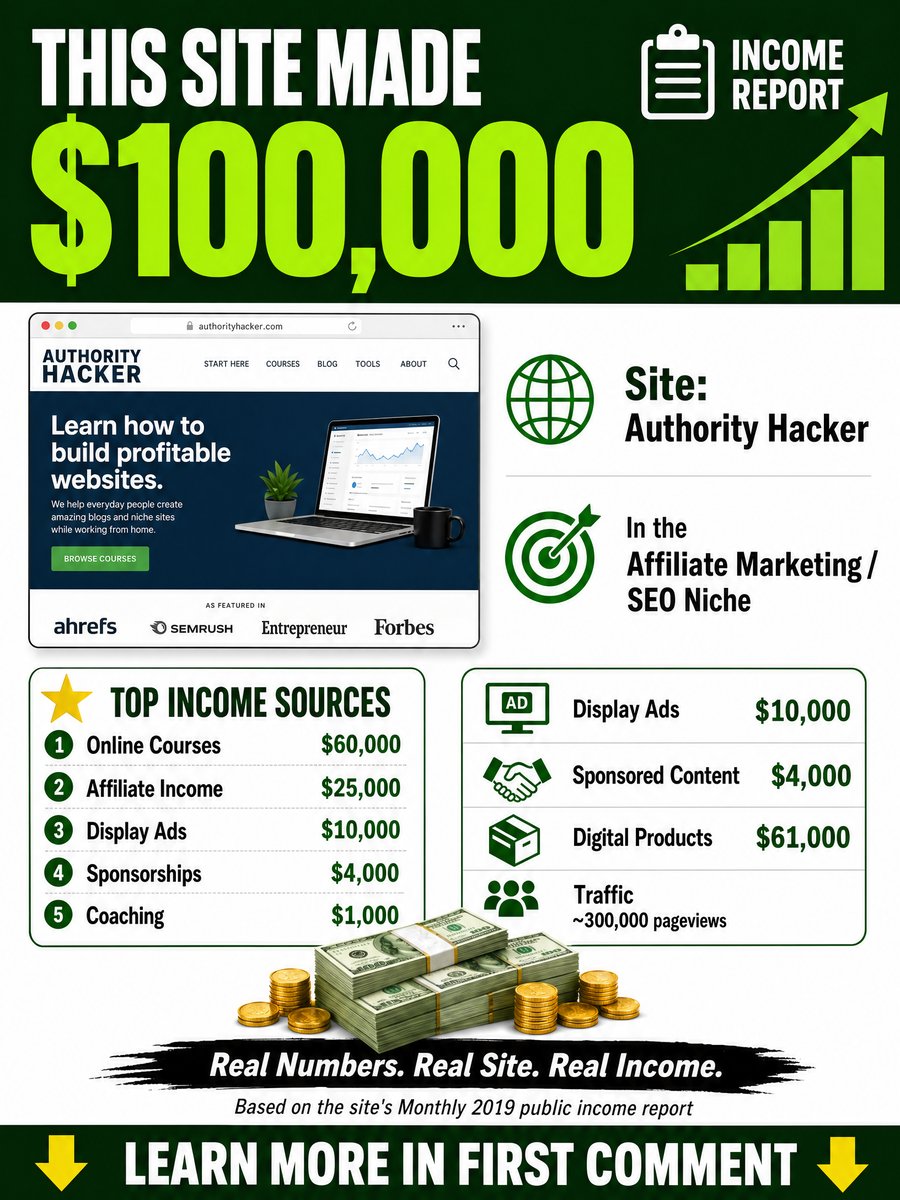
An affiliate marketing and SEO website can grow beyond referral commissions into a diversified digital education business. By building expertise, earning trust, and creating courses, training, tools, and resources, publishers can monetize their knowledge in multiple ways. The Authority Hacker example in the supplied image illustrates this approach.
The image presents Authority Hacker as generating about $100,000 per month from 300,000 pageviews, with revenue from online courses, affiliate income, display ads, sponsorships, and coaching. However, these figures come from the supplied graphic and should be treated as estimates rather than independently verified current earnings.
Authority Hacker is a real and active company founded by Gael Breton and Mark Webster in 2014. The business has evolved over time, showing how SEO expertise can develop into a broader education-focused brand.
Site Snapshot
| Metric | Information |
| Site | Authority Hacker |
| Niche | Affiliate Marketing / SEO / Online Business |
| Monthly Revenue Shown in Image | ~$100,000 |
| Monthly Traffic Shown in Image | ~300,000 Pageviews |
| Largest Revenue Source Shown | Online Courses — $60,000 |
| Affiliate Income Shown | $25,000 |
| Display Ads Shown | $10,000 |
| Sponsorships Shown | $4,000 |
| Coaching Shown | $1,000 |
| Report Period Claimed by Image | Monthly 2019 Public Income Report |
What Is Authority Hacker?
Authority Hacker was founded by Gael Breton and Mark Webster in 2014 after they transitioned from running an agency to creating educational resources for online business owners. The company says it has helped more than 15,000 customers and built its reputation by testing strategies before teaching them.
The brand became known for SEO, content marketing, affiliate marketing, link building, and authority website strategies. Its growth shows how free educational content can build an audience that becomes more valuable than advertising alone.
Since 2019, Authority Hacker has evolved toward AI-powered growth systems and automation for established businesses. This highlights an important lesson: successful content businesses must adapt their products and strategies as technology and markets change.
Understanding the $100,000 Monthly Revenue Figure
The supplied image estimates Authority Hacker earns around $100,000 per month, with revenue from online courses ($60,000), affiliate income ($25,000), display ads ($10,000), sponsorships ($4,000), and coaching ($1,000). These figures add up exactly to the reported total.
The image also includes a summary panel showing $10,000 from ads, $4,000 from sponsorships, and $61,000 from digital products, which appears to combine courses and coaching. Since the affiliate figure is not included in that summary, the detailed income table provides the most complete breakdown.
| Revenue Source | Monthly Amount Shown | Share of $100,000 |
| Online Courses | $60,000 | 60% |
| Affiliate Income | $25,000 | 25% |
| Display Ads | $10,000 | 10% |
| Sponsorships | $4,000 | 4% |
| Coaching | $1,000 | 1% |
| Total | $100,000 | 100% |
These figures should not be interpreted as Authority Hacker’s present-day revenue. They represent the historical model described by the supplied image, while the company’s current products and positioning are substantially different.
Online Courses: $60,000 Per Month
Online courses are the largest revenue source in the supplied image, generating an estimated $60,000 per month (60% of the reported total). This highlights the difference between monetizing traffic and monetizing expertise.
- Traffic-based model: Display ads earn revenue mainly from pageviews, meaning publishers often need large amounts of traffic to generate significant income.
- Expertise-based model: Premium courses can generate hundreds or thousands of dollars from a single customer, allowing a smaller but highly targeted audience to produce substantial revenue.
Authority Hacker built its reputation around SEO, affiliate marketing, authority websites, and online business education. Over time, the company shifted its focus as the content-site landscape changed, moving toward AI and automation resources such as its AI Accelerator. The broader lesson remains the same: free content builds an audience, while premium education turns that audience into higher-value revenue.
Affiliate Marketing: $25,000 Per Month
Affiliate marketing is the second-largest revenue source in the image, generating about $25,000 per month. It works well with SEO and education websites because readers often need tools to apply what they learn.
For example, keyword research articles can recommend SEO tools, email tutorials can mention email platforms, and website guides can include hosting, analytics, or conversion software.
Relevant affiliate categories can include:
- SEO software: Keyword research, rank tracking, backlink analysis, and site-audit platforms.
- Web hosting: Hosting and managed WordPress services.
- Email marketing: Newsletter and marketing automation platforms.
- Website tools: Themes, page builders, plugins, and optimization software.
- Analytics: Reporting, attribution, and conversion tools.
- AI tools: Content, research, automation, coding, and productivity platforms.
- Business software: Project management, CRM, outreach, and workflow tools.
Affiliate recommendations work best when they naturally support useful educational content. Trust grows when readers believe recommendations are based on value, not just commissions. Authority Hacker also emphasizes that its content is educational, not a guarantee of results, and encourages readers to do their own research because online business practices change frequently.
Display Advertising: $10,000 Per Month
The image estimates around $10,000 per month from display advertising, representing 10% of the reported $100,000 total. While valuable, it is much smaller than the revenue attributed to courses and affiliate marketing.
- Traffic alone is not the main driver: General publishers often rely heavily on large pageview numbers because each visitor has lower commercial value.
- Expert audiences are more valuable: SEO and business-focused websites can earn more from a smaller audience because readers are more likely to buy software, courses, memberships, and tools.
With an estimated 300,000 monthly pageviews, advertising would serve as supporting income rather than the main business engine. The greater value of the traffic comes from converting readers into customers for higher-value offers.
Sponsorships: $4,000 Per Month
The supplied graphic estimates around $4,000 per month from sponsorships. This revenue stream fits well with marketing-focused publications because brands like SEO tools, software companies, hosting providers, and business services want access to targeted audiences.
- Sponsorship opportunities: Publishers can sell newsletter placements, podcast sponsorships, webinars, sponsored articles, video integrations, or event partnerships.
- Owned audiences create value: A strong email list, podcast, or community allows publishers to reach readers directly instead of depending only on search traffic or ad networks.
- Audience quality matters: A smaller audience of business owners or marketers can be more valuable to sponsors than a larger but less targeted audience.
Authority Hacker’s broader media presence demonstrates the importance of building a recognizable audience, not just chasing pageviews.
Coaching: $1,000 Per Month
Coaching is the smallest revenue source in the image at approximately $1,000 per month, but it shows another way expertise can be monetized.
- High-value guidance: Experts in SEO, affiliate marketing, conversion optimization, or business systems can offer personalized support to customers who need direct help.
- Limited scalability: Coaching depends on the creator’s time, unlike courses or digital products that can be sold repeatedly.
- Useful for growth: Early coaching and consulting can reveal customer problems and questions, which can later inspire articles, templates, courses, tools, or other scalable products.
Why Affiliate Marketing and SEO Content Can Be Valuable
Affiliate marketing and SEO attract a valuable audience because readers are often looking for solutions to business goals like increasing traffic, improving rankings, boosting conversions, or building better systems.
- High commercial intent: These audiences often need software, training, tools, or services, creating more monetization opportunities than general informational content.
- Content can support multiple revenue streams: A useful tutorial can attract search traffic, build trust, recommend relevant products, grow an email list, and lead readers toward premium offers.
The stronger strategy is not just publishing SEO articles with ads. It is building an ecosystem where free content builds authority and paid products solve more valuable problems.
Content Strategy for an Affiliate Marketing and SEO Website
A successful website in this niche needs valuable educational content, not just product reviews. The best strategy is to solve real marketing and website problems through tutorials, experiments, case studies, comparisons, industry insights, and practical workflows. Organizing content into topic clusters helps readers explore related resources and builds long-term authority.
Strong content categories include:
- Affiliate marketing
- Search engine optimization
- Keyword research
- Content strategy
- Link building
- Conversion optimization
- Email marketing
- Website monetization
- AI and automation
- Marketing software
- Online business systems
- Case studies and experiments
Authority Hacker’s current positioning continues this educational approach even though the subject matter has evolved. The company’s present site describes its work as testing systems internally and then teaching what has been validated, with current material increasingly focused on AI-enabled business growth.
Keyword Opportunities
An affiliate marketing and SEO publication can target both informational and commercial search queries. Informational searches bring users into the website earlier in their learning process, while commercial searches attract visitors who are evaluating software or other paid solutions. A healthy content strategy generally needs both.
Informational keyword ideas include:
- how affiliate marketing works
- how to start affiliate marketing
- SEO for beginners
- how to do keyword research
- how to build backlinks
- how to increase organic traffic
- content marketing strategy
- affiliate website examples
- how to monetize a website
- how to improve Google rankings
Commercial-intent keywords like “best SEO tools,” “keyword research tools,” “email marketing software,” and software comparisons may attract fewer visitors but often bring higher-value audiences closer to purchasing. However, keyword selection should also consider search intent, expertise, competition, and the ability to create genuinely useful content.
Building Topical Authority
Topical authority comes from covering a subject deeply and connecting related content in a useful structure. Instead of targeting random keywords, an affiliate marketing website can create content clusters that guide readers from beginner topics to advanced strategies.
- Example cluster: A keyword research section could include beginner guides, search intent, long-tail keywords, competitor analysis, keyword clustering, tool comparisons, and real case studies.
- Internal linking improves the experience: Connected resources help readers continue learning without needing to search for every next step.
- Original experience builds stronger authority: Real examples, experiments, screenshots, data, lessons, and results create content that is harder for competitors to copy.
Email Marketing as a Core Business Asset
Email is especially valuable for education businesses because most visitors will not buy a course or software on their first visit. An email list allows publishers to continue providing value and build long-term relationships.
- Owned audience matters: Authority Hacker’s current website highlights an audience of over 80,000 email subscribers, showing the importance of direct communication.
- Lead magnets attract subscribers: Smaller websites can offer useful resources like SEO checklists, keyword templates, content brief templates, affiliate launch guides, or free mini-courses.
- Email supports monetization: Subscribers can receive educational content, case studies, product recommendations, and updates that gradually build trust and encourage purchases.
YouTube and Podcast Opportunities
SEO and online-business education work well across multiple formats because many topics benefit from demonstrations, interviews, and detailed explanations.
- Repurpose content: One research project can become a blog article, YouTube tutorial, podcast episode, newsletter, and social media posts.
- Reach different audiences: Multiple formats allow people to learn through their preferred channels while increasing the value of each piece of research.
Authority Hacker shows the value of diversification, with its podcast expanding its reach beyond written content. A strong content business should build relationships across multiple platforms instead of relying on one channel alone.
Creating Digital Products
The image’s $60,000 course figure demonstrates why digital products can dramatically change the economics of a niche website. A publisher that only earns advertising revenue monetizes attention indirectly, while a publisher selling its own education captures substantially more value when readers need deeper assistance.
Possible products for an SEO and affiliate marketing publication include:
- Online courses
- Premium communities
- SEO templates
- Content brief systems
- Keyword research spreadsheets
- Outreach templates
- Marketing SOPs
- Automation workflows
- Reporting dashboards
- Training libraries
Digital products should solve problems that free articles cannot solve efficiently. A paid course should not simply package information already available elsewhere. Its value can come from organization, implementation guidance, tested systems, templates, community support, or access to expertise. Authority Hacker’s present AI Accelerator follows this broader model by combining educational material, community, and implementation resources around AI and automation.
Why Diversified Monetization Matters
The key lesson from the income model is not the $100,000 revenue figure, but the diversification behind it. The reported income comes from five sources: courses, affiliate commissions, advertising, sponsorships, and coaching.
- Diversification reduces risk: Affiliate rates can change, ad revenue can fluctuate, search traffic can decline, and products can become outdated.
- Adaptation is essential: Authority Hacker’s shift from traditional SEO courses toward AI and automation shows why digital businesses must evolve with changing markets.
The main takeaway is that successful content businesses are built on multiple revenue streams rather than relying on one model forever.
How a New Website Could Apply This Model
A new publisher should not begin by trying to reproduce a $100,000-per-month business immediately. A more realistic approach is to establish expertise around a specific problem, build a library of genuinely useful content, develop an email audience, and introduce monetization gradually.
The progression could look like this:
- Choose a focused audience: Target a defined type of marketer or online-business owner rather than everyone interested in making money online.
- Build expert content: Publish tutorials, experiments, case studies, and useful resources.
- Develop owned distribution: Build an email list rather than depending entirely on search traffic.
- Introduce relevant affiliates: Recommend products that genuinely help readers implement the strategies being taught.
- Create a small digital product: Use recurring audience problems to determine what people may pay to solve.
- Expand into premium education: Develop courses, communities, templates, or systems only after validating demand.
- Diversify traffic: Add video, podcasting, partnerships, social distribution, and direct audience channels.
- Continuously update the model: Retire products and strategies when market conditions make them less useful.
This approach is slower than simply publishing affiliate articles, but it creates a more defensible business because the publisher is building expertise, audience relationships, intellectual property, and products simultaneously.
Conclusion
The Authority Hacker affiliate marketing and SEO model shows how educational content can grow into a larger digital business. The supplied image estimates around $100,000/month from 300,000 pageviews through courses, affiliate income, ads, sponsorships, and coaching, though these figures should be treated as reported estimates rather than independently verified results. The broader lesson is that specialized expertise can be monetized beyond advertising by combining free content, affiliate recommendations, audience building, and premium products that solve valuable problems.
Key Takeaway: An Affiliate Marketing and SEO Website can become a valuable digital education business by combining free content with courses, affiliate partnerships, ads, sponsorships, and premium services. The supplied Authority Hacker example shows that owned products can generate more value than relying only on traffic, with courses accounting for most reported revenue. However, success today requires adapting through original expertise, strong content, email audiences, multiple channels, trusted recommendations, and products that solve real customer problems.
Leave a Reply