Income School Blogging and SEO Website Makes $40,000 Per Month
Building a profitable website requires more than random articles. The strongest model combines SEO, useful content, audience trust, affiliates, education, advertising, and other relevant revenue streams.
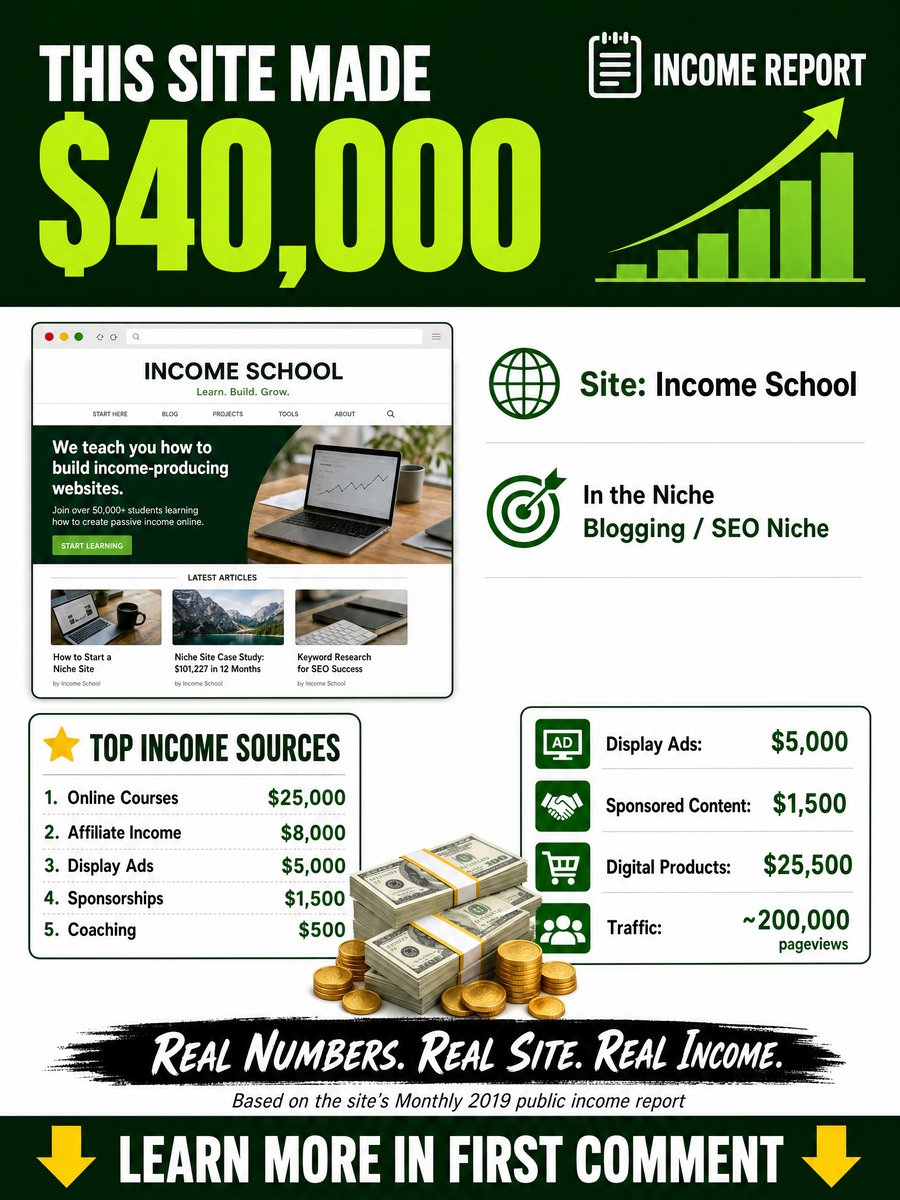
Income School demonstrates this approach. According to the supplied 2019 public income report, the business generated about $40,000/month from 200,000 pageviews in the Blogging and SEO niche. Revenue came from online courses ($25,000), affiliates ($8,000), ads ($5,000), sponsorships ($1,500), and coaching ($500).
The key lesson is that a targeted audience can be highly valuable. Readers building websites often need training, tools, hosting, and software, allowing educational content to generate revenue beyond advertising. This report explores the business model, SEO strategy, affiliate opportunities, and monetization methods behind a successful blogging-focused website.
Site Snapshot
| Metric | Details |
| Website | Income School |
| Primary Niche | Blogging / SEO |
| Related Topics | Niche Sites, Keyword Research, Website Building, Online Business |
| Estimated Monthly Revenue | $40,000 |
| Estimated Monthly Traffic | ~200,000 Pageviews |
| Largest Revenue Source | Online Courses |
| Online Courses | $25,000 |
| Affiliate Income | $8,000 |
| Display Ads | $5,000 |
| Sponsorships | $1,500 |
| Coaching | $500 |
| Report Basis | Monthly 2019 Public Income Report |
Why the Blogging and SEO Niche Can Be Profitable
Blogging and SEO have strong monetization potential because the audience is usually trying to accomplish something measurable. Readers may want to start a website, increase Google traffic, find better keywords, build an affiliate site, grow an email list, or turn content into income.
Those goals often require both education and software.
A person searching for “how to start a niche website” may eventually purchase hosting. Someone learning keyword research may subscribe to an SEO platform. Another reader might decide that following scattered tutorials takes too long and purchase a structured course instead.
Useful content areas include:
- Starting a blog
- Building niche websites
- Keyword research
- SEO for beginners
- Content planning
- Affiliate marketing
- Website monetization
- WordPress
- Organic traffic
- Email marketing
- Niche selection
- Blogging case studies
These subjects also connect naturally with one another. Someone who learns how to choose a niche will eventually need help creating content, ranking that content, monetizing traffic, and improving the business. A well-organized website can guide readers through that entire journey.
Revenue Breakdown
The reported $40,000 comes from five distinct revenue streams, giving the business much more diversification than a website dependent entirely on ads.
| Revenue Source | Estimated Monthly Revenue |
| Online Courses | $25,000 |
| Affiliate Income | $8,000 |
| Display Ads | $5,000 |
| Sponsorships | $1,500 |
| Coaching | $500 |
| Estimated Total | $40,000 |
The broader monetization summary groups $25,500 under digital products. That aligns directly with the $25,000 in online-course income plus $500 in coaching.
| Summary Category | Amount |
| Digital Products | $25,500 |
| Display Ads | $5,000 |
| Sponsored Content | $1,500 |
| Traffic | ~200,000 Pageviews |
The remaining $8,000 comes from affiliate income, completing the $40,000 total.
This structure immediately tells us something important: the business isn’t built around maximizing pageviews. It’s built around turning a targeted audience into customers and qualified referrals.
How Income School Makes Money
Income School’s model combines free education with multiple revenue streams, allowing readers to enter at different levels of commitment.
- Online Courses ($25,000): The largest source, showing strong demand for structured training.
- Affiliate Marketing ($8,000): Monetizes recommendations for hosting, SEO tools, email platforms, and other blogging resources.
- Display Advertising ($5,000): Earns revenue from free-content visitors who are not ready to buy.
- Sponsorships ($1,500): Provides direct income from brands targeting website owners and entrepreneurs.
- Coaching ($500): Offers personalized support for readers seeking additional guidance.
This approach creates a balanced business by serving both free readers and paying customers.
Online Courses Are the Core Revenue Driver
The largest source is clearly online education, with $25,000 coming from courses. That’s especially logical in the blogging and SEO niche because readers are trying to learn processes that involve many connected steps.
A free blog post can explain keyword research. Another can teach basic SEO. Another can cover niche selection. But someone who wants a complete system may prefer a structured program that puts everything in the correct order.
Courses in this niche can cover topics such as:
- Starting a niche website
- Finding profitable topics
- Keyword research
- SEO fundamentals
- Writing search-focused content
- Website monetization
- Affiliate marketing
- Content planning
- Growing organic traffic
The advantage for the publisher is ownership. Affiliate programs can change their commissions and ad revenue can fluctuate, but an owned course gives the business more control over pricing, curriculum, positioning, and customer relationships.
It also increases revenue per reader. Even a relatively small number of course buyers can generate far more income than thousands of additional ad impressions.
Affiliate Marketing Adds $8,000
Affiliate income contributes $8,000, making it a major revenue source because blogging requires tools and services.
- Natural product fit: Hosting, SEO tools, and email platforms can be recommended within relevant tutorials.
- Helpful first: The best affiliate strategy is recommending products that genuinely help readers complete a task.
- Content leads the recommendation: Products should support the solution rather than become the main purpose of the article.
Popular Affiliate Programs
The report provides an $8,000 affiliate-income figure, but it doesn’t identify the individual programs responsible for that revenue. The following are current examples that fit a Blogging and SEO Website; they should not be treated as confirmed Income School partnerships.
Affiliate Program Breakdown
| Affiliate Program | Category | Official Link |
| Bluehost | Web Hosting | Bluehost Affiliate Program |
| Semrush | SEO and Keyword Research | Semrush Affiliate Program |
| Kit | Email Marketing | Kit Affiliate Program |
| WP Engine | Managed WordPress Hosting | WP Engine Affiliate Program |
Bluehost, Semrush, Kit, and WP Engine offer affiliate programs for creators promoting hosting, SEO, email, and marketing tools. Programs and commissions can change, so publishers should verify current terms.
The best affiliate strategy is not choosing the highest payout, but recommending products that genuinely solve the reader’s problem.
Display Ads and Sponsorships Provide Supporting Revenue
- Display Ads ($5,000): Provide supporting revenue from informational readers who may not be ready to buy. Articles, case studies, and tutorials can still generate value through traffic.
- Sponsored Content ($1,500): Brands in hosting, SEO, content tools, website platforms, and email marketing may pay to reach a targeted audience.
- Trust matters: Paid partnerships should be clearly disclosed, with a clear separation between sponsored content and independent recommendations.
Content Strategy for a Blogging and SEO Website
A strong Blogging and SEO Website needs more than generic articles about “making money online.” The content should solve specific problems people encounter while building and growing websites.
Case studies are especially valuable because they turn abstract strategies into something concrete. A detailed article explaining how a niche site was built, what content was published, and what results followed can be far more useful than another list of generic SEO tips.
Useful content categories include:
- How to start a niche site
- Keyword research tutorials
- SEO guides
- Niche-site case studies
- Website monetization
- Blogging strategy
- Affiliate marketing
- Content planning
- Organic traffic
- Website tools
A strong content library should also serve different experience levels. Beginner guides bring new people into the audience, while detailed SEO and monetization articles give more experienced readers reasons to stay.
That progression supports the course model nicely. Readers can learn freely until they decide they want more organized training.
Keyword Opportunities
This niche includes a healthy mix of informational and commercial searches. Informational keywords build traffic, while commercial keywords can lead directly to affiliate revenue.
Potential informational topics include:
- how to start a niche website
- blogging for beginners
- how to find a niche
- keyword research for beginners
- how to get organic traffic
- how to monetize a blog
- SEO for bloggers
- affiliate marketing for beginners
- how to build a content website
- niche site ideas
Commercial topics can include:
- best web hosting for bloggers
- best keyword research tools
- best SEO software
- best email marketing platform
- best WordPress hosting
- SEO tool comparison
- blogging tools
- website hosting comparison
The strongest approach uses both types. Educational articles bring people into the site, and commercial articles help readers choose the products they need once they’re ready to act.
SEO Strategy
A website teaching SEO should prove its expertise through its own content strategy. Strong results come from building useful topic clusters rather than chasing random keywords.
- Keyword Research Cluster: Covers search intent, competition, long-tail keywords, topic selection, content planning, and tools.
- Niche Site Cluster: Covers choosing a niche, launching a site, creating content, getting traffic, monetizing, and scaling.
- Internal linking: Helps readers move through related topics while improving site structure.
- Regular updates: SEO changes over time, so tutorials and tool reviews need maintenance.
- Original case studies: Provide unique value and help a site stand out from competitors.
Traffic Strategy Behind 200,000 Pageviews
The report shows about 200,000 pageviews, but it does not provide a breakdown of traffic sources.
- Search traffic: Helps attract new readers through tutorials and keyword-focused content.
- Email audience: Turns visitors into returning readers through newsletters, case studies, and product updates.
- Video content: Can support topics that benefit from demonstrations, such as SEO tools or website setup.
The key is converting traffic into an owned audience, since returning subscribers are more valuable than one-time visitors.
Why This Business Model Works
The Income School model works because the audience has a clear objective: building and growing websites. That objective naturally creates demand for both information and products.
Free articles attract people who are learning. Courses provide structured training for readers who want to move faster. Affiliates monetize tools those readers already need. Ads monetize broader informational traffic. Sponsorships create additional revenue from relevant companies.
The numbers make the balance easy to see:
- Courses: $25,000
- Affiliate Income: $8,000
- Display Ads: $5,000
- Sponsorships: $1,500
- Coaching: $500
The biggest lesson is that only $5,000 of the $40,000 total comes from display advertising. Most of the business depends on serving a targeted audience more deeply.
That’s why 200,000 pageviews can support a much stronger business than the traffic number alone might suggest.
Lessons for Content Creators
A new creator in the Blogging and SEO niche should prioritize usefulness and trust over exaggerated income claims.
- Create valuable content: Solve specific problems, build connected topic clusters, and use transparent case studies.
- Build relationships: Grow an email list and recommend tools only when they genuinely help readers.
- Monetize with value: Courses, affiliates, and products work best when they provide deeper solutions than free content.
The strongest asset is not traffic or a single product—it is audience trust.
Conclusion
The Income School Blogging and SEO Website report shows how educational content can build a diversified online business. The 2019 report estimates $40,000/month from 200,000 pageviews, with $25,000 from courses, $8,000 from affiliates, $5,000 from ads, $1,500 from sponsorships, and $500 from coaching.
The key lesson is that success comes from building a trusted learning ecosystem, not just publishing SEO articles. A targeted audience can support courses, affiliates, ads, sponsorships, and services without requiring massive traffic.
Leave a Reply