Wellness Mama Natural Health and Holistic Parenting Website Makes $80,000 Per Month
Health, nutrition, parenting, and natural living are evergreen topics with strong search demand. A Natural Health and Holistic Parenting Website can combine these interests and monetize through ads, affiliates, sponsorships, digital products, and audio content.
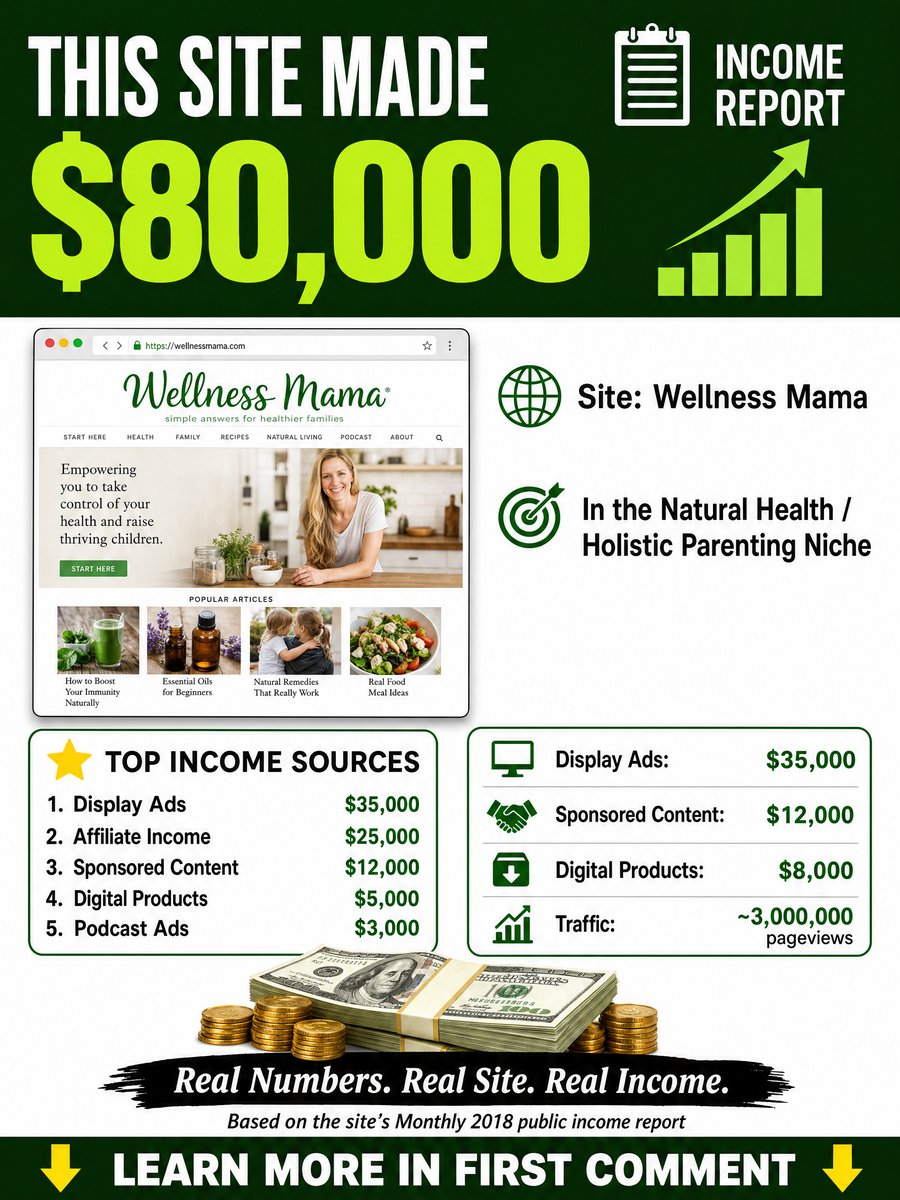
The supplied report image features Wellness Mama, estimating about $80,000/month from 3 million pageviews. The detailed breakdown shows $35,000 from ads, $25,000 from affiliates, $12,000 from sponsorships, $5,000 from digital products, and $3,000 from podcast ads. A separate summary panel shows broader categories, but the detailed list provides the clearest breakdown.
This report explores the niche’s monetization model, content strategy, SEO opportunities, affiliate potential, podcast growth, and the importance of responsible health publishing.
Site Snapshot
Site Snapshot
| Metric | Details |
| Website | Wellness Mama |
| Domain Shown | wellnessmama.com |
| Primary Niche | Natural Health and Holistic Parenting |
| Related Topics Shown | Health, Family, Recipes, Natural Living, Podcast |
| Estimated Monthly Revenue Shown | $80,000 |
| Estimated Traffic Shown | ~3,000,000 Pageviews |
| Largest Income Source Shown | Display Advertising |
| Primary Monetization | Display Ads, Affiliate Income, Sponsored Content, Digital Products, Podcast Ads |
| Report Basis Shown | Monthly 2018 Public Income Report |
Why the Natural Health and Holistic Parenting Niche Is So Profitable
The Natural Health and Holistic Parenting niche is valuable because it connects with major consumer categories like food, household products, wellness, education, and family needs. A trusted publication can influence many purchasing decisions.
The audience also has strong long-term potential. Readers may return for recipes, parenting advice, natural living, and wellness content, creating opportunities for newsletters, podcasts, affiliates, and digital products.
Popular content areas in this niche can include:
- Healthy family recipes
- Meal planning
- Ingredient guides
- Family wellness routines
- Natural living
- Household product comparisons
- Parenting resources
- Family organization
- Food preparation
- Personal care
- Sleep routines
- Fitness and movement
- Podcast interviews
- Evidence-based wellness education
The image itself illustrates this breadth through visible article topics involving immunity, essential oils, natural remedies, and real-food meal ideas. Those themes show the kind of content the publication uses, but health-related claims should always be evaluated carefully rather than repeated simply because they appear in a lifestyle article.
Estimated Monthly Revenue Breakdown
The image’s detailed Top Income Sources panel provides the clearest explanation of the $80,000 headline figure. The five listed sources add exactly to $80,000, so they should be treated as the primary revenue breakdown when analyzing the graphic.
| Revenue Source | Amount Shown |
| Display Ads | $35,000 |
| Affiliate Income | $25,000 |
| Sponsored Content | $12,000 |
| Digital Products | $5,000 |
| Podcast Ads | $3,000 |
| Estimated Total | $80,000 |
The right-side summary panel presents the business somewhat differently:
| Highlighted Metric | Amount Shown |
| Display Ads | $35,000 |
| Sponsored Content | $12,000 |
| Digital Products | $8,000 |
| Traffic | ~3,000,000 Pageviews |
The image does not explicitly explain why digital products are $5,000 in the detailed list but $8,000 in the summary. Because $5,000 in digital products plus $3,000 in podcast ads equals $8,000, the summary may be grouping those categories together. That is an interpretation, however, not something the source states directly, so it is more accurate to keep both panels visible rather than silently rewriting the numbers.
How Wellness Mama Makes Money
The business model shown in the image combines traffic-based revenue with higher-value audience monetization:
- Display Advertising ($35,000): The largest revenue source. With around 3 million pageviews, informational content can generate significant ad revenue even from readers who are not ready to buy.
- Affiliate Income ($25,000): Wellness and parenting content naturally connects with products like kitchen tools, books, household items, personal care products, and educational resources. The best recommendations solve real reader problems.
- Sponsored Content ($12,000): Brands targeting parents, families, and wellness audiences may pay to reach a trusted community through sponsored articles or campaigns.
- Digital Products ($5,000): A wellness site can create owned products such as meal plans, recipe collections, printable guides, family resources, and educational materials.
- Podcast Ads ($3,000): Audio content builds deeper audience relationships and creates another monetization channel beyond website traffic.
Display Advertising Benefits From Broad Evergreen Content
The $35,000 display-ad figure shows how broad informational content can generate revenue even when readers are not ready to buy.
- Evergreen traffic adds up: Articles about recipes, parenting, family routines, and natural living can attract consistent search traffic over time.
- Trust drives long-term value: A good user experience encourages visitors to return, subscribe, listen to podcasts, and purchase recommended products.
- Content supports multiple revenue streams: High-volume informational articles can become the foundation for ads, affiliates, sponsorships, and owned products.
Affiliate Marketing Opportunities
The image shows $25,000 in affiliate income, making product recommendations a major revenue source.
- Strong buying intent: Family and wellness readers often research products related to food, household needs, children, and personal care before purchasing.
- Potential categories: A site could cover kitchen tools, cookware, storage, books, educational products, fitness items, and wellness-related products.
- Trust matters: Wellness recommendations require careful research, as commissions should never outweigh evidence or safety.
- Focus on solving problems: Useful content like meal-prep guides, product comparisons, and transparent reviews can help readers make better decisions while generating affiliate revenue.
- Disclose partnerships: Clear affiliate disclosures maintain trust and keep recommendations reader-focused.
Popular Affiliate Programs
The supplied image confirms $25,000 in affiliate income, but it does not identify the specific programs responsible for that revenue. The following examples therefore represent relevant affiliate opportunities that a Natural Health and Holistic Parenting publisher could investigate, not programs confirmed by the image as being used by Wellness Mama.
Affiliate Program Breakdown
| Affiliate Program or Network | Relevant Category | Website |
| Amazon Associates | Books, Kitchen and Household Products | https://affiliate-program.amazon.com |
| Thrive Market | Grocery and Household Shopping | https://thrivemarket.com |
| iHerb | Wellness and Personal Care Products | https://www.iherb.com |
| Vitacost | Wellness and Household Products | https://www.vitacost.com |
| Impact | Brand and Retail Partnerships | https://impact.com |
| CJ Affiliate | Affiliate Network | https://www.cj.com |
| Awin | Retail and Lifestyle Affiliate Network | https://www.awin.com |
| ShareASale | Retail and Lifestyle Brands | https://www.shareasale.com |
Affiliate terms, commissions, and requirements can change, so publishers should verify current program details before promoting products. In wellness, credibility matters most—avoid unsupported health claims and prioritize trusted recommendations over short-term commissions.
Sponsored Content and Brand Partnerships
The report image shows $12,000 from sponsored content, highlighting the value of direct brand partnerships. Family wellness audiences are attractive because readers often make household purchasing decisions. Potential sponsors may include food, kitchen, household, personal-care, education, fitness, and family-focused brands that genuinely match the audience.
Sponsored campaigns could take several forms:
- Sponsored educational articles
- Recipe partnerships
- Newsletter sponsorships
- Podcast sponsorships
- Product demonstrations
- Branded video
- Seasonal family guides
- Sponsored giveaways
The strongest partnerships are those that make sense even without the payment. If a brand conflicts with the site’s editorial standards or requires exaggerated claims, the sponsorship can damage more long-term value than it creates in immediate revenue. Clear labeling is also essential. Readers should be able to distinguish sponsored material from independent editorial recommendations without ambiguity.
Digital Products Can Diversify Revenue
The image shows digital products as another revenue source, listing $5,000 in the detailed panel and $8,000 in the summary box. This suggests the business also monetizes through owned products rather than relying only on ads and sponsors. Digital products allow publishers to control pricing, branding, and customer relationships while providing deeper solutions than individual free articles.
Potential products in this niche include:
- Meal-planning templates
- Recipe collections
- Family routine planners
- Grocery planning resources
- Household organization systems
- Printable checklists
- Educational workshops
- Premium newsletters
- Wellness journals
- Family activity guides
The strongest digital products usually come from repeated audience questions. If readers continually struggle with weekly meal planning, for example, a useful planning system may have more value than simply publishing another list of recipes.
Owned products also help reduce dependence on advertising algorithms, affiliate commission changes, and sponsored-campaign availability.
Podcast Advertising Adds Another Audience Channel
The report lists $3,000 in podcast advertising, which may be smaller than other revenue sources but still provides strategic value.
- Builds deeper engagement: Podcasts allow longer conversations and stronger audience relationships compared with short website visits.
- Fits the niche well: Health, family, and lifestyle topics can work well through interviews, parenting discussions, nutrition topics, recipe stories, and expert conversations.
- Supports other revenue streams: A podcast can promote articles, newsletters, books, affiliate products, and digital resources while generating sponsorship income.
- Requires careful credibility: Health-related episodes should consider guest qualifications and avoid presenting unsupported claims as medical evidence.
Content Strategy That Can Drive 3 Million Pageviews
The reported 3 million pageviews suggest a broad content library covering recipes, parenting, wellness, lifestyle, and household topics. A diverse content strategy helps attract search traffic while allowing readers to discover related resources across the brand.
High-potential content categories include:
- Family recipes
- Healthy meal ideas
- Meal preparation
- Ingredient education
- Parenting routines
- Family organization
- Household products
- Natural living
- Personal care
- Fitness and movement
- Sleep habits
- Podcast interviews
- Evidence-based wellness education
- Food preparation techniques
A successful strategy should distinguish low-risk lifestyle content from higher-risk medical topics. An article about organizing a pantry requires different editorial controls from an article discussing disease, treatment, supplements, or children’s health. That distinction becomes essential as the site grows.
Keyword Opportunities
The Natural Health and Holistic Parenting niche contains enormous search demand because it combines several content categories that people research repeatedly. A publisher can target informational terms for traffic while using carefully selected commercial queries to generate affiliate revenue.
Potential high-traffic informational keywords include:
- healthy family meals
- easy healthy recipes
- meal planning for families
- healthy snacks for kids
- natural living
- family wellness
- healthy breakfast ideas
- family meal prep
- simple healthy dinners
- household organization
- healthy habits for families
- parenting routines
Potential commercial keywords can include:
- best blender for family meals
- best food processor
- best meal prep containers
- best cookware
- best family cookbooks
- best water filter
- best reusable food storage
- best kitchen tools
- best healthy cooking appliances
- best family meal planner
Commercial search intent can be highly valuable, but product recommendations should be based on transparent criteria rather than commission potential. For wellness-related products in particular, publishers should avoid implying that an ordinary consumer product can prevent, treat, or cure medical conditions without reliable evidence.
Building Strong Topic Clusters
Topic clusters can turn a wellness blog into an organized authority site by connecting related content and improving user navigation.
- Family Recipes: Covers breakfasts, dinners, snacks, meal prep, batch cooking, lunch ideas, freezer meals, and seasonal recipes. Product recommendations can naturally include cookware and kitchen tools.
- Natural Living: Focuses on low-waste habits, household routines, ingredient awareness, organization, and practical sustainability.
- Family Wellness: Includes sleep, movement, meal routines, stress management, and evidence-based lifestyle education.
- Parenting and Family: Covers routines, schedules, responsibilities, organization, and household systems.
This structure helps readers discover related content while making it easier for search engines to understand the site’s expertise.
SEO Strategy for a Health and Wellness Publisher
SEO in health-related niches requires extra care because content can influence real health decisions. Strong publishers should prioritize accurate sources, expert review, clear authorship, and trustworthy information over sensational claims or short-term rankings.
Important SEO and editorial practices include:
- Publishing comprehensive evergreen guides
- Using reliable scientific and medical references for health claims
- Identifying authors clearly
- Using qualified medical review when appropriate
- Separating personal experience from established evidence
- Updating articles as guidance changes
- Correcting outdated information
- Avoiding unsupported cure or treatment claims
- Building strong internal links
- Creating original recipes, photographs, and practical tools
Health articles should also communicate uncertainty when evidence is mixed. “Some evidence suggests” is different from “this works,” and responsible publishing should preserve that distinction. A high-quality wellness site can still rank strongly without exaggerating claims. In fact, credibility is one of the most defensible competitive advantages in the niche.
Medical Accuracy and Reader Trust
The natural-health focus of this niche makes strong editorial standards essential. Topics like immunity, essential oils, and natural remedies require careful handling because “natural” does not always mean safe or effective.
- Health claims need evidence: Natural products can cause allergies, interact with medications, or be unsuitable for certain people, including children and pregnant individuals.
- Use expert guidance: Higher-risk health topics should rely on credible evidence and qualified review. Serious conditions should be addressed by healthcare professionals.
- Trust drives growth: Accurate, responsible content builds reader confidence, leading to more returning visitors, subscribers, recommendations, and stronger commercial value.
Trust is a long-term business asset.
Estimated Traffic Strategy
The report image provides an overall traffic figure of approximately 3 million pageviews, but it does not specify what percentage comes from Google, direct visitors, social media, newsletters, or referrals. Any exact source breakdown would therefore be an estimate rather than information derived from the image.
A successful Natural Health and Holistic Parenting Website could reasonably use several acquisition channels together:
| Traffic Channel | Main Opportunity |
| Google Search | Recipes, family wellness and evergreen how-to content |
| Recipes, household ideas and visual lifestyle content | |
| Email Newsletter | Repeat visits and direct audience relationships |
| Direct Traffic | Returning readers and brand recognition |
| Podcast | Deeper audience engagement |
| Social Media | Recipes, family tips and short-form educational content |
| Referral Traffic | Mentions from other family, food and wellness publications |
Search can attract readers with specific questions, while visual platforms are especially useful for recipes and household content. Email and podcasts then help transform those one-time visitors into a recurring audience. A diversified traffic strategy also makes the business less vulnerable to changes on any single platform.
Email Marketing Can Increase Reader Lifetime Value
Email is especially valuable in this niche because families face recurring problems every week. Readers need meals, routines, household systems, wellness information, and parenting resources continuously rather than once.
Potential newsletter lead magnets include:
- Weekly family meal planner
- Grocery checklist
- Family routine template
- Healthy recipe collection
- Household organization checklist
- Meal-prep calendar
- Family wellness journal
An email list helps a wellness publication maintain direct relationships with readers through recipes, articles, podcasts, guides, and product recommendations. It also supports digital products and affiliate revenue while reducing reliance on search traffic. Over time, a strong email audience becomes a valuable business asset.
Why This Business Model Works
The Natural Health and Holistic Parenting model works because it combines enormous evergreen audience demand with multiple monetization channels. Families repeatedly search for meals, household solutions, parenting information, products, and wellness education, giving the publication numerous opportunities to remain relevant.
Several structural advantages make the model particularly attractive:
- Large family audience: Parenting and household topics affect millions of readers.
- Evergreen demand: Families continually need recipes, routines, and practical advice.
- Commercial product opportunities: Kitchen, household, food, and lifestyle purchases support affiliate content.
- High pageview potential: Broad informational coverage can create substantial ad inventory.
- Brand sponsorship opportunities: Family and lifestyle brands want targeted audiences.
- Podcast compatibility: Wellness and parenting topics work well in long-form conversation.
- Owned-product potential: Planners, guides, recipes, and educational products can diversify revenue.
- Strong repeat behavior: Readers can return weekly or even daily for new information.
The model becomes strongest when the site treats reader trust as the foundation of monetization rather than something that can be traded away for higher short-term commissions.
Lessons for Content Creators
A new publisher should avoid competing through volume alone. The stronger strategy is to focus on a specific audience, solve real family problems, and build trusted expertise. Health content also requires greater responsibility than general lifestyle topics. As the stakes increase, publishers need stronger research, accuracy, and editorial standards.
Key lessons include:
- Choose a defined audience: Know whether the site serves parents, busy families, wellness-focused households, or another specific group.
- Build deep topic clusters: Recipes, family routines, natural living, and wellness can support extensive evergreen libraries.
- Use evidence carefully: Do not turn anecdotes into medical claims.
- Invest in original content: Recipes, photography, testing, and firsthand experience create differentiation.
- Use affiliates responsibly: Recommend products because they fit the reader’s needs.
- Disclose sponsorships clearly: Commercial relationships should never be hidden.
- Build an email list: Direct audience access reduces dependence on algorithms.
- Use podcasts strategically: Audio can deepen trust and add sponsorship inventory.
- Develop owned products: Planners, guides, and other resources can diversify income.
- Prioritize long-term credibility: Trust is more valuable than any single affiliate commission.
A publication that consistently helps families make better-informed decisions can build a much stronger business than one designed merely to maximize clicks.
Conclusion
The Wellness Mama Natural Health and Holistic Parenting Website example shows how family-wellness content can combine large-scale traffic with multiple revenue streams. Recipes, parenting, natural living, podcasts, and wellness education can attract a wide audience.
According to the supplied image, the site generates about $80,000 from 3 million pageviews, with $35,000 from ads, $25,000 from affiliates, $12,000 from sponsorships, $5,000 from digital products, and $3,000 from podcast ads. A separate $8,000 digital products figure appears in the image, but its relationship to the detailed breakdown is unclear.
The key lesson is that a strong wellness publication grows through evergreen content, affiliates, ads, sponsorships, products, email, and podcasts. However, long-term success depends most on building reader trust through accurate and responsible information.
Key Takeaway: The Wellness Mama report shows a diversified Natural Health and Holistic Parenting Website model with revenue from ads, affiliates, sponsorships, digital products, and podcasts alongside about 3 million pageviews. The strongest strategy is combining evergreen family content, trusted recommendations, email, podcasts, sponsorships, and owned resources while making credibility the foundation of the business.
Leave a Reply