Gretchen Rubin Happiness and Habits Website Makes $80,000 Per Month
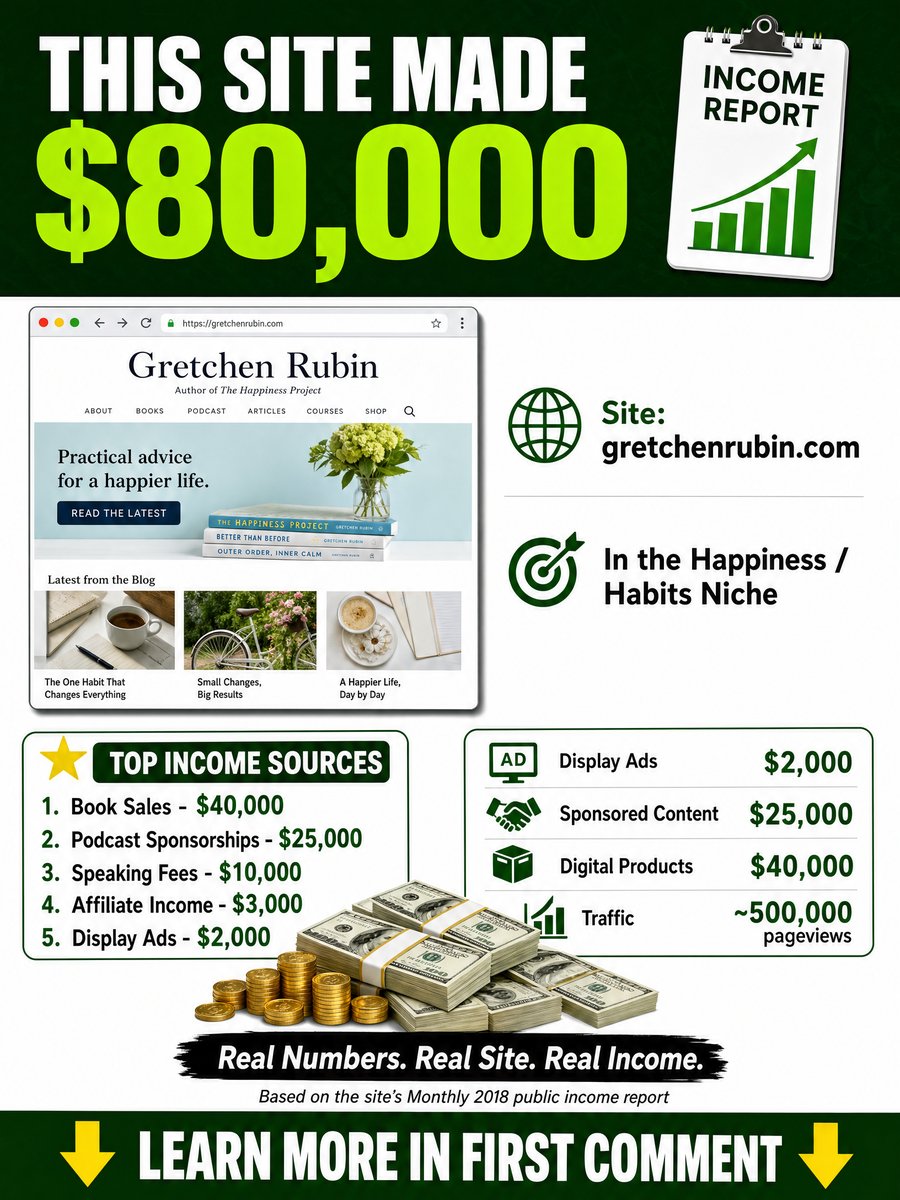
Happiness and habit-building are evergreen personal-development topics, giving creators opportunities to build loyal audiences through content, products, and media. The supplied report image features Gretchen Rubin and estimates $80,000/month from 500,000 pageviews, with revenue from books ($40,000), podcast sponsorships ($25,000), speaking ($10,000), affiliates ($3,000), and ads ($2,000).
The separate summary panel aligns with these categories, showing $40,000 in digital products, $25,000 in sponsored content, and $2,000 in ads. Based on the image’s 2018 public income report, these figures should be treated as estimates. The key lesson is that personal-development brands can monetize trust and expertise through books, podcasts, speaking, affiliates, and products rather than relying mainly on advertising.
Site Snapshot
Site Snapshot
| Metric | Details |
| Website | Gretchen Rubin |
| Domain Shown | gretchenrubin.com |
| Primary Niche | Happiness and Habits |
| Related Topics | Habits, Happiness, Personal Growth, Daily Routines, Behavior Change |
| Estimated Monthly Revenue Shown | $80,000 |
| Estimated Monthly Traffic Shown | ~500,000 Pageviews |
| Largest Income Source Shown | Book Sales |
| Primary Monetization | Books, Podcast Sponsorships, Speaking, Affiliates, Display Ads |
| Digital Products Summary | $40,000 |
| Report Basis Shown | Monthly 2018 Public Income Report |
Why the Happiness and Habits Niche Can Be Profitable
The Happiness and Habits niche works because it focuses on recurring challenges like productivity, routines, organization, and personal growth. Readers often return as new goals and habits emerge.
Its broad appeal also makes it valuable. Students, professionals, parents, entrepreneurs, and retirees can apply habit-building ideas to work, relationships, health, finances, creativity, and daily life.
Useful content areas include:
- Building better habits
- Breaking unwanted habits
- Morning and evening routines
- Goal setting
- Personal organization
- Productivity
- Happiness practices
- Decision-making
- Motivation
- Reading habits
- Relationships
- Time management
- Self-reflection
- Everyday behavior change
That breadth allows a publisher to generate evergreen search traffic while also building a recognizable philosophy that can support books, podcasts, courses, journals, and speaking opportunities.
Estimated Monthly Revenue Breakdown
The supplied image’s Top Income Sources section gives the clearest breakdown of the featured $80,000 total. The five categories add exactly to the headline figure, so they provide a straightforward picture of how the business model is presented.
| Revenue Source | Amount Shown |
| Book Sales | $40,000 |
| Podcast Sponsorships | $25,000 |
| Speaking Fees | $10,000 |
| Affiliate Income | $3,000 |
| Display Ads | $2,000 |
| Estimated Total | $80,000 |
The image also summarizes selected categories separately:
| Highlighted Metric | Amount Shown |
| Display Ads | $2,000 |
| Sponsored Content | $25,000 |
| Digital Products | $40,000 |
| Traffic | ~500,000 Pageviews |
The two panels are reasonably consistent. Book sales account for the same $40,000 shown as digital products, while podcast sponsorships correspond to the $25,000 sponsored-content category. The remaining $13,000 comes from speaking fees, affiliate income, and advertising.
The biggest takeaway is clear: this model earns very little from display advertising compared with the income generated from books, audio sponsorships, and expertise.
How a Happiness and Habits Website Makes Money
The image shows how a creator-led personal-development site can earn more from expertise and audience trust than from advertising alone.
- Book Sales ($40,000): The largest revenue source. Books work well in this niche because readers often want complete frameworks for habits, motivation, routines, and personal growth.
- Podcast Sponsorships ($25,000): Long-form audio builds stronger audience relationships, allowing creators to earn from sponsors while providing valuable content.
- Speaking Fees ($10,000): A recognized personal-development brand can generate income through conferences, workshops, and professional events.
- Affiliate Income ($3,000): Relevant recommendations such as books, productivity tools, journals, and resources can add another revenue stream.
- Display Ads ($2,000): The smallest source, showing that creator-led brands can rely more on trust, products, and intellectual property than ad impressions.
Why Books Are the Core Revenue Driver
The $40,000 book-sales figure highlights how free content can become valuable intellectual property. Articles introduce ideas, while books provide deeper frameworks, examples, and structured guidance.
- Books strengthen the brand: They can attract new readers, grow podcast audiences, create speaking opportunities, and increase authority.
- Original frameworks create more opportunities: A unique idea can expand into articles, books, podcasts, workshops, journals, or courses.
Creator-led websites succeed when they build recognizable concepts rather than only publishing general self-improvement advice.
Podcast Sponsorships Build Revenue Around a Loyal Audience
The report shows $25,000 from podcast sponsorships, making audio a major revenue source. Podcast value comes from listener trust and attention, not just traffic.
- Strong content fit: Happiness and habit topics work well in audio through routines, personal stories, listener questions, relationships, and behavior discussions.
- Extends audience relationships: Podcasts can support books, newsletters, events, and future products by keeping listeners engaged over time.
- Sponsor alignment matters: Successful sponsorships should match the audience’s interests and protect the trust that makes the podcast valuable.
Affiliate Marketing Opportunities
The report lists $3,000 in affiliate income, showing that recommendations can complement a personal-development brand when they are relevant.
- Natural product fit: Potential recommendations include books, audiobooks, journals, productivity tools, planners, and educational resources.
- Helpful over promotional: The best affiliate content solves a reader’s problem instead of adding unnecessary product links.
- Examples: Reading habit articles can recommend books or audiobooks, while habit-tracking content can suggest journals or planning tools.
- Trust comes first: In personal development, long-term audience relationships matter more than maximizing short-term commissions.
Popular Affiliate Programs
The supplied image confirms affiliate revenue but does not identify which affiliate programs generated the $3,000 shown. The programs below are therefore relevant opportunities for a Happiness and Habits publisher to consider, not confirmed Gretchen Rubin partnerships.
Affiliate Program Breakdown
| Affiliate Program | Relevant Category | Website |
| Amazon Associates | Books, Journals and General Products | https://affiliate-program.amazon.com |
| Bookshop.org | Books | https://bookshop.org |
| Audible Affiliates | Audiobooks | https://www.audible.com |
| Impact Marketplace | Lifestyle and Digital Brand Partnerships | https://impact.com |
Relevant affiliate opportunities may include Amazon Associates for product referrals, Bookshop.org for book commissions, Audible for audiobook referrals, and Impact for discovering brand partnerships. Since commissions and requirements can change, publishers should verify current program terms before creating promotional content.
Content Strategy That Can Drive 500,000 Pageviews
The image shows around 500,000 pageviews, suggesting the need for a large library of evergreen content. Happiness and habit topics work well because readers continually search for advice on routines, motivation, and personal growth.
A strong strategy combines searchable guides with unique creator-led ideas, such as original frameworks, observations, and personal experiments.
Useful content categories include:
- Habit formation
- Happiness
- Daily routines
- Personal organization
- Motivation
- Goal setting
- Productivity
- Relationships
- Reading
- Personal experiments
- Reflection exercises
- Simple behavior changes
This mix gives the site two valuable traffic sources. Search-friendly articles introduce new readers, while distinctive ideas create loyal followers who begin seeking the creator by name rather than relying on Google to rediscover the website.
Keyword Opportunities
A Happiness and Habits Website can target a broad collection of evergreen informational searches. Many people begin with a specific problem rather than searching for a particular author, which gives a new publication plenty of opportunities to reach readers before it becomes a recognized brand.
Potential high-interest topics include:
- how to build better habits
- how to break a bad habit
- morning routine ideas
- habit tracker ideas
- how to be more consistent
- how to stop procrastinating
- how to create a routine
- daily habits for happiness
- how to read more books
- productivity habits
- goal setting habits
- how to stay motivated
Commercial searches can be narrower and should stay relevant to the editorial mission. Examples might include best habit journals, best books about habits, best productivity books, best planners, or audiobook services for personal-development readers.
The goal is not to publish a commercial article for every possible product. A better strategy is to build authority around useful informational content first and introduce commercial recommendations where readers genuinely need additional resources.
SEO Strategy
SEO can work especially well in this niche because many questions are timeless. An article explaining how to create a consistent habit can remain relevant for years when it is well written and periodically refreshed. The same applies to routines, organization, motivation, and many general personal-development topics.
A strong SEO strategy should emphasize topical depth rather than publishing isolated articles. A habit cluster might cover starting habits, tracking habits, recovering after missing a day, environmental cues, motivation, routines, and common mistakes. These pieces can link naturally to one another and provide a more complete learning experience.
Useful SEO practices include:
- Building deep topic clusters
- Publishing practical evergreen guides
- Using clear examples
- Creating original frameworks
- Updating older articles
- Strengthening internal links
- Writing titles that accurately match search intent
- Publishing distinctive ideas worth citing
- Building recognizable author authority
The biggest competitive advantage is originality. Generic lists such as “10 habits of happy people” are easy to reproduce. A memorable framework or genuinely useful way of thinking about behavior is much harder to replace.
Why This Business Model Works
The Happiness and Habits Website model shown in the image works because it turns one area of expertise into several complementary formats. Articles attract readers, books package the ideas into structured intellectual property, podcasts maintain an ongoing relationship, and speaking monetizes the creator’s authority directly.
Several strengths make the model particularly attractive:
- Evergreen demand: People continually seek better habits and happier routines.
- Broad audience: Personal improvement applies across many demographics.
- Strong book potential: The subject translates naturally into long-form education.
- Podcast compatibility: Personal-development ideas work well in conversation.
- Speaking opportunities: Recognizable frameworks can support premium engagements.
- Low dependence on ads: Only $2,000 of the image’s $80,000 comes from display advertising.
- Direct audience relationships: Email, books, and podcasts strengthen loyalty.
- Multiple monetization channels: Revenue does not depend on a single platform.
The central lesson is that the value comes from trust and recognizable expertise, not simply traffic. Approximately 500,000 pageviews may introduce a significant audience, but the image suggests that the real economic engine is converting that attention into deeper relationships around books, audio, and ideas.
Lessons for Content Creators
A creator entering this niche should avoid trying to become another generic self-improvement blog. Personal-development content is crowded, and repeating familiar advice without a distinctive perspective makes it difficult to build lasting authority.
A stronger approach is to choose a clear subject, develop original frameworks, and repeatedly apply those ideas to practical problems. Over time, readers should be able to describe what makes the publication different rather than simply saying it publishes motivational articles.
Useful lessons from the model include:
- Develop original ideas: Distinctive frameworks create stronger brands.
- Use free content to build trust: Articles should provide genuine value before asking readers to buy anything.
- Create owned intellectual property: Books can become both revenue sources and authority builders.
- Build a podcast audience: Audio creates deeper and more frequent contact with followers.
- Grow an email list: Direct audience access supports every other monetization channel.
- Use affiliates selectively: Relevant recommendations strengthen trust; excessive promotion weakens it.
- Think beyond advertising: Expertise can produce far more value than ad impressions alone.
- Keep content practical: Readers return when ideas help them change real behavior.
The strongest creator-led businesses do not ask only how to monetize traffic. They ask how to become genuinely useful enough that readers want to continue following the work across several formats.
Conclusion
The Gretchen Rubin Happiness and Habits Website example shows how a personal-development brand can build a diversified business beyond ads. The supplied image estimates $80,000/month from 500,000 pageviews, with revenue from books ($40,000), podcasts ($25,000), speaking ($10,000), affiliates ($3,000), and ads ($2,000). Based on a 2018 public income report, these figures should be treated as estimates. The key lesson is that evergreen content can build trust and support books, podcasts, speaking, affiliates, and other products rather than relying mainly on advertising.
Key Takeaway: The report shows that a Happiness and Habits Website can create more value through expertise and trust than pageviews alone. Books and podcast sponsorships generate $65,000 of the $80,000 total shown, while ads contribute only $2,000. The strongest strategy is turning evergreen ideas into books, podcasts, speaking, email, affiliates, and other products.
Leave a Reply